




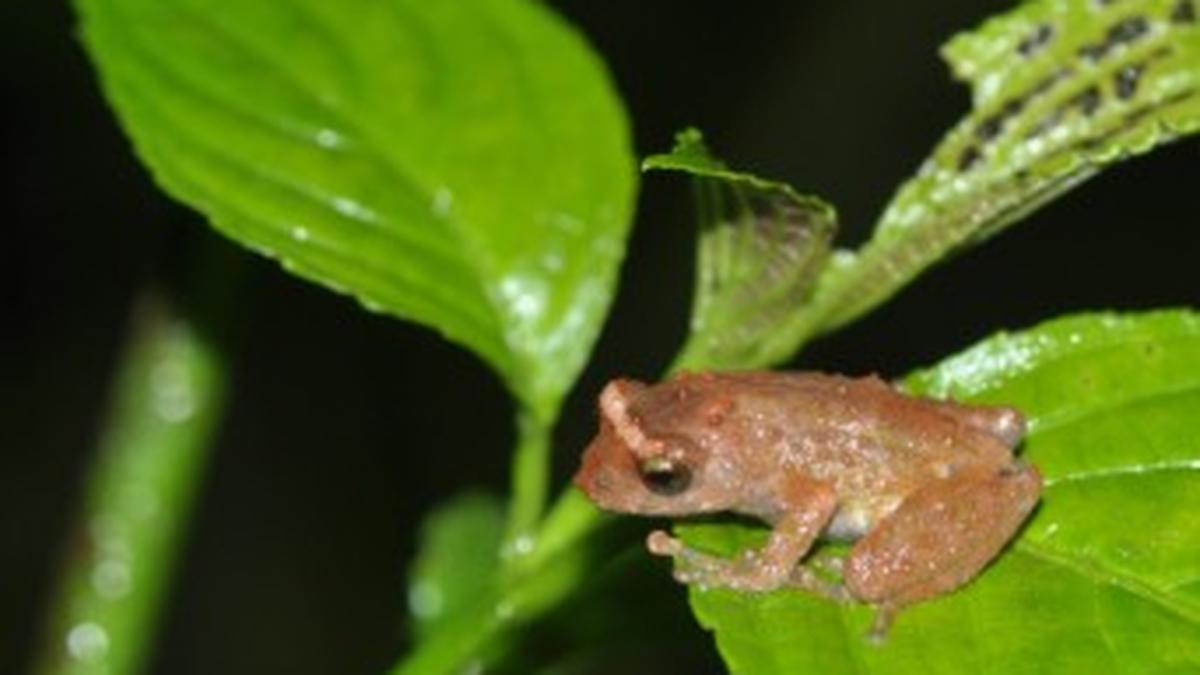

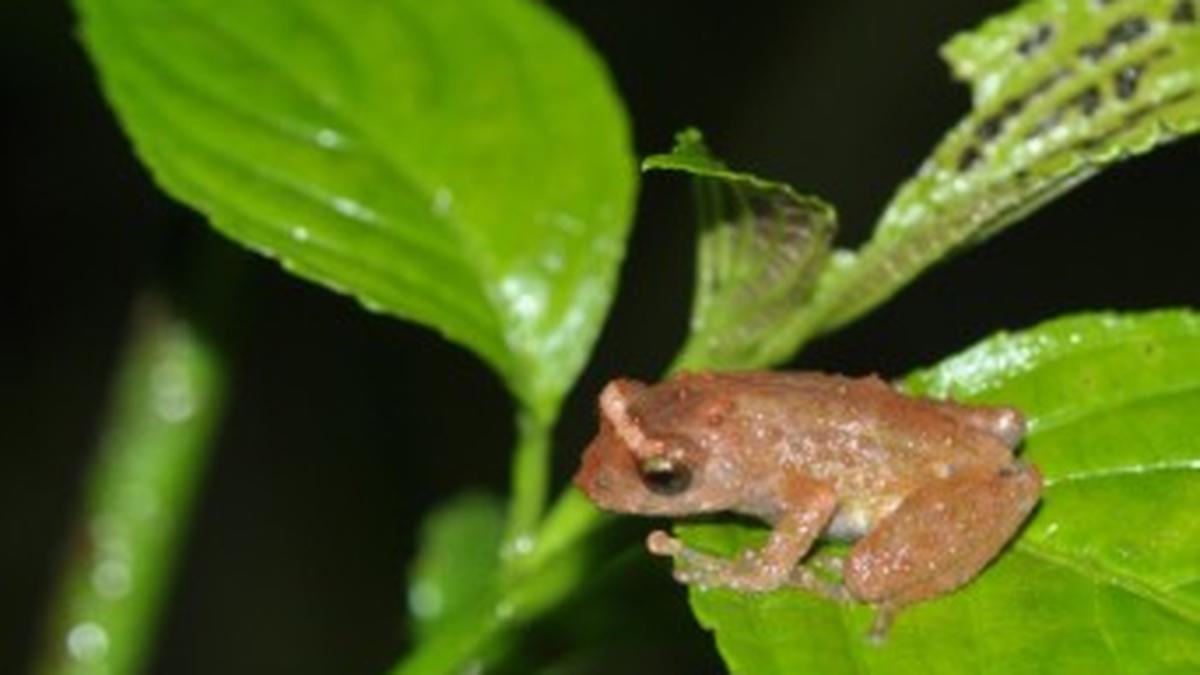
Eaglenest bush frog. Photo credit: Special arrangement
In a major taxonomic revision of bush frogs, the Dehradun-based Wildlife Institute of India (WII) has recorded 13 new-to-science species of amphibians from the northeastern part of the country.
These new species have been described in a study published in the latest issue of Vertebrate Zoology, an international journal. The authors of the study are Bitupan Boruah and Abhijit Das of the WII, and V. Deepak, associated with museums in Germany and the United Kingdom.
According to the authors, this is the highest number of vertebrate species described in a single publication in over a decade from India.
Of these 13 new species, six were recorded from Arunachal Pradesh, three from Meghalaya, and one each from Assam, Mizoram, Nagaland, and Manipur. Seven species were found in the protected areas of Arunachal Pradesh, Assam, and Meghalaya, while one was recorded in a community-protected forest of Nagaland’s Khonoma village.
“Bush frogs, currently in the genera Raorchestes and Philautus, are poorly documented from northeast India when compared to the Western Ghats of southwestern India… Before the study, there were 82 species of bush frogs known from India, 15 of which were from the northeastern region,” the study read.
The six species recorded from Arunachal Pradesh are Eaglenest bush frog, Arunachal bush frog, large bush frog, Dibang Valley bush frog, pointy-nosed bush frog, and eastern bush frog. Two of these were registered from the Namdapha Tiger Reserve, and one each from Eaglenest Wildlife Sanctuary and Mehao Wildlife Sanctuary.
The Narpuh bush frog, Mawsynram bush frog, and Boulenger bush frog were recorded from Meghalaya. The first was recorded in the Narpuh Wildlife Sanctuary and the second in Mawsynram, one of the world’s rainiest places, while the third was named after G.A. Boulenger, an authority on amphibians during the British rule in India.
The Barak Valley bush frog was recorded in Assam’s Barail Wildlife Sanctuary, the Willong-Khullen bush frog from Manipur, the Lawngtlai bush frog from Mizoram’s Lawngtlai district, and the Khonoma bush frog from Nagaland’s Khonoma village.
“The integrated acoustics, genetics, and morphology of the amphibians entailed revisiting the status of century-old museum collections from the Indo-Burma region,” one of the researchers said.
“It was based on a large sampling approach covering 81 localities in eight States, including 25 protected areas. It also revised the distribution of known species.
A significant aspect of the study was that it overcame three conservation shortfalls – Linnean (naming species before they are lost), Wallacean (knowing the distribution), and Darwinian (providing evolutionary relationships).
Published – November 24, 2025 07:47 am IST