





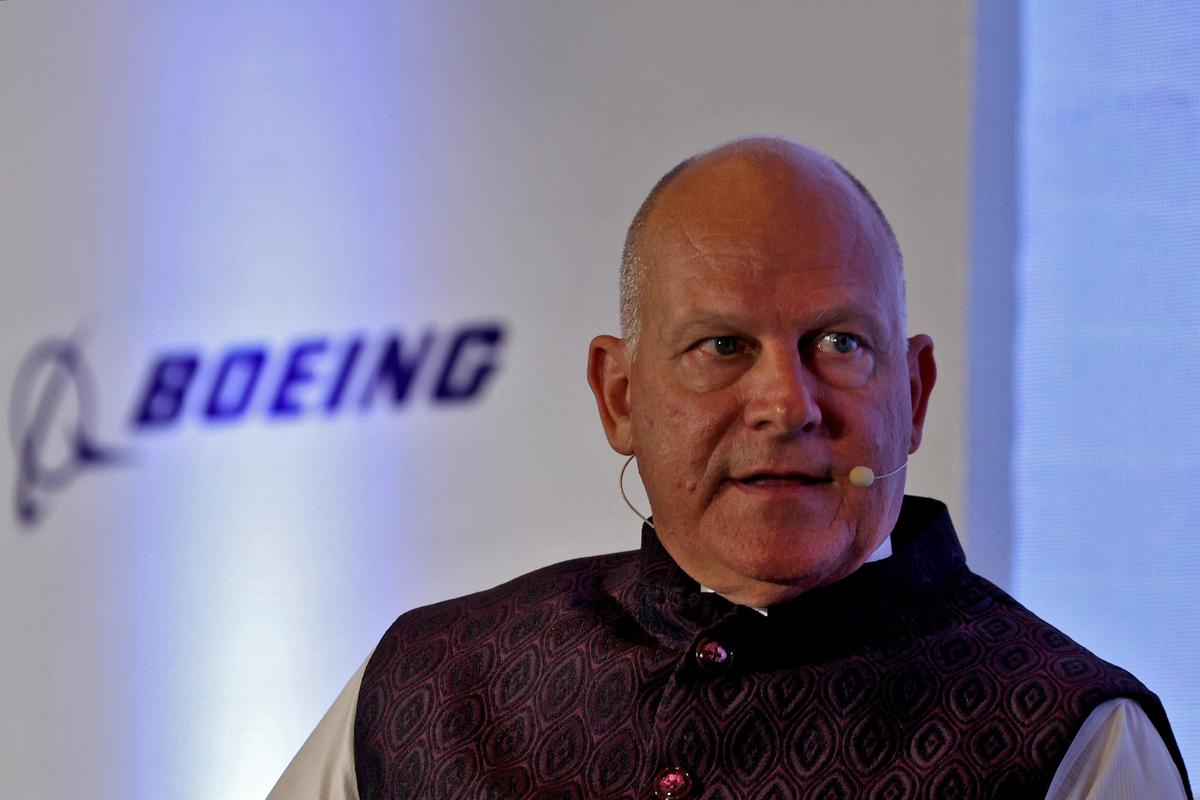
Air India CEO Campbell Wilson
| Photo Credit:
BHAWIKA CHHABRA
Air India will induct a new wide-body aircraft every six weeks in 2026 for the next two years, which, alongside the refurbishment of its legacy Boeing 787 and 777 fleet, will position it as a “modern, international” airline by 2028, according to CEO Campbell Wilson.
“Through the course of 2026 there is a massive ramp-up in our widebody induction,” Mr Wilson said at Aviation India Summit here. The new additions will include the first of the 787-9s joining the airline in December 2025 and then in 2026 an average of one every six weeks. These will be mostly 787-9s and also two Airbus A350-1000s in the financial year 2026. So far, the airline has inducted six A350s from its order of 68 widebody jets, which form part of its larger 570-aircraft purchase from Boeing and Airbus. So far the Air India Group, including Air India Express, has added nearly 50 new planes.
Overall, the airline will continue to add a new aircraft every six to seven days.
By 2027, all of the 26 787 fleet will be refurbished completely, which will include brand-new seats in each cabin, advanced inflight entertainment (IFE) systems, new carpeting, curtains, upholstery, lavatories, and galleys. Subsequently, from late 2026 and until 2028 all of the 13 777s will be refurbished as well.
These timelines are in sync with Air India’s vision for transforming the airline over a period of five years since its privatisation in January 2022.
IndiGo too will explore “interim” solutions for bigger planes as it awaits the joining of the first of its Airbus A350 widebodies that join the fleet starting 2027. The longer-range A321XLR narrow body aircraft will also begin joining the fleet next month. The airline has already damp leased (or borrowed) four Boeing 787s from Norse to kickstart direct flights to European destinations such as Manchester, Amsterdam, Copenhagen and London Heathrow.
On the issue of opening access to Indian aviation market, Mr. Wilson said markets such as Europe, Australia and North America had already been liberalised as there is an Open Sky arrangement but there were constraints in accessing their airport slots. He said that airlines from those continents have had an advantage in securing slots at both ends, but with the growing ambitions of Indian carriers there needs to be an “association between access to Indian market and airport slots” available for Indian airlines overseas.
Closer to the Indian market though, foreign carriers were uplifting up to 90% of passengers that were transiting through their hubs and going somewhere else. “Therefore, it’s in India’s interests to make sure the pace of liberalisation is such that it doesn’t undercut investments being made by Indian (entities)” such as in buying new aircraft, as well as erode “ancillary benefits” to MRO, manufacturing, and tourism.
Published – October 29, 2025 09:17 pm IST