





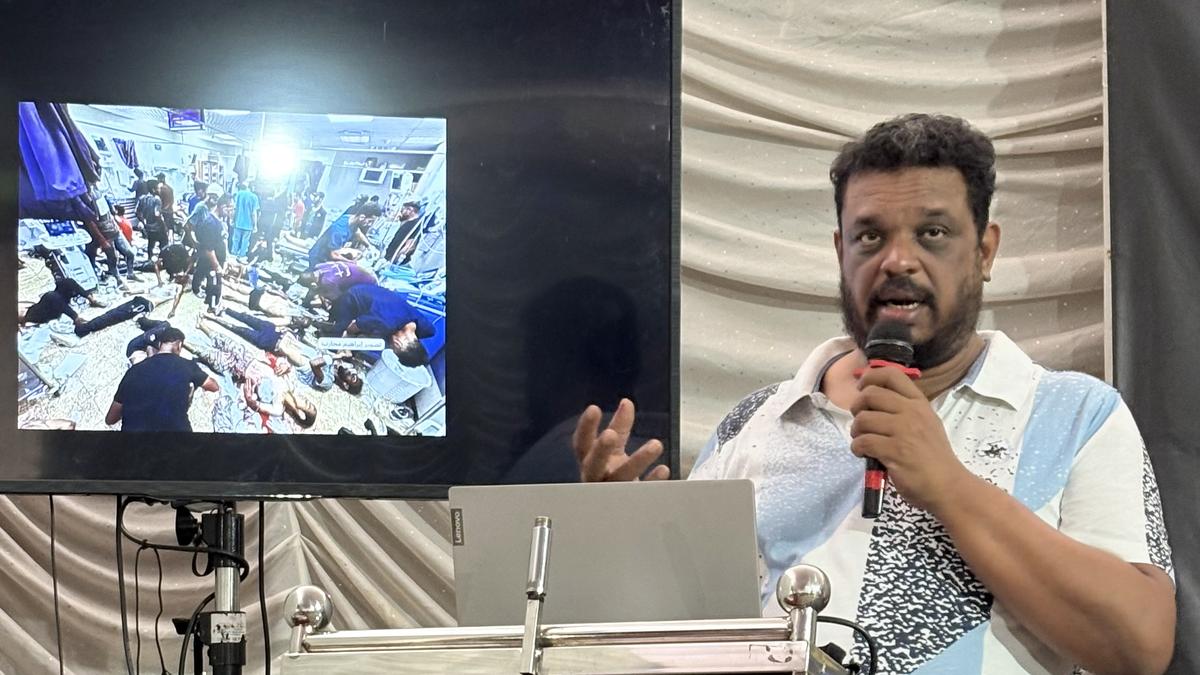

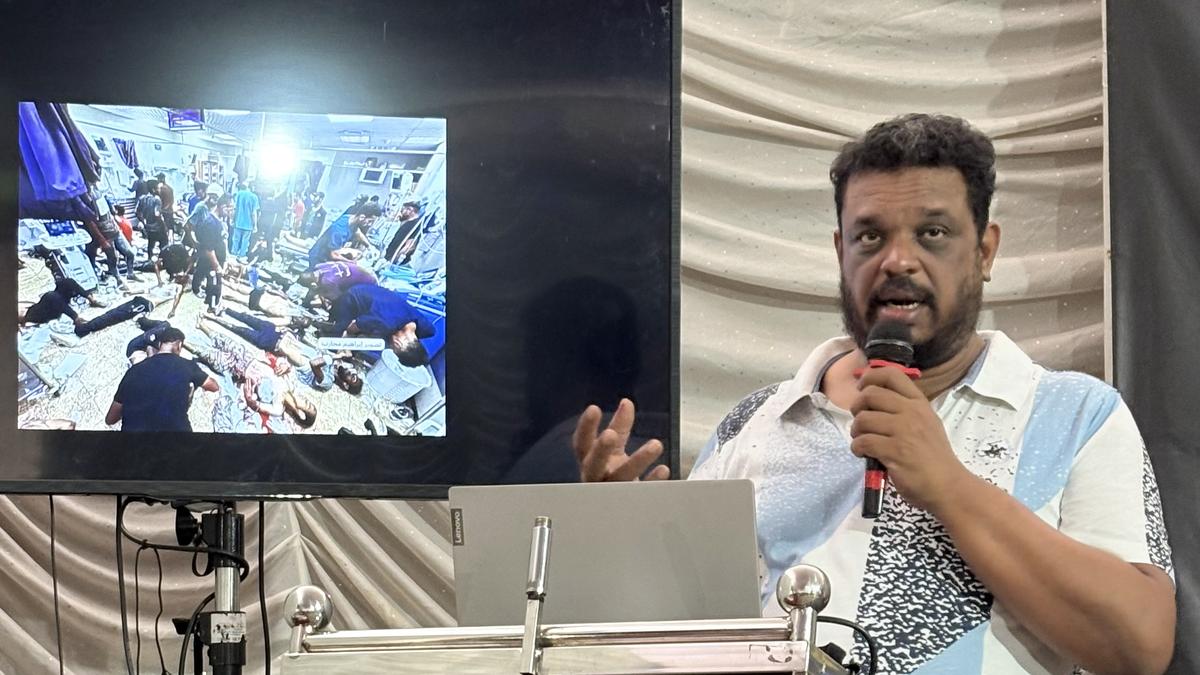
Santhosh Kumar S.S. recounting his experience in Gaza at Government College, Malappuram, on Tuesday.
| Photo Credit: SAKEER HUSSAIN
Before the world reads its morning headlines, Santhosh Kumar S.S., director of the UN emergency medical team in Gaza and currently Professor of Orthopaedics and Emergency Medicine at Government Medical College, Thiruvananthapuram, had already endured nights that scar the soul.
Speaking at the Quantum Century exhibition organised by Kerala Sasthra Sahitya Parishad (KSSP) at Government College here on Tuesday, he described a land where hospitals were bombed, hunger drove people to riots and killings, and families were forced into tents without water, sanitation or food.
People listened with tears in their eyes as Dr. Santhosh Kumar, supported by stark photographs, laid bare one of the worst humanitarian and genocidal crises of the century.
“Gaza will disappear,” he said, voicing his gut feeling after having served there three times in recent years.
Life in Gaza is a daily struggle for survival. Tents are the only shelter. The moment one enters, the stench of hydrogen sulphide, sulphur dioxide and methane hits the senses.
Nearly 2,500 people share a single toilet, often without water, while overflowing septic tanks turn the ground to filth. Water is scarce, and people drink from any source they find. Typhoid, cholera, giardiasis and shigellosis are rampant, affecting 35% of the population.
“Deaths due to breathlessness during the COVID-19 pandemic had more dignity than this,” he said. “Here, people die of diarrhoea and cholera without even toilet facilities. Dozens collapse and die on faeces, and bodies are buried using bulldozers. A six-foot grave is a luxury; most are laid to rest in pits barely two feet deep.”
Aid workers endured extreme hardship. Dr. Santhosh Kumar and his team ate only once a day, considering it a sin to eat in front of starving families. Bathing was impossible for months, and clothes were worn for weeks before being discarded. “You wear a shirt for two months and throw it away; there is no washing,” he recalled.
The trauma was everywhere. One photograph showed the tip of a missile lodged in a boy’s leg. Critically injured patients faced only two choices: bleed to death or undergo surgery without anaesthesia. Limbs were tied, mouths stuffed with cloth, and doctors operated on fully conscious patients. Hospitals were bombed or forced to close; at his hospital alone, an average of 50 critically injured patients arrived every hour.
“We have heard of genocides in Rwanda, Armenia, Bosnia and elsewhere,” said Dr. Santhosh. “Those were carried out in secrecy. What is happening in Gaza is blatant, done without shame or remorse, like a video game.”
He concluded with the haunting story of a young boy who, in innocent curiosity, stood up to watch the pyrotechnics in the night sky, only to be struck by a hail of bullets. His body was riddled with nearly 50 wounds, a chilling symbol of the indiscriminate violence that has engulfed Gaza.
Published – February 04, 2026 06:03 pm IST