

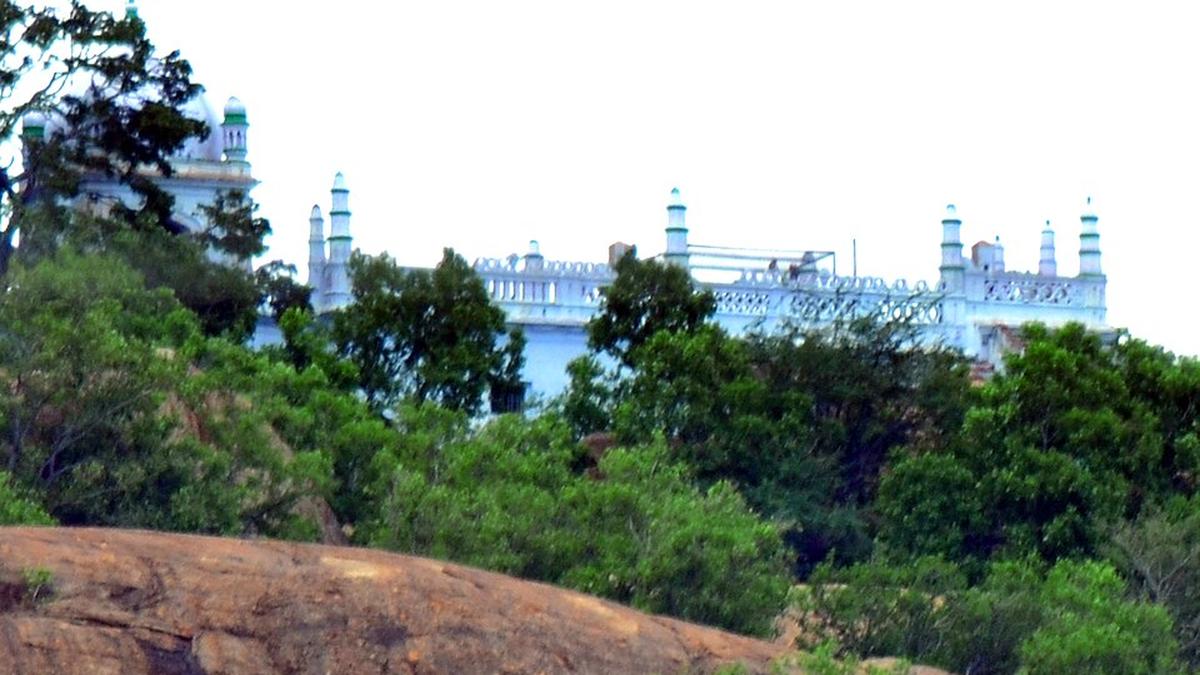

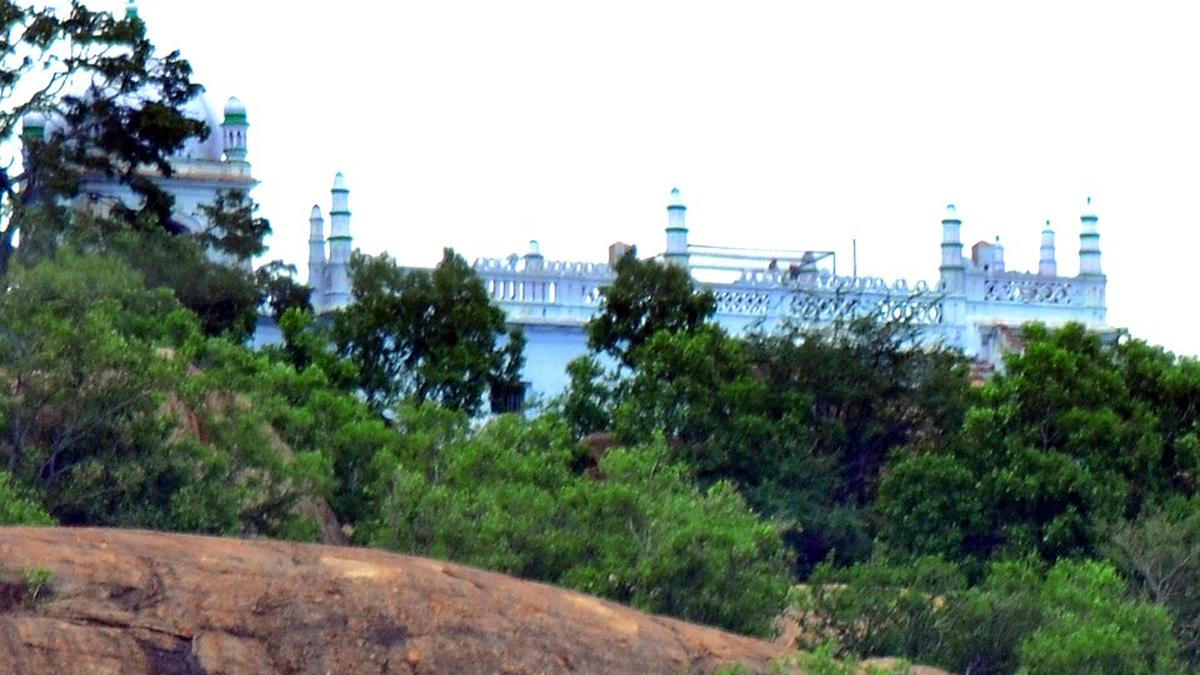
A view of Sikkandar Badhusha Avuliya Dargah, located atop the Thirupparankundram hill. Photo: Wikipedia
The Supreme Court, on Monday (February 9, 2026), refused to entertain a challenge to Madras High Court orders restricting the conduct of prayer, including namaz, at Nellithoppu area of the Sikkandar Badhusha Avuliya Dargah, located atop the Thirupparankundram hill in Madurai district of Tamil Nadu, during Ramzan and Bakrid festival days alone.
Appearing before a Bench headed by Justice Aravind Kumar, advocate Prashant Bhushan, appearing for petitioner Imam Hussain, said the High Court’s finding that “Mohammedans could be permitted to offer their prayers in Neilithoppu area during Ramzan and Bakrid festival days alone… without disturbing the traditional footsteps which lead to Kasi Vishwanathar Temple” had crossed the “constitutional boundary”.

The petition said the High Court had merely endorsed a peace committee understanding with regard to performance of namaz at Nellithoppu during Ramzan and Bakrid.
“The High Court took this situational compromise meant to avert law and order issues and elevated it into a permanent judicial rule that prayer should be confined to Ramzan and Bakrid alone. It is submitted that a temporary understanding reached in an administrative meeting cannot crystallise into a Constitutional ceiling on religious practice,” Mr. Bhushan argued.
He submitted from the petition that the High Court, without pointing to any specific statutory authority, dictated the occasions on which namaz, an “essential religious practice”, could be observed.
The petition challenged the High Court’s finding that the practice of offering namaz was only of a “recent origin”.

“Neither Article 25 (freedom of religion) nor settled Constitutional jurisprudence require proof for ‘recognised essential religious practice’ from time-immemorial as a condition precedent for protection. It is submitted that the only requirement is to determine whether the practice/ritual is bona fide, religious in character, and not prohibited by law,” the petition countered.
The High Court, the plea challenged, had concluded that a large number of persons offering namaz and prayers would obstruct the pathway leading to the Kasi Viswanathar Temple and encroach upon other portions of the temple premises, thereby resulting in a violation of a civil court decree passed over a century ago on August 25,1923.
The October 10, 2025 order was passed by a third judge after a Division of the High Court gave a split view on June 24, 2025 regarding the restrictions on the offering of namaz.
The petition, which was dismissed after a short hearing, submitted in the apex court that the limitation placed by the High Court through its October 10 decision on the offering of the “well-recognised essential religious practice of Islam, namely namaz, to only two occasions in a year at the Nellithoppu area owned by the Dargah/Mosque Committee, even though believers offer namaz every day” was arbitrary and contrary to the breadth of Article 25, which protects the continuous practice and manifestation of faith”.
Also read: Thirupparankundram row: when politics invades a syncretic hill town
The petitioner said that he was a regular worshipper at the Hazarath Sultan Sikkandar Badhusha Avuliya Dargah and the adjoining prayer space at Neliithoppu. The High Court orders, he alleged, had effectively barred him from offering namaz at the Neliithoppu area.
“By confining prayer at Neilithoppu area to two festival days, the High Court order of October 10 impermissibly abridges equality before law by disproportionately burdening one community. It violates dignity and personal liberty by compelling adherents to suppress their religious identity except on designated days. It invades the freedom of conscience and profession of faith protected under Article 25. The order undermines the denominational right to manage its own religious affairs under Article 26,” the petition said.
Published – February 09, 2026 01:52 pm IST