



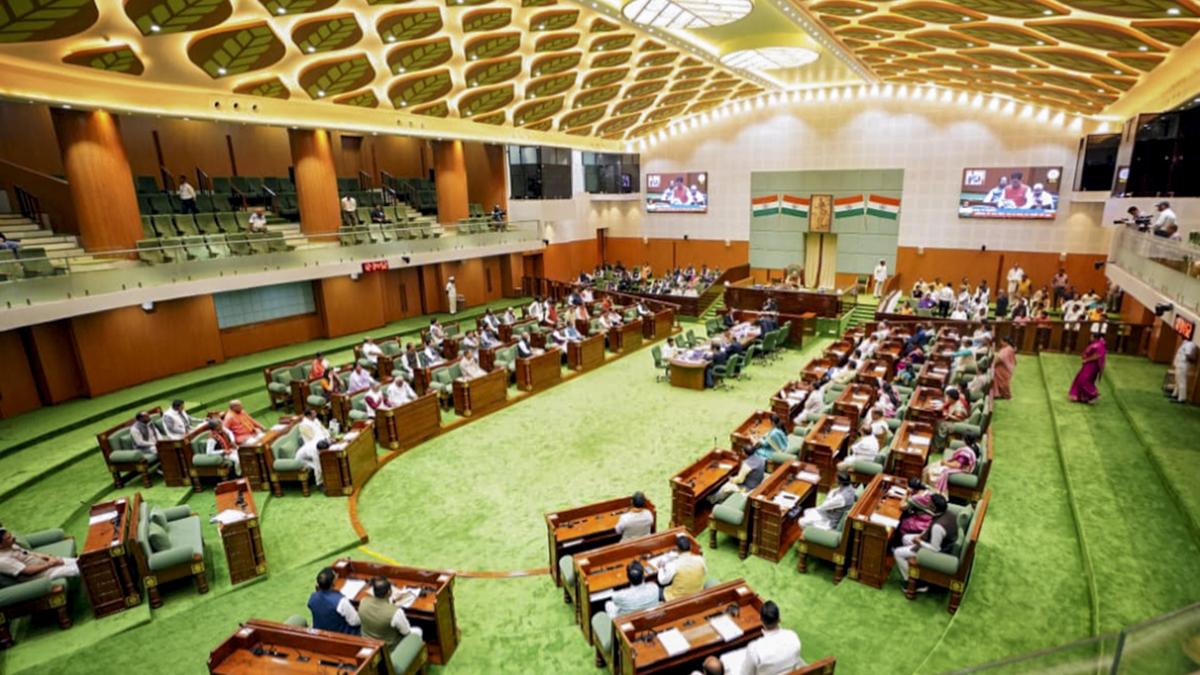

The Chhattisgarh Legislative Assembly on Thursday (March 19, 2026) passed a new legislation to regulate religious conversions. Even as the State joined several Bharatiya Janata Party (BJP)-ruled States that have passed similar legislation in recent years, the Opposition boycotted the House proceedings, calling for a review.
The Chhattisgarh Dharm Swatantra Vidheyak (Freedom of Religion Bill), 2026 seeks to replace a 1968 law from undivided Madhya Pradesh. It holds any conversion violating its provisions as “illegal”, and introduces stricter penalties, including life imprisonment and fines up to ₹25 lakh in specific cases.
It would “stop conversions carried out by taking advantage of people’s poverty, and lack of education and knowledge”, Chief Minister Vishnu Deo Sai told journalists after the Bill was passed.
The 58-year-old law had become inadequate in the present scenario “to effectively control the use of force, greed and fraudulent practices for conversion from one religion to another. Hence, it has become necessary to enact a comprehensive law”, Deputy Chief Minister Vijay Sharma, who also holds the Home portfolio, said in the Assembly.
“No person shall convert, directly or otherwise, or by use or practice of glorification, misrepresentation, force, undue influence, coercion, allurement, by physical or digital means, or by any other means, to convert or abet the conversion of any person or persons from one faith or religion to another,” according to the Bill.
Redefining inducements
The Bill broadens the definition of allurements to include monetary benefits, gifts, employment, free education or medical facilities, promises of better lifestyle, or marriage. “Coercion”, according to the Bill, includes psychological pressure, physical force, or threats, including social boycott. It also proposes publishing “details of the proposed religious conversion on its official website maintained by the Competent Authority under this Act”, and the setting up of special courts to hear all such cases registered under the proposed law.
Undue influence has been defined as the use of a position of authority, trust or power arising from a fiduciary relationship, actual or apparent authority, or other similar circumstances, with the intent to obtain an undue advantage or benefit, to influence the will of another person and to induce such person to act contrary to his free will or best interests.
Mass conversions, which the law defines as the conversion of two or more persons, may attract imprisonment of not less than 10 years, extendable to life imprisonment, and fines of ₹25 lakh or more, while repeat offenders may face life imprisonment. In other cases, penal provisions, including punishment ranging from 10 to 20 years imprisonment, and a fine, which shall not be less than ₹10 lakh in cases involving minors; women; mentally challenged persons; and members of Scheduled Castes, Scheduled Tribes or Other Backward Classes have been mentioned in the Bill.
Conversion solely for the “purpose of marriage, or marriage done for conversion, will be treated as invalid unless due legal procedures are followed” the proposed law states.
Prior intimation
Individuals intending to convert must submit a declaration to the competent authority, and religious functionaries conducting the conversion must also provide prior intimation, the draft Bill states.
“For the purposes of this Act, ‘Competent Authority’ means the District Magistrate or any officer specially authoried by the District Magistrate, who is not below the rank of an Additional District Magistrate,” it added.
According to the proposed law, accepting foreign or domestic funds for activities with the objective of violating the Act will allow the State to withdraw financial or infrastructural assistance from violators.
Reconversion to one’s ancestral religion will not be treated as conversion under the law, according to the Bill.
Earlier, when the Bill was introduced in the House, Congress MLAs raised objections, called for broader consultations, and sought the handing over of the Bill to a ‘Select Committee’. Leader of the Opposition Charan Das Mahant said similar laws from 11 States were currently under consideration before the Supreme Court and, therefore, the Bill should not be taken up in the House hastily.
The issue was relevant to the State, and conversions had not been reported in various districts of Bastar between 2004 and 2021 despite the earliest law being in existence, Mr. Sharma said during the discussion on the Bill. The Opposition wasn’t boycotting but escaping, the Deputy CM said.
Published – March 19, 2026 10:53 pm IST