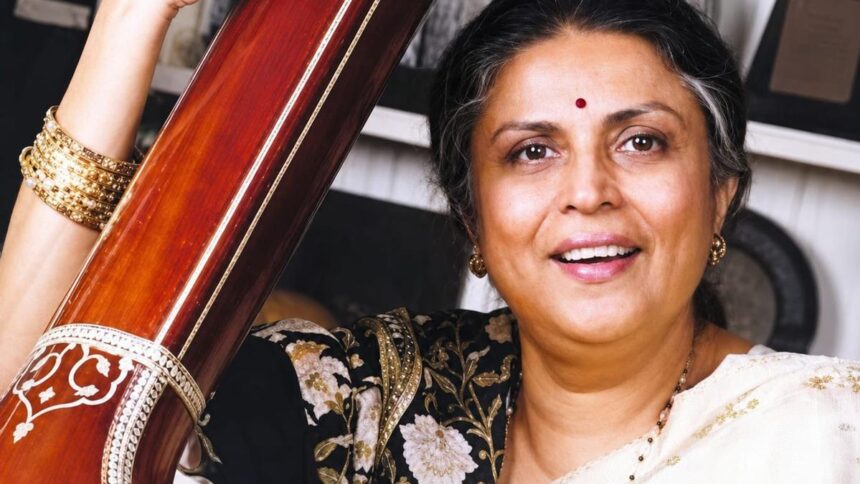



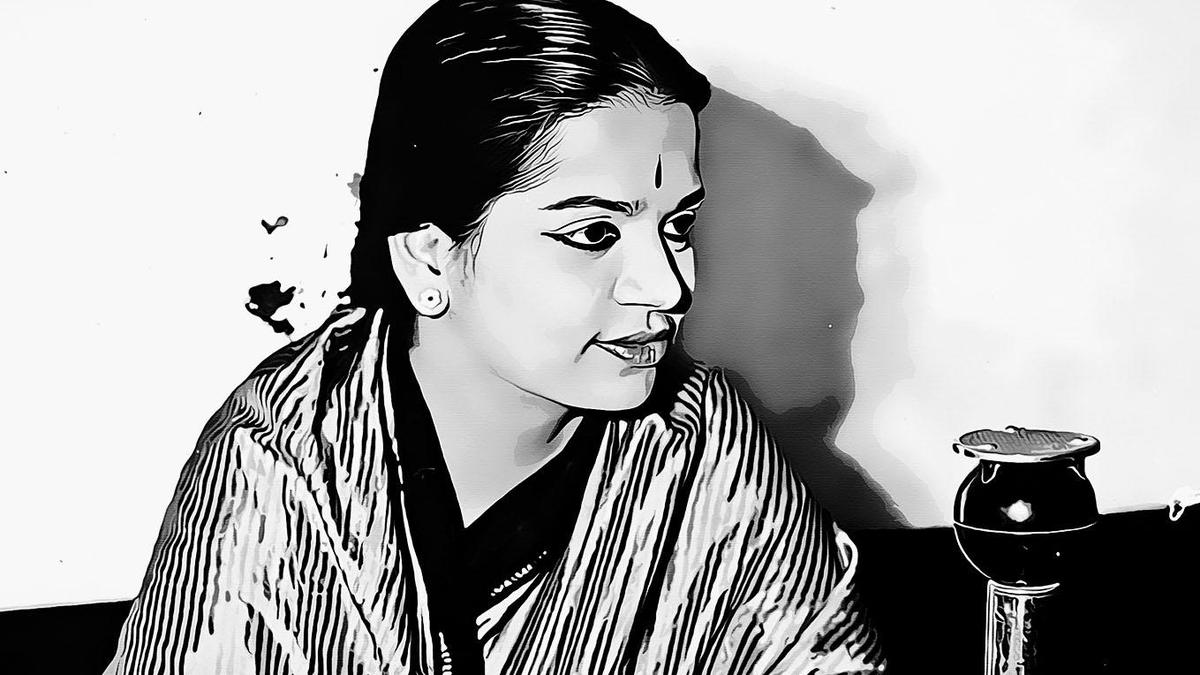


M.L. Vasanthakumari.
| Photo Credit: The Hindu Archives
The connection between Sangita Pitamaha Purandaradasa and the Aiyaswamy–Lalithangi–M.L. Vasanthakumari family seems to have been preordained. How else can one explain the arrival in Madras in the 1930s of a wandering minstrel, Narasimha Dasa, and his chance encounter with the Aiyaswamys when they were earnestly seeking to learn and preserve Purandaradasa’s compositions?
One afternoon, Aiyaswamy hurried to catch a bus, humming a tune as was his wont, and he heard a soulful voice singing in praise of Vittala to the accompaniment of hand-held cymbals. Drawn by the music, he went up to the singer and said: “I am Aiyaswamy Iyer from Koothanoor”.
‘’I am Narasimha dasa, from Karnataka,‘’ said the singer, in Kannada. Aiyaswamy took him home and introduced him to Lalithangi. They welcomed him into their home and expressed their desire to learn Dasar padas from him.
Young Vasanthi (MLV), who was already learning Carnatic music, sat down listening to the songs, while her parents wrote the notations. Their goal was to propagate Purandaradasa’s compositions in their authentic tunes.
Soon, their home on Chennai’s Edward Elliot’s Road echoed with Dasa sahitya — ’Dayamado ranga’ in raga Kalyani, ‘’Gajavadana beduvey’ in Dhanyasi, ‘Laalisi dhalu magana’ in Arabhi, ‘Yaare rangana’ in Hindolam, ‘Yenu dhanyalo lakumi’ in Thodi, ‘Nandathanaya govindhana’ in Bhimpalas, ‘Venkatachala nilayam’ in Sindhubhairavi and many more.
Aiyaswamy introduced Narasimha Dasa to his close friends, Parur Sundaram Iyer, Mudicondan Venkatrama Iyer and Rangaramanuja Iyengar. At an impromptu gathering, they enjoyed the rare compositions he sang and engaged in discussions with him on Purandaradasa’s life and music. The conversations also touched upon the Dasakoota tradition and the emergence of Kanakadasa, the illustrious disciple of Purandaradasa. The link between Hindustani music and Dasa compositions was traced to Karnataka’s proximity to Maharashtra and its long-standing cultural exchanges with the region.

The first edition of Sri Purandara Manimalai was released in 1941. It features 51 songs with lyrics and swara notations.
Aiyaswamy later compiled Sri Purandara Manimaalai featuring a biographical sketch of the composer and 51 songs with lyrics and swara notations. To finance this venture, he sold his ancestral land in his native village.
Their daughter and disciple, the child prodigy M.L. Vasanthakumari, imbibed the same values as her illustrious musician-parents — utter dedication to music, selfless service to the art, and teaching without charging a fee.
The first edition of Sri Purandara Manimaalai was released in 1941. After some years, MLV dedicated another set of copies, to the memory of her parents, with notations finetuned by vidwan T.K. Govinda Rao.
The crowning moment came when MLV was awarded an honorary doctorate by Mysore University in recognition of her efforts to preserve and propagate Dasa compositions.
Published – July 01, 2026 01:08 pm IST