



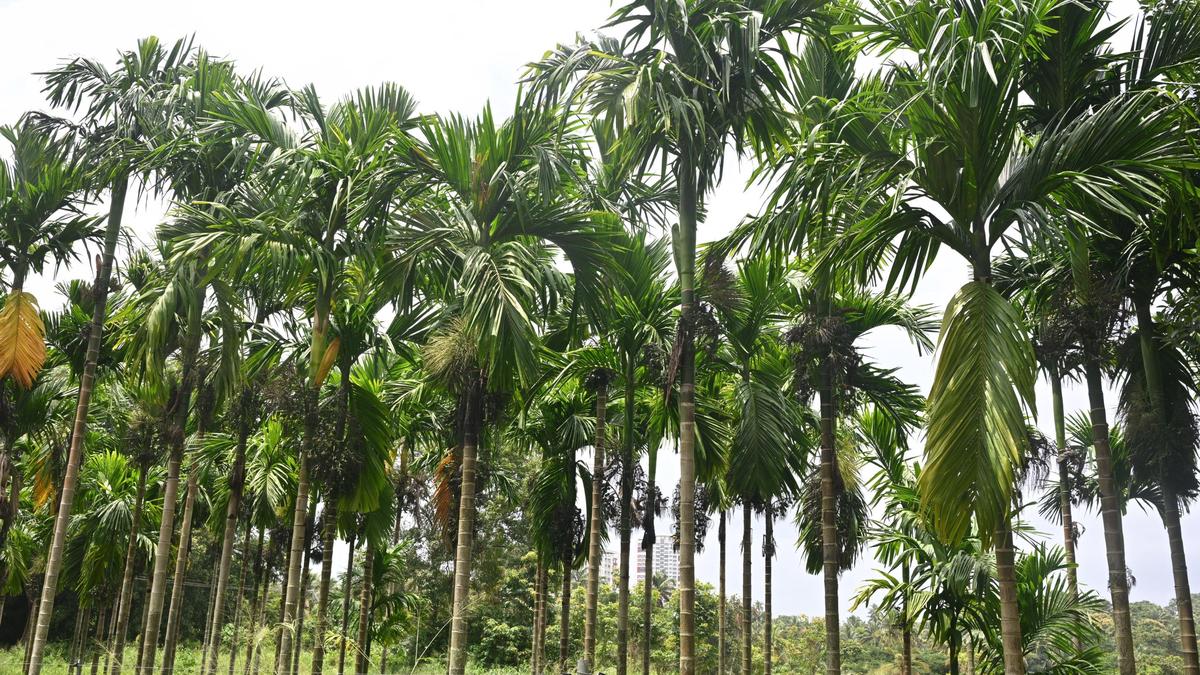


An arecanut farm in Mangaluru.
| Photo Credit: H.S. MANJUNATH
With coastal Karnataka recording 29% deficit rainfall, as per Karnataka State Natural Disaster Monitoring Centre (KSNDMC), despite rains picking up in early July, paddy cultivation in the region is yet to pick up.
If rain continues to play truant, two major crops of the region — coconut and arecanut — will face the risk of low yield.
K. Balachandra Hebbar, director, ICAR-Central Plantation Crops Research Institute (CPCRI), Kasaragod, Kerala, told The Hindu that deficit rainfall in the coastal region might result in increase in white fly menace in coconut plantations. When temperature goes up and moisture level reduces in coconut palms, whiteflies multiply, thus weakening the membrane.
On the other hand, coconut plantations in districts like Chikkamagaluru, Hassan, Tumakuru, Mandya, Bengaluru South and Mysuru are likely to witness an increase in the menace of black-headed caterpillars, Mr. Hebbar said.
Impact on arecanut
‘Kole roga’ (fruit rot disease) in arecanut plantations is associated with constant heavy rainfall. Scanty rainfall might protect arecanut farms from the disease. But farmers will have to be prepared to face another risk.
“Deficit rainfall will result in increased nut shedding in arecanut plantations, thus hitting the production,” said Mr. Hebbar.
This will be another blow to many arecanut farmers whose farms have already been hit by yellow leaf disease (YLD) and leaf spot disease.
The director said that CPCRI has already informed Karnataka Horticulture Department officials about the precautionary measures to be taken to face the diseases and pest threats in the plantations.
Paddy cultivation

A paddy field being prepared for sowing in Mangaluru.
| Photo Credit:
H.S. MANJUNATH
Once rich in paddy cultivation, vast tracks of paddy fields in the coastal region have now come under commercial activities. Some of them remain uncultivated.
The Agriculture Department has set a target of 10,000 hectares of paddy sowing in Dakshina Kannada, Of this, only 686 hectares (6.86%) has seen sowing, said Joint Director of Agriculture Honnappa Gowda.
Of the 37,000 hectares target set in Udupi district, sowing has been completed on 10,300 hectares (27.84%), said G.C. Poornima, Joint Director of Agriculture.
In Uttara Kannada, the target set is 36,860 hectares. Sowing has been completed on 14,378 hectares (39%), said an official.
Human-animal conflict
Dinesh Holla, environmental activist and an avid trekker in the Western Ghats for the past three decades, said that with less rainfall, shola forests in the ghats will not hold water for the non-rainy season. Rivers and streams will dry even before winter, he added.
“The Human-animal conflict is likely to increase, with wild animals coming out in search of water and food to human habitations,” he warned.
Hydel power production will be hit this year, he pointed out.
Published – July 08, 2026 09:31 pm IST