



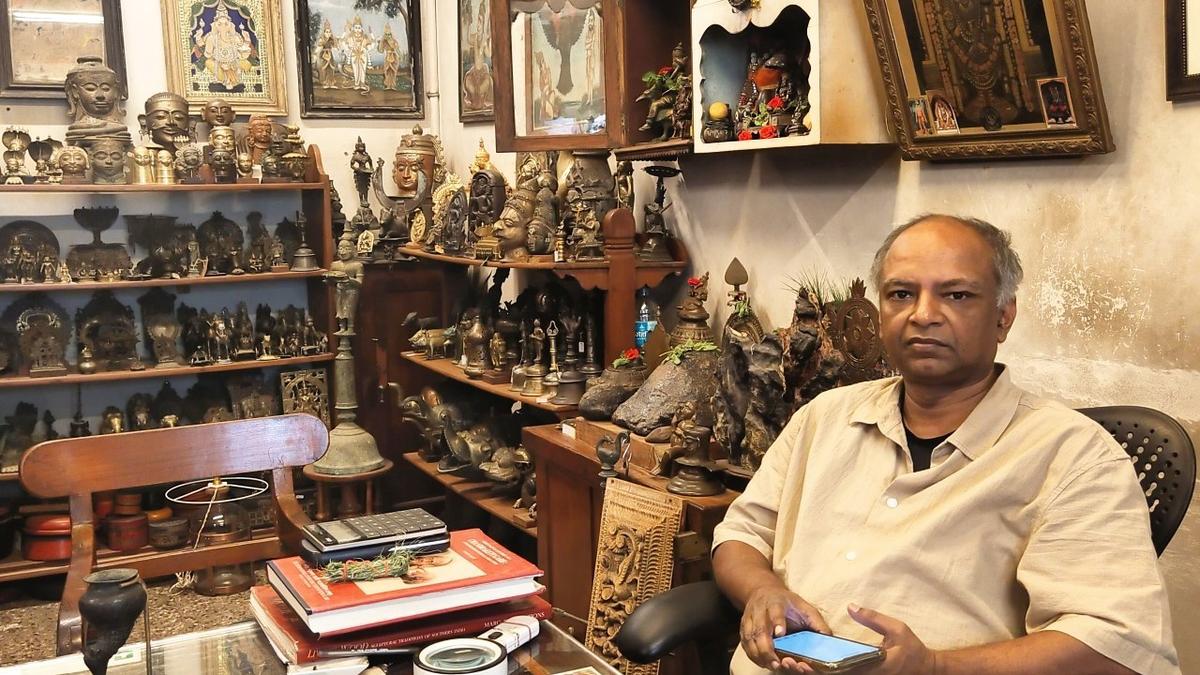


DG Balaji, the owner of Balaji’s Antiques and Collectibles
| Photo Credit: C Madan Mohan
When asked if he could recall a specific story about any of the artefacts they have collected or sold, DG Balaji, owner of Balaji’s Antiques and Collectibles, stares at the mini Dhara Pathra on his desk for a few seconds before finally admitting there are too many to choose from.
Balaji is the present owner of this century-old, family antique store in Bengaluru. His surroundings are a testament to his dilemma. As I entered the shop located in a labyrinth within the hustle and bustle of Avenue Road, it was clear every room here holds stories galore.
It started as the Seethaphone Company which sold gramophones and vinyl records in 1924, and was founded by DN Seetharama Shetty, DG Balaji’s grandfather. It was located just a few blocks away from the present day store in Avenue Road and is still functioning. Balaji’s Antiques and Collectibles branched out from Seethaphone Company in 1994. Today, Seethaphone is managed by Venkatesh Babu, and specialises in modern art and vinyl records. The reason for branching out, DG Balaji says, is because Seethaphone company was not interested in selling antiques.
The bounty at this rustic store takes me by surprise — artefacts, framed and unframed paintings, and other curios sit on shelves, while bootha masks, Marapachi and Dasara dolls, and lithographs of gods and goddesses gaze down from their perch on the walls.

Paintings and curios at the store
| Photo Credit:
C Madan Mohan
David Lean visits Avenue Road
An interesting aspect of Balaji’s Antiques and Collectibles lies in a special client from the 1980s, during the production of David Lean’s acclaimed film A Passage to India (1984). When I asked about it, DG Balaji fondly remembers that he was eight or nine years old then. When I enquire if his parents told him of Lean’s visit, he says, “No, I met the team.” He recalls how Lean’s team initially wanted to rent the antiques as props, but once they realised Balaji’s were not keen on the idea, they purchased whatever they required. He has been assisting and witnessing the happenings at the Antique store from a very young age. Today, he is 58 years old and has the same unwavering passion for antiques.
“Colonial furniture was one of our most sought after items then,” he says, adding that could be one the reason the filmmakers reached out. “We supplied them with quite a few props; ranging from old newspapers to vintage cars, most of which can be seen in the film.”
Lessons from years of antiquing
Balaji finds the business of collectibles a meditative and evolving experience. “There is no one method behind finding antiques. Sometimes we go in search of them, at other times collectors come to us with requests. The process is not monotonous and is more mutual than it seems.”

Lithograph of a Raja Ravi Varma painting
| Photo Credit:
C Madan Mohan
He says there are no salaried teams or researchers on the lookout for antiques; they still rely on contacts garnered over the hundred years of its existence.
“However, there is more awareness today. People are interested in our history, traditions and culture, and as result, it has become harder to acquire antiques. The younger generation is not disposing heirlooms and keepsakes as they used to.”
Despite its impact on business, Balaji feels, “anything that has to do with our country and history must be preserved and protected.”
Published – September 09, 2026 07:28 pm IST