






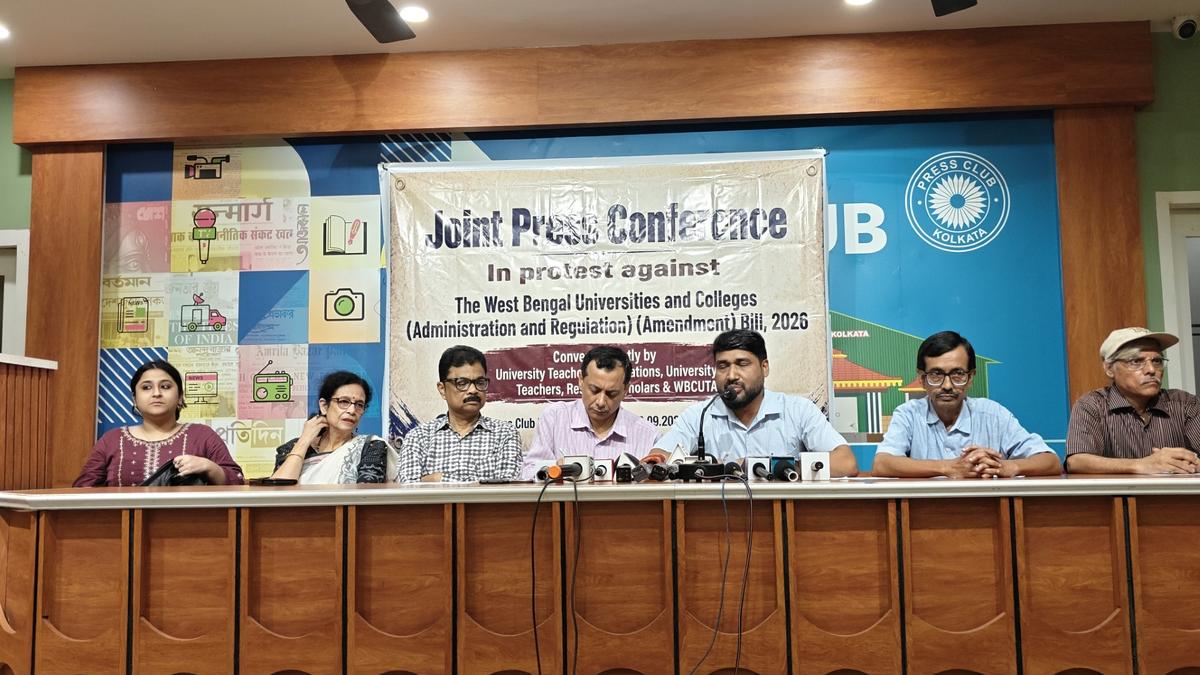


West Bengal College and University Teachers Association (WBCUTA) hold a press conference in Kolkata on September 12, 2026, to protest against the inter-university teacher transfer Bill.
| Photo Credit: Special arrangement
West Bengal College and University Teachers Association (WBCUTA) on Saturday (September 12, 2026) accused the State government of attacking education through its proposed teacher transfer Bill and said it would intensify its movement and take to the streets if the legislation was not withdrawn.
The professors accused that most of the higher education institutes already work with only 40-60% of their sanctioned teaching strength, and transferring some of them will only further weaken the institutes.

“This is a direct attack on the autonomy of universities. It will destroy the centres of excellence and ruin the academic atmosphere. Brilliant students who are from economically backward will fall even further behind,” Jadavpur University (JU) professor Partha Pratim Roy and member of WBCUTA told The Hindu. He added that NAAC accreditation and NIRF rankings are also dependent on the teachers available at the institutes, without which the rankings will crash, rankings where JU has always remained at the top.
The West Bengal Universities and Colleges (Administration and Regulation) Amendment Bill, 2026 was tabled by State’s Higher Education Minister Jagannath Chattopadhyay on September 10. The Bill states that employees, both teaching and non-teaching staff can be transferred to any university and college across the State due to “administrative reasons” with the Cancellor and State government’s consultation. There is no provision to take consent from the concerned employees.
The teachers have vowed to first write to the Governor, who is also the Cancellor of Universities, and make an appeal. They will also hold a signature campaign, a simultaneous protest march will be organised inside the all the universities and colleges across the State to make their voices heard. They will also organise a mass convention to hear students, professors, intellectuals, and educationists on the matter.
Despite these measures, if the government fails to roll back the bill even after these steps, the professors threatened that they would hit the streets. They will also take legal action against this bill after detailed consultation with legal experts.

Teachers have also pointed out that if this Bill is passed, research scholars who work under them will also suffer. Transfer of the guide can lead to the cancellation of the PhD registration of a student according to the University Grants Commission’s regulations. Their years of work will go to waste, Calcutta University professor Mahalaya Chattopadhyay said.
When the Bill was tabled, Chief Minister Suvendu Adhikari had taken multiple swipes at Jadavpur University and had said that “so-called pundits” would be sent to newly established institutions which would benefit from their experience.
A day before the Bill was tabled, in a march outside JU, Mr. Adhikari had said that they would restore “nationalism” on the campus and uproot all “anti-national” elements, for which they are “taking adequate measures” leading to concerns among professors about targeted transfers.
However, professors said that many of the new institutes where they are being threatened to get transferred to do not even have buildings or classrooms. They claimed that sending them there will only destroy the existing education system and do nothing for the new places.
“If they really wanted to change the situation, they would conduct new recruitment and give jobs to people which would also slowly help the new institutes grow, without destroying the existing academic system,” Subhoday Dasgupta, President of WBCUTA said.
“The language being used to threaten us has no place in a civilised society. How did the teachers who once taught these politicians also become their enemy?” Professor Gautam Maity, convenor of All Bengal University Teachers’ Association said. He also added that arbitary transfer is not the answer to better the education system, rather more fund allocation, rapid recruitments, and infrastructure development is the way forward.
“They are punishing teachers who dare to speak. But we have a responsibility towards the public, because these are public institutions, and we will not give up without a fight,” Professor Maity added.
Published – September 13, 2026 05:51 am IST