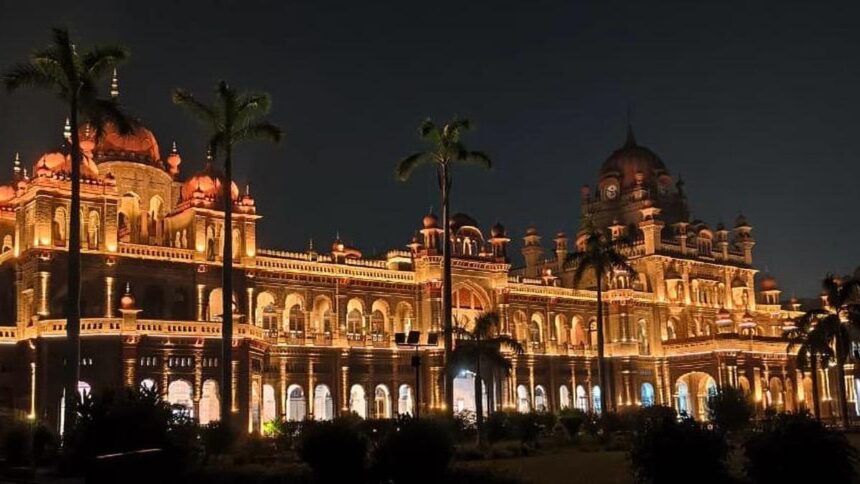









A view of Pudumandapam near Meenakshi Sundareswarar Temple in Madurai on Sunday.
| Photo Credit: R. ASHOK
Standing as a magnificent testament to 17th-century architectural brilliance, the historic Pudumandapam in Madurai continues to captivate visitors with its intricate stone carvings, sprawling corridors, and deep-rooted royal heritage.
Built by Thirumalai Naicker, the seventh ruler of the Nayak dynasty who shifted the kingdom’s capital from Tiruchirappalli to Madurai, this iconic hall remains an enduring symbol of a golden era of art and devotion.
Thirumalai Naicker, who ruled efficiently for 36 years, was renowned for his profound passion for architecture and deep religious faith.
Credited with constructing numerous monumental structures in the Indo-Saracenic style, including his famed palace, the Mariamman Teppakulam, and the Raya Gopuram, the king believed that Goddess Meenakshi herself cured his illness, says legend.
In profound gratitude, he poured endless endowments into the Meenakshi Sundareswarar Temple.
According to K.G.R.M. Rathina Basker, the author of the book ‘Monoliths of Madurai Pudumandapam – Line Art Illustrations,’ “Directly opposite the temple’s eastern gopuram, he commissioned the construction of the Vasantha Mandapam—widely known today as Pudumandapam. Constructed entirely of black kadappa stone over a span of 22 years from 1626 to 1645 CE, its creation is historically documented in the Thiruvalavayudar Thiruppani Malai, while contemporaneous manuscripts like Mrityunjaya shed light on the Nayak administrative system.”
Crafted under the supervision of chief sculptor Sumanthiramurthy, the hall was built to host the grand 10-day Vasantha Festival in Vaikasi and the 9-day Thailakkappu Festival in Margazhi.
Historically, water was channelled into the outer moat-like structures and covered with floating blossoms, creating a serene ambiance for the celebrations, he added.
Today, the tradition lives on as festival deities are placed on a raised wooden platform (Saukku) inside the western section, which features 12 gleaming black stone pillars complemented by exquisite, intricate wooden ceiling carvings.
Spanning 322 feet from east to west and 90 feet from south to north, the majestic rectangular structure rises to a height of 25 feet, supported by 124 ornately carved pillars and five smaller ones.
“The hall is a veritable gallery of ancient sculpture, housing 22 divine figures, two sage statues, four maiden sculptures, 10 fierce Yali figures, six horse-rider statues, and depictions of 10 Nayak dynasty rulers alongside their consorts. Each pillar is adorned with approximately 14 distinct relief sculptures,” said Mr. Rathina Basker.
Among its architectural marvels are the striking Ekapada Moorthy and towering Yali statues in the southwest corner, alongside a sculpture depicting Lord Shiva feeding tiger milk to a calf.
Further inside, visitors encounter the formidable dancing form of Goddess Kali, the divine wedding scene of Meenakshi and Sundareswarar—symbolising the unity of Shaivism and Vaishnavism where Lord Vishnu gives away his sister in marriage—and the commanding presence of Ravana Anugraha Moorthy.
The northern and southern wings also feature shrines dedicated to the 63 Nayanmars, alongside detailed carvings of celestial bodies, zodiac wheels, and historical portraits of Nayak rulers from Viswanatha Nayakar down to Thirumalai Naicker himself.
More than four centuries after its completion, Pudumandapam remains a vibrant cultural landmark, seamlessly bridging Madurai’s storied royal past with its living architectural heritage.
Published – September 13, 2026 07:27 pm IST