


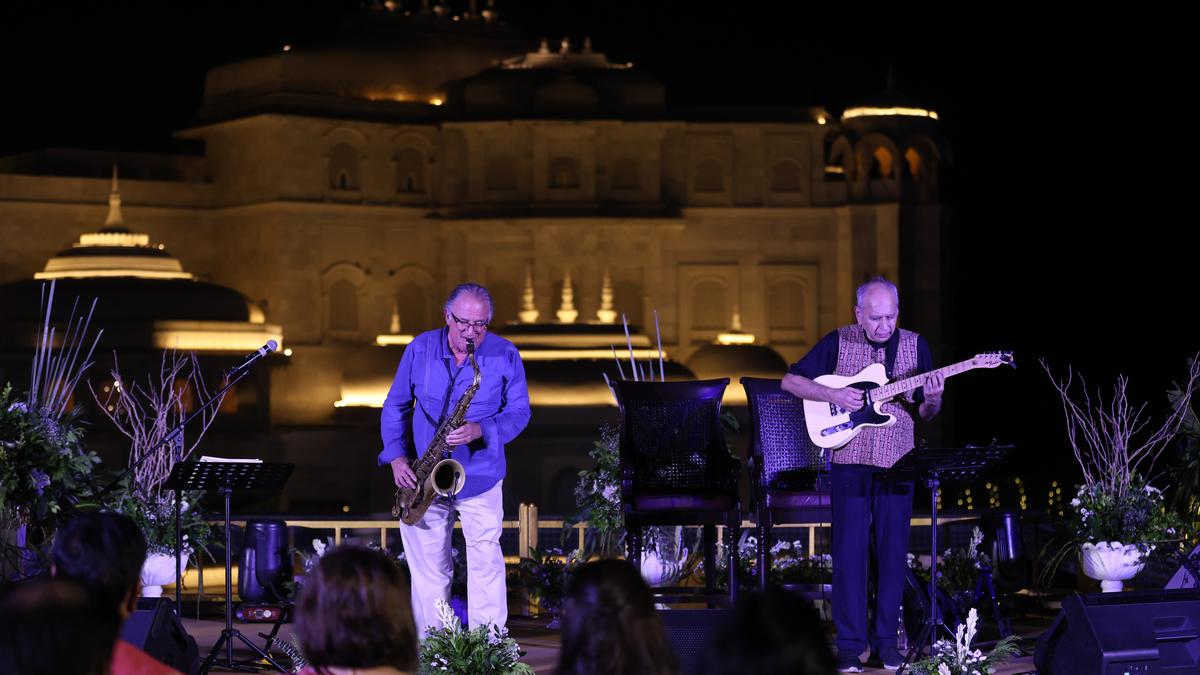


Performance from the previous edition of India Music Retreat
| Photo Credit: Special Arrangement
In a world of playlists, earbuds and music consumed between meetings, commutes and scrolling, the India Music Retreat asks for something increasingly rare: time. For three days in Jaipur, over 400 people will put aside the usual hurry, and listen to music across the day in relaxed, informal spaces that lets them be present. The premise is less about attending a festival than entering a slower, more immersive relationship with music.
“There are festivals happening all the time, public concerts, auditoriums, sabhas in Chennai. But how do you create a relationship with music which is more intense, an exchange of energy between the musician and the audience? How do you create an experience which is 360 degrees, where people experience it together, talk about it for days on end, and create a relationship that is for a lifetime?,” these are the questions Mala Sekhri, founder, India Music Retreat answered before the idea came to her.
That experiment would eventually evolve into the India Music Retreat, now in its second edition. Set to take place at Fairmont Jaipur from September 18 to 21, the retreat will bring together musicians including Aruna Sairam, Shahid Parvez Khan, Ashwini Bhide Deshpande and Jasbir Jassi, alongside conversations, intimate performances and shared listening experiences spread across the property.
“Our music is not meant to be confined to auditoriums. It needs atmosphere, mahol, vibe,” she says. The idea that music is shaped as much by its surroundings as by the performance itself, sits at the heart of the retreat’s programming. Before Jaipur, Mala and her team experimented with a range of formats, including Kinare Darya, a three-night musical journey aboard a ship sailing along the Hooghly with just 60 guests. The aim, she says, was not simply to present music but to create an environment in which audiences could live with it.
“Today what is at a premium? Time. The fact that these are 400 people who come and give you three days of their lives to throw music at them, I think is something I value deeply. Because today people can give anything. They can go anywhere, but they don’t give you time,” she says, adding that she sees the retreat’s audience not merely as consumers of music but as potential patrons who can sustain artists beyond the stage.
For Mala, the success of curation lies not just in assembling a strong lineup, but in building enough trust for audiences to arrive without knowing exactly what, or who, they are going to hear. The retreat deliberately puts established musicians alongside artistes who may be unfamiliar to its audience, with discovery becoming part of the experience.

Jayanthi Kumaresh
| Photo Credit:
Special Arrangement
“ Yes, the maestros are there, but we must have platforms for discovery. We must have new artistes who are fantastic or the maestros of tomorrow whom we place on stage. And we allow discoverability and allow patronage to be developed for them,” she says.
The retreat’s other proposition is that listening need not be a solitary act. The most compelling part may be what happens between the performances. People who arrive as strangers find community, share recommendations, and interests. The music may end when the three days are over, but the relationships between listeners, artistes and the music they discover together need not.
Published – September 18, 2026 12:26 pm IST