





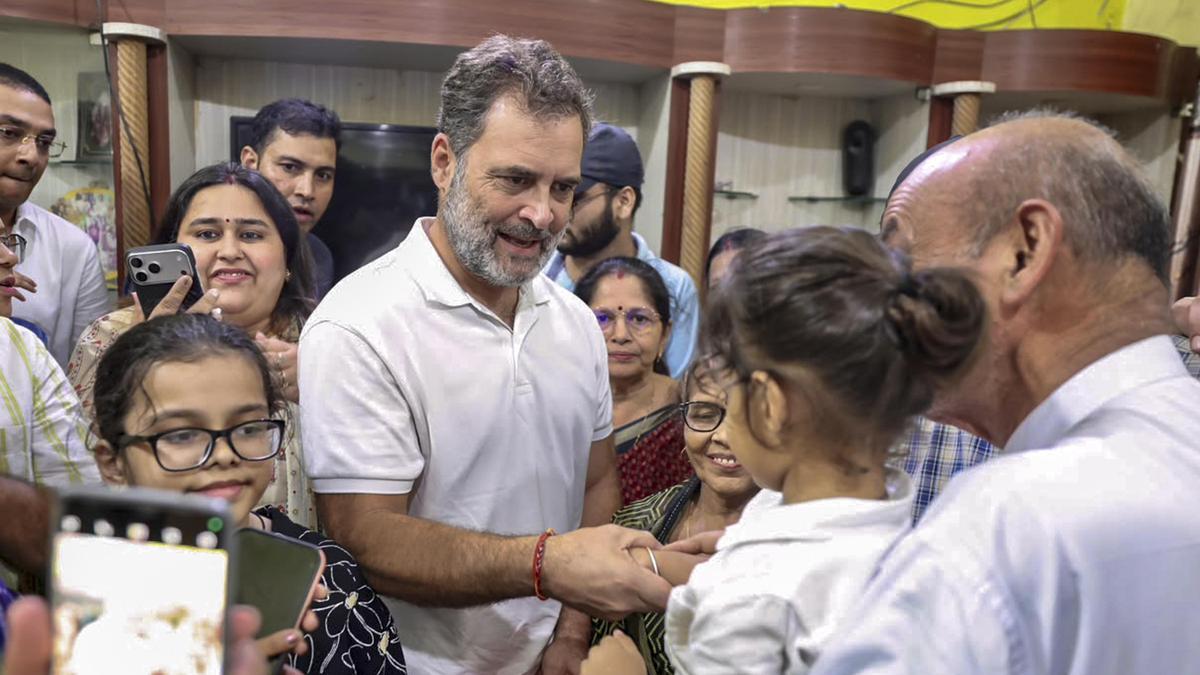

When Leader of the Opposition in the Lok SabhaRahul Gandhi sat on a dharna at Delhi’s Parliament Street police station on August 21 to register a first information report (FIR) along with Sahil Lochab, one of the pellet-gun victims of police action during the students’ agitation against paper leaks, he was trying out a new political playbook: sudden, swift action that catches the rival by surprise and pressures the authorities to act.

Exactly a month earlier, the Opposition leader had sat on an unannounced dharna outside the Prime Minister’s residence, prompting senior ministers to rush in to listen to the Opposition’s demands on the paper-leak issue.
After arriving at the police station around noon, Mr. Gandhi spent six hours before the cameras, exchanging words with police officials, eating kathi rolls for lunch and giving occasional soundbites to waiting television crews, until senior Home Ministry officials agreed to register an FIR on Mr. Lochab’s complaint.

As images of Mr. Lochab and his mother with Mr. Gandhi went viral and the Congress claimed credit, many on social media felt that the Opposition had hit a “purple patch”.
But can an individual leader’s popularity translate into electoral dividends? The recurring criticism is that the Congress lacks the organisational strength on the ground to convert goodwill into votes. In Hindi heartland States such as Uttar Pradesh and Bihar, the party’s organisational machinery inspires little confidence, even among its supporters.
“While it is correct to argue that electoral victory of an organisation is consolidated by a charismatic leader, the charisma of a leader is translated into votes only if it is backed by organisational strength,” says Associate Professor Kumar Sanjay Singh, who teaches History at Delhi University’s Swami Shraddhanand College.

However, this is not how the Congress has worked in the recent past as the party has often won elections riding on popular sentiments and the charisma of the Gandhis. When the party was in power at the Centre for a decade (2004-2014) and in nearly a dozen States, AICC general secretaries spent more time in Delhi power centres than in States they were meant to handle. By 2014, when the BJP swept the Lok Sabha polls, the party’s organisation was hollowed out and its coffers were near empty.
That explains why the party is undertaking a massive organisational rewiring, alongside social re-engineering, under the Sangathan Srijan Abhiyan (SSA). Until mid-September, nearly 1,000 District Congress Committee (DCC) presidents have been appointed across 25 States under the SSA. Adopted at the All India Congress Committee (AICC) session in Ahmedabad in April 2025, the exercise has been completed in most States. Kerala and Assam, where Assembly elections were held earlier this year, are yet to undergo the restructuring.
Rebuilding the base
K.C. Venugopal, general secretary in charge of organisation, or GSO, who is overseeing the ambitious revival plan, explains how the process works on the ground. “Senior leaders go as AICC observers to a State and cover the districts where they identify and shortlist potential district committee leaders. They spend about 10-15 days, seeking opinion from workers, eminent citizens, activists and so on,” Mr. Venugopal says.

He adds that the DCC president is usually appointed from the topmost contenders on a shortlist, which usually contains five or six names. “Only when there are serious differences, we consult Congress Legislature Party and Congress Working Committee (CWC) members. But even then, weightage is given to observers,” he says.
The party has made the DCCs the focal point of the proposed turnaround process, with the emphasis on making its presence felt at the grassroots. From giving district offices a fresh coat of paint to framing national issues in local idioms and taking up district-specific concerns, suggestions are pouring in from AICC observers tasked with shortlisting district chiefs who can revive the party.
“In my 30 years in the Congress party, I have not come across such an elaborate exercise that involves leaders at every level,” says Ashok Tanwar, a former Haryana Congress chief who rejoined the party after a stint in the BJP.

Mr. Tanwar, one of the top 10 AICC observers who covered districts in Tamil Nadu, Rajasthan, and Uttar Pradesh, says the exercise was not just about appointing DCC chiefs but also about identifying people who could be the party’s link with the public. “There are many people who want to selflessly strengthen the party. All we have to do is identify and empower them,” he said.
He claims the year-long campaign is beginning to show electoral results. “We have won a majority of the wards in Ajmer after 36 years. This is the power of SSA,” says Mr. Tanwar, who was the observer for Ajmer, where urban local body polls were held this month.
Monitoring mechanism
Once appointed, the new DCC chiefs are monitored for their performance and effectiveness in carrying forward the party’s ideology. Every observer creates a WhatsApp group of district-level leaders to convey national campaigns as well as local issues. Leaders are assessed on their participation in party programmes, with regular reports sent to the GSO. Where a district chief is found wanting, there is provision to replace the leader.
“As and when we see some shortcoming, we make corrections,” Venugopal says, pointing to cases in Uttarakhand, Haryana, and Odisha where leaders in some districts will be changed. District chiefs are graded, with top performers placed in the A category and those in the D category liable to be replaced.

The observers are also marked on a scale of 100. The parameters include the quality of ground reports, choice of potential district chiefs, interaction with civil society, reporting of activities, and integrity and conduct.
“This campaign has certainly helped us rejuvenate the party at the lowest level. People at booth and block levels feel assured that the AICC is listening to their grievances,” says Abdul Khaleque, former Lok Sabha member from Assam, who has been ranked the best-performing AICC observer.
“At times factionalism, even at the most basic tier of the party structure, poses a challenge,” says Mr. Khaleque, who was an observer for Madhya Pradesh, Jharkhand and West Bengal. He adds that people are then checked.
Intense factionalism is a product of entrenched hierarchies that do not accept change easily. There were no district-level committees in Haryana for 12 years. Though powerful leaders such as Ghulam Nabi Azad, Kamal Nath, and Shakeel Ahmad were general secretaries in charge of the State, they failed to build an effective organisation amid factionalism promoted by the satraps.
“The SSA is a policy decision of the party and everyone has to accept it. It is always better than an individual effort. That’s why everyone in Haryana comes under one umbrella,” says Mr. Tanwar.
Observers who do not want to be identified say they have witnessed underlying tensions between the old guard and younger leaders in States such as Madhya Pradesh, Punjab, and Rajasthan. The silver lining, many say, is that the high command is mostly listening to the ground. “In one or two cases, there are some suggestions to change the names that come up from the ground, but the party leadership goes with the observer’s recommendations,” says B.P. Singh, another top-performing observer, who travelled to Karnataka, Madhya Pradesh, Punjab, and Himachal Pradesh.
Prof. Singh says that the Congress is outmatched by the organisational network of RSS-BJP in the Hindi heartland. “Even if one were to accept Congress’s claims of effort to rebuild its organisation from grassroots to the top, especially in the Hindi heartland, whether this will be able to successfully challenge the electoral machine of the RSS-BJP is open to question,” he notes.
Securing social justice
While established leaders push for their acolytes, AICC observers have also been mandated to find effective leaders while ensuring representation for Scheduled Castes, Scheduled Tribes, Other Backward Classes, minorities, and women.
An analysis of the 830 DCC presidents appointed until the end of August shows that 553, or 66.6%, belonged to SC, ST, OBC and minority communities. This is an increase of nearly 10 percentage points over the earlier composition of district-level leadership.
Only 57 of the 830, or about 7%, are women. At the same time, 415, or 50%, of the new chiefs are below 50, in line with a resolution adopted by the party at Udaipur in 2022.
“We are not saying that the process is perfect but we are making a sincere attempt to change and get battle ready,” says Mr. Venugopal. The battle he speaks about is the Parliamentary election of 2029.
Getting battle-ready
With the special intensive revision (SIR) of electoral rolls becoming one of the most contentious political issues, preparing booth-level agents from among the 16 lakh office-bearers is the top priority. The party wants a trained cadre capable of detecting alleged electoral malpractice.
After the Gen Z protests at Jantar Mantar over paper leaks, the thrust of the Congress’s campaign has shifted towards youth outreach. At its meeting on August 19, the Congress Working Committee approved a plan to expand Chhatron Ki Goonj (that loosely translates from Hindi to a student reverberation) to as many as 800 cities over the next few months. This is an attempt to turn a series of student interactions into a nationwide programme.
Gandhi is likely to address as many as 28 student interaction programmes under the campaign as the party seeks to build sustained outreach among young voters ahead of the 2029 Lok Sabha election. Gen Z could account for roughly 25-30% of India’s voting population by 2029, according to some demographic projections.
“This government is playing with the future of our youth and Rahulji is at the forefront of raising their issues and becoming their voice. We will continue to follow that path and bring about real change,” Mr. Venugopal says.
The real test
Appointing DCC presidents and grading observers, and maintaining WhatsApp groups may bring discipline to a party whose structure has often been allowed to drift, but none of these measures by itself guarantees an active booth-level cadre. The Congress has attempted several rounds of organisational renewal in the past, and State-level factionalism, the dominance of established leaders and the gap between the high command and the grassroots, have blunted them, say political commentators.
Greater representation of younger leaders and of SC, ST, OBC, and minority communities may widen the social base, but representation will have to translate into authority, resources, and electoral responsibility.
“Rahul has successfully built a narrative to stitch together a multilateral alliance, by bringing social justice, educational reform, and employment to the centre of the political discourse. He has also tapped into the populist psyche of the middle classes and the poor by launching a sharp critique on crony capitalism,” Mr. Venugopal says, admitting that the response to Rahul’s attacks on crony capitalism is at best tepid even within Congress.
The same applies to its student outreach efforts. The failure of the Congress’s student wing, National Students Union of India, to win any seat in the students’ body polls of the Delhi University Students’ Union (DUSU) shows that perceived popularity or visibility of its leader isn’t enough to win elections. The Akhil Bharatiya Vidyarthi Parishad, the student wing of the RSS, swept the DUSU polls. The DUSU setback is even more striking since it comes in a period when the Congress, since the Gen Z protests in July, is trying to build a narrative that the youth are moving away from the BJP.
“Since the Gen Z movement is triggered in Delhi, ABVP’s electoral defeat would have gone a long way in consolidating this narrative,” says Prof. Singh. He claims that the BJP reacted to this challenge with alacrity and Prime Minister Narendra Modi returned to the Shri Ram College of Commerce (SRCC), which had helmed his campaign in 2013, the year before he became Prime Minister.
“This time he spoke at the centenary celebrations of the college on September 5, just a fortnight before the DUSU election. The Congress on the other hand treats it as a run-of-the-mill election and misses the significance of timing in changing the momentum of politics,” adds Prof. Singh.
For a party that has spent much of the past decade struggling to arrest its organisational decline, the Congress is attempting something beyond filling vacant posts, by changing the way its organisation is built — beginning not with the State leadership but with the district, block, and booth.
The real test, however, will come at election time, when the new organisational architecture will be put to the test.