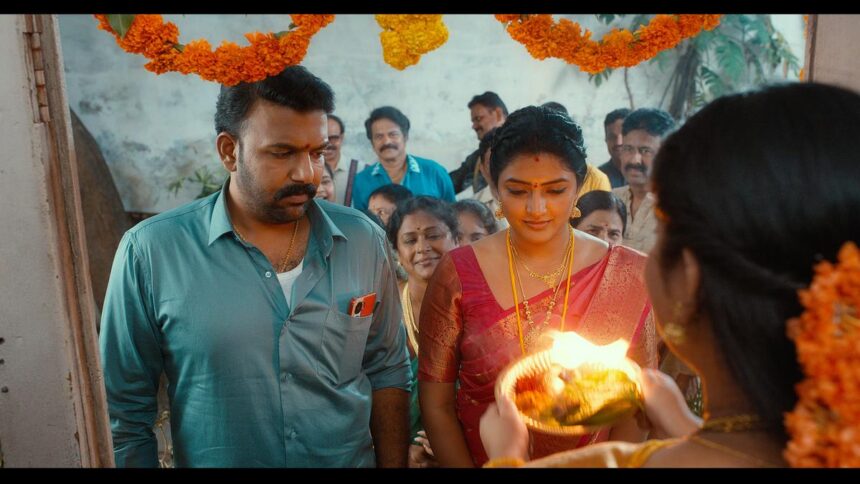









In a scene from Heggana Muddu, Ajith (Poornachandra Mysore) and Prerana (Aditi Sagar) find themselves alone together for the first time after their arranged marriage. Ajith quickly breaks the ice, chatting about everything from how their modest home is small but just right for the two of them, to the dishes he enjoys cooking for her, and even the shopping options available in the neighbourhood.
Prerana, however, feels suffocated. No one has asked her what is going on in her mind, leaving her to grapple with the emotional weight of her new life. She is naturally homesick, missing her mother and longing for a little space of her own. She finds a small moment of respite by opening the balcony door, letting in some fresh air and giving herself room to breathe.
The scene defines the two polar-opposite lead characters. Prerana keeps her feelings to herself. She adapts to situations and endures complex scenarios through her quiet resilience. Ajith, on the other hand, is full of himself, so much so that he decides what’s good for both of them in the relationship.
Heggana Muddu (Kannada)
Director: Avinash
Cast: Poornachandra Mysore, Aditi Sagar, Vijay Shobaraj Pavoor, Mysore Anand, Rekha Kudligi
Runtime: 149 minutes
Storyline: As Ajitha and Prerana navigate their way through relationships, family and a few complicated situations, they discover that things are not always as they seem.
For a while, debutant Avinash Balekkala’s Heggana Muddu moves along as an interesting case study of this unlikely relationship. The focus is mainly on Ajith, who shows the morally grey traits of Mukundan Unni from Mukundan Unni Associates (2022). Ajith is remorseless, having zero empathy for the harm he causes others. His deep-seated suspicion extends to his own wife, and his vindictive mind seeks revenge even for the pettiest of things.
Ajith justifies the behaviour that ultimately ruptures his relationship by claiming that he has never really grown up around women and was deprived of a mother’s love. He further backs this up with another tired argument: while he may not understand women very well, he claims to know all too well the “cheap” mindset of men.
The humour works to an extent, as we laugh at Ajith’s hypocrisy. The film is set in the mid-2000s, when Orkut was the first social home for Indians before Facebook took over. The film references the time when Emraan Hashmi and John Abraham were flourishing in Bollywood, as Ajith asks Prerana to avoid their movies because they feature a lot of kissing and bare-bodied scenes. This self-fashioned image of Ajith reminds you of Shammi’s “complete man” persona in Kumbalangi Nights (2019). Amid the dark comedy, Heggana Muddu makes you uneasy about the plight of Prerana, who faces the consequences of Ajith’s fragile ego.
Despite the comparisons, Heggana Muddu is a decent watch, mainly due to Poorna’s brilliant performance. He peels back the many layers of a flawed man shaped by, and deeply entrenched in, patriarchy. As the character sinks deeper into his darker, more deplorable side, his performance becomes increasingly convincing. The film has a likeable simplicity, further enhanced by Vasuki Vaibhav’s songs.
After promising a relatable, realistic relationship drama, director Avinash splits his lead characters, giving each an individual track. These events lack excitement, and the tonal shift is jarring. The director’s hesitancy to stick to the movie’s core theme and build conflicts around it dents Heggana Muddu’s overall impact. After imagining two interesting characters, it becomes apparent that the director doesn’t know what to do with them.
Prerana (played earnestly by Aditi) never gets the voice she deserves until the final scene. Heggana Muddu wants us to root for her, but one strong scene involving her cannot mask the movie’s over-dominant spotlight on Ajith’s ever-dwindling character. Imagine being a mute spectator to a man who brings the same motivational, self-help mindset from his pyramid-scheme job into his home life. Ajith approaches everything through his own philosophies and psychological theories, while Prerana is given no such luxury. Prerana should have had more opportunities to express her discomfort with Ajith’s selfish acts, which he justifies as devotion and “pure love.”
In a movie that claims to champion the woman’s cause, the leading male character remains the film’s driving force. For a film that attempts a modern take on relationships, Heggana Muddu eventually settles for a traditional conclusion, where the woman pardons the man. Prerana pardons Ajith despite his tendency to cast himself as the victim, thereby justifying the movie’s title, which comes from the Kannada saying, “Hettavarige Heggana nu muddu” (meaning: to a parent, even a bandicoot is cute or darling).
A parent’s unconditional love is understandable, but equating that with an unworkable marriage feels off. Even if the movie is set at a time when relationships largely relied on compromise, Heggana Muddu misses a great opportunity to offer a more progressive view of marriage.
Heggana Muddu is currently running in theatres
Published – September 25, 2026 10:54 am IST