

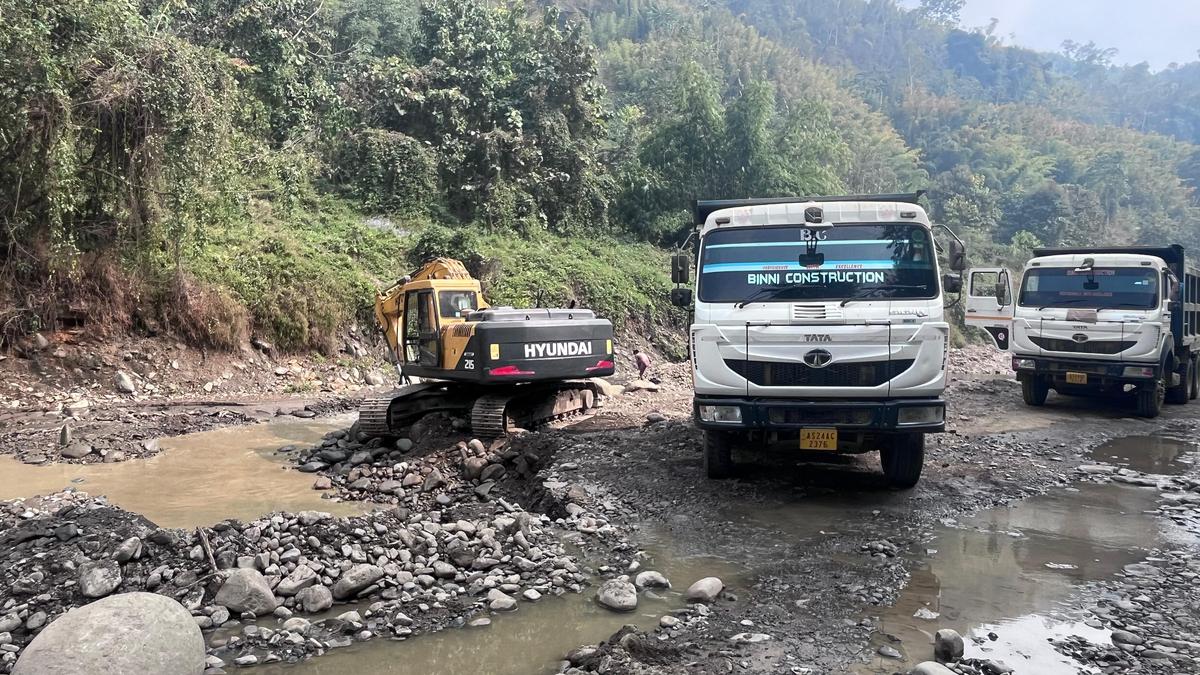


Riverbed mining in Assam’s Dima Hasao district. Photo: Special Arrangement
GUWAHATI
The All Dimasa Students’ Union (ADSU) has flagged “unscientific, illegal and excessive” riverbed mining in Dima Hasao district in Assam, warning that unchecked extraction was threatening severe bank erosion, threatening key transport corridors and drying up drinking water sources for rural communities.

In a complaint letter to the district’s Chief Conservator of Forests on Friday (September 25, 2026), the ADSU highlighted unregulated commercial extraction of sand, gravel, stone and boulders, driven by the rampant use of heavy mechanised excavators inside active river channels, across the Diyung, Mahur, Langting and Jatinga rivers.
The union said these activities were affecting local ecosystems, infrastructure, and indigenous communities in the district.
The ADSU pointed to severe bank erosion and structural hazards, warning that mechanised dredging and unscientific riverbed scooping were destabilising riverbanks and accelerating soil erosion during the monsoon season. It said this was endangering critical lifelines, including National Highway 27 and railway lines, while triggering recurrent landslides near habitations.

The union further warned of extensive aquatic habitat destruction, with excessive siltation and riverbed disturbance decimating local biodiversity, including native and endangered fish species, by destroying breeding grounds and disrupting natural hydrology.
“Indiscriminate deep mining breaches the natural water table, drastically lowering groundwater levels and drying up vital gravity-fed drinking water streams across rural settlements,” the ADSU said, raising concerns about water security.
Livelihoods affected
The letter, signed by ADSU general secretary Suraj Naiding and president Arujit Kemprai, highlighted the impact of such activities on tribal livelihoods. It noted that rural and indigenous communities, dependent on these riparian systems for traditional fishing, agriculture and household water, were facing immediate socio-economic distress.

The ADSU underlined that Dima Hasao, an ecologically fragile hill region protected under the Sixth Schedule of the Constitution of India, was witness to extraction activity in contravention of the Assam Minor Mineral Concession Rules, 2013, the Supreme Court’s mandatory guidelines in Deepak Kumar versus State of Haryana (2012), and standing directions of the National Green Tribunal prohibiting heavy mechanised in-stream extraction without approved district survey reports and valid environmental clearances.
The ADU called for immediate cessation of illegal mining, including a cease-and-desist order against all non-compliant extraction sites and the impounding of unauthorised heavy machinery operating in river channels.

The union also demanded a joint ground inspection and audit, urging the formation of a task force comprising the Forest Department, Revenue and Forest officials of the Dima Hasao Autonomous Council, the district civil administration, ecological experts and local student representatives.
It called for strict penal action against illegal operators and quarry owners operating without approved mining plans, valid leases or environmental clearances from the State-Level Environment Impact Assessment Authority, under the Mines and Minerals (Development and Regulation) Act, 1957, and the Environment (Protection) Act, 1986.
Additionally, the ADSU sought scientific demarcation of no-mining ecological zones, covering critical river bends, bridge buffers, erosion-prone areas and other ecologically sensitive stretches.
Published – September 26, 2026 03:08 pm IST