






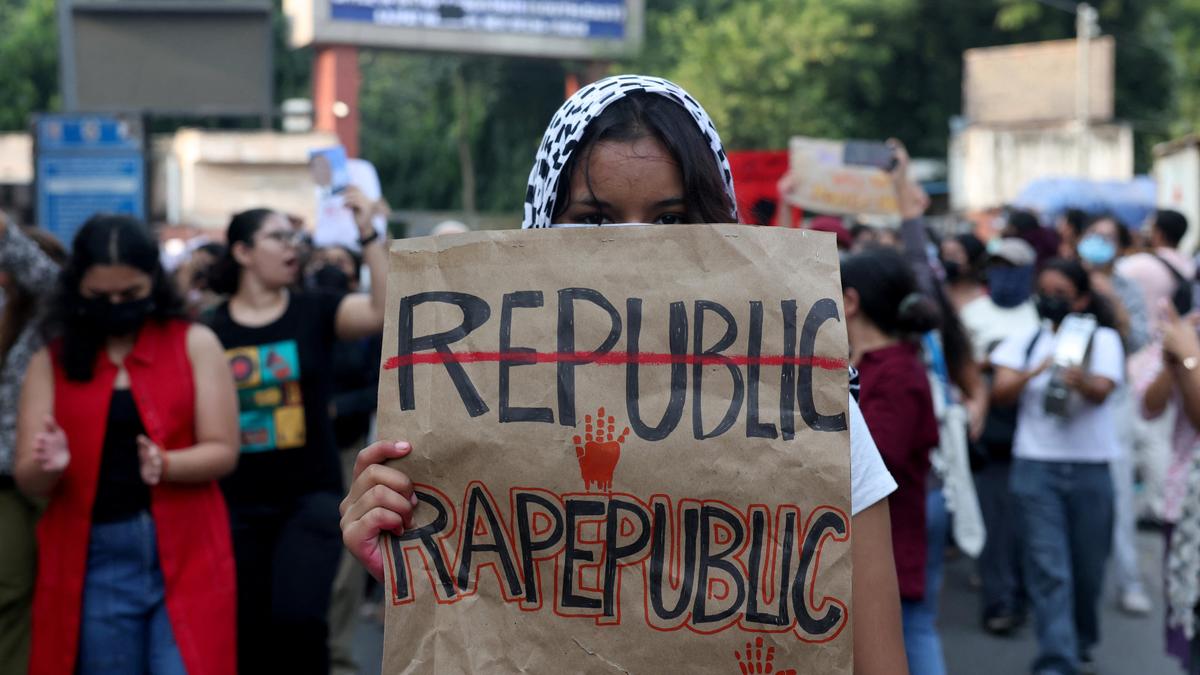


A college student holds a placard during a solidarity march demanding police action and better safety for women following the alleged gang rape of a girl, in New Delhi. File
| Photo Credit: Reuters
The gang rape of a 17-year-old girl at Aastha Kunj Park in southeast Delhi’s Kalkaji area has highlighted safety and maintenance issues concerning the sprawling 142-acre green space and other such DDA parks, with residents and local Residents’ Welfare Associations (RWA) flagging poor lighting, broken sections of the boundary walls and inadequate security.

Residents said the Delhi Development Authority (DDA) parks remain poorly lit in the evening and portions of boundary walls are damaged, making it difficult to monitor movement in and around the premises.
“One of the biggest issues is that these are huge parks, which are under DDA, but there is no proper ownership. The recent incident has highlighted the problem. If the DDA is unable to properly upkeep these parks, it should let locals come together and form neighbourhood park safety committees, with members from RWAs, police officials and others,” said Ruby Makhija, secretary of Navjiwan RWA.

The suggestion falls in line with the global trend of shifting management of public parks from a state-funded model to a collaborative public-private partnership.
Ms. Makhija also said that DDA park timings should be clearly displayed and authorities should ensure proper illumination throughout the parks.
In the recent incident, the survivor, a resident of Faridabad, was allegedly gang-raped by three men posing as police personnel at the park on Monday (September 21, 2026). It has led to scrutiny of security arrangements at the DDA-maintained park, particularly after dark, as well as the monitoring of its multiple entry and exit points.

Aastha Kunj is among the large green spaces maintained by the DDA, which manages more than 16,000 acres of green assets in the city, including over 700 parks, biodiversity zones, city forests, regional parks, and neighbourhood gardens. Residents have questioned whether the existing system is adequate to ensure security and maintenance across such large areas.
“Aastha Kunj was once our go-to spot every morning and evening. My son and I used to regularly go there for walks and jogging, but the situation has completely deteriorated now. DDA can and should be held accountable for the condition and management of the public environment under its control,” K. K. Anand, a resident of East of Kailash, said.
He said, “When the State manages a public space, citizens should not have to discover its vulnerabilities through a tragedy.”

Vaibhav Gupta, general secretary of the Sant Nagar RWA, which is located near Aastha Kunj, said, “The facts emerging from the investigation raise fundamental questions about DDA’s management of one of Delhi’s major public parks. If DDA needs outside agencies or adoption models to maintain parks effectively, why has it not established a consistently effective system of basic security and maintenance within parks under its direct jurisdiction?”
The DDA has said several steps have been taken to strengthen the security at parks. “Additional security guards have been deployed during the night shift; regular patrolling is being carried out to ensure that every corner of the site is covered. Bike patrolling with torches and other safety equipment is being undertaken during night hours, and additional lighting is being provided at identified dark spots to improve visibility and safety,” it said in a response.
Delhi L-G T. S. Sandhu, who heads DDA, has directed a safety audit of all DDA parks by next week. Several safety measures are also expected to be put in place in the interim period.
Published – September 27, 2026 03:06 pm IST