








Fast bowling is a very physically demanding and unnatural activity that places immense strain on various different parts of the body. The most affected, one might say, are the back, the knees and the ankles, but the shoulder bears a heavy burden too, as does the heel and the shin.
Fast bowling calls for sheer bloody-mindedness, especially in a country like India where, until perhaps a decade back, the pitches offered absolutely no assistance even in domestic cricket. The diktat to leave a few millimetres of grass, interestingly during Sourav Ganguly’s tenure as the BCCI president, has had a domino effect with the medium-pacers and those slightly quicker than that having a field day at the expense of spin. But even so, it requires a certain mindset to want to embrace fast bowling in the subcontinent – perhaps with the exception of Pakistan, who somehow seem to throw up quicks a dime a dozen.
It’s not as if spin bowling is an easier endeavour. It would seem to be an unequal contest, fast bowlers thundering in from 20 yards to hurl the cherry and the spinners trundling in from five or six yards – unless you were Derek Underwood or Ajantha Mendis – to let go of the ball. But anyone who thinks bowling spin comes easy clearly doesn’t understand cricket enough.
And it’s not as if spinners aren’t putting themselves at the risk of picking up injuries, either. The seam cutting against the inside of the forefinger and the middle finger triggers such pain and discomfort that oftentimes, it’s hard to even grip the ball and well nigh impossible to release it with the desired revs. But such is their devotion to their craft that the finger spinners make light of such terrible exigencies, determined to hoodwink batters in the air and off the surface while being mindful of how much the odds are stacked against them in modern-day cricket.
If the lot of quality finger-spinners is anything but straightforward, think of the wrist-spinner. There is arguably no other type of bowling that asks such probing questions as that of a wristie. For starters, they need to be encouraged to keep at it because a bad delivery is never far away, because such is the very nature of that craft. Especially in one’s formative years, it is very easy to get disheartened, and more so if encouragement isn’t forthcoming from coaches, captains, parents and peers. But even when one establishes themselves at the highest level, the gremlins of self-doubt never disappear completely.
Shane Warne might have made leg-spin look glamorous and ridiculously easy with his larger-than-life persona and a supreme command over how the ball left his hand but hey, how many wrist-spinners have taken 700 Test wickets? Or even 700 wickets in first-class cricket? Warne was the striking exception, the genius touched by greatness long before he made an eminently forgettable Test debut in Sydney in January 1992 against India. Figures of one for 150 – his lone success was double-centurion Ravi Shastri – were hardly flattering, but Warne wasn’t the only to show that it isn’t how you start, but how you develop and finish, that matters the most.
Generous with inputs
Warne wasn’t just a great bowler, he was also generous with his inputs and advice, with his learnings and wisdom. In international cricket, they talk of a fast bowlers’ club, and a spinners’ club. For a long time, the latter was populated by three of the most successful tweakers of all time – Warne, Sri Lankan giant Muttiah Muralitharan (Test cricket’s highest wicket-taker with 800 scalps) and our own Anil Kumble, with the temperament of a fast bowler and the heart of a champion that often took the sheen away from his not inconsiderable skillset.
It was probably little less than providential that two of these three members contributed to a rookie left-arm wrist-spinner – the term Chinaman is frowned upon these days, apparently because it is politically incorrect – announcing himself on the world stage more than nine and a half years back. Kumble was India’s head coach for only one year – more the Indian team’s loss than the towering Bengalurean’s – but that was time enough for him to bequeath to Indian cricket that great rarity in the history of the game, a left-arm wrist-spinner.

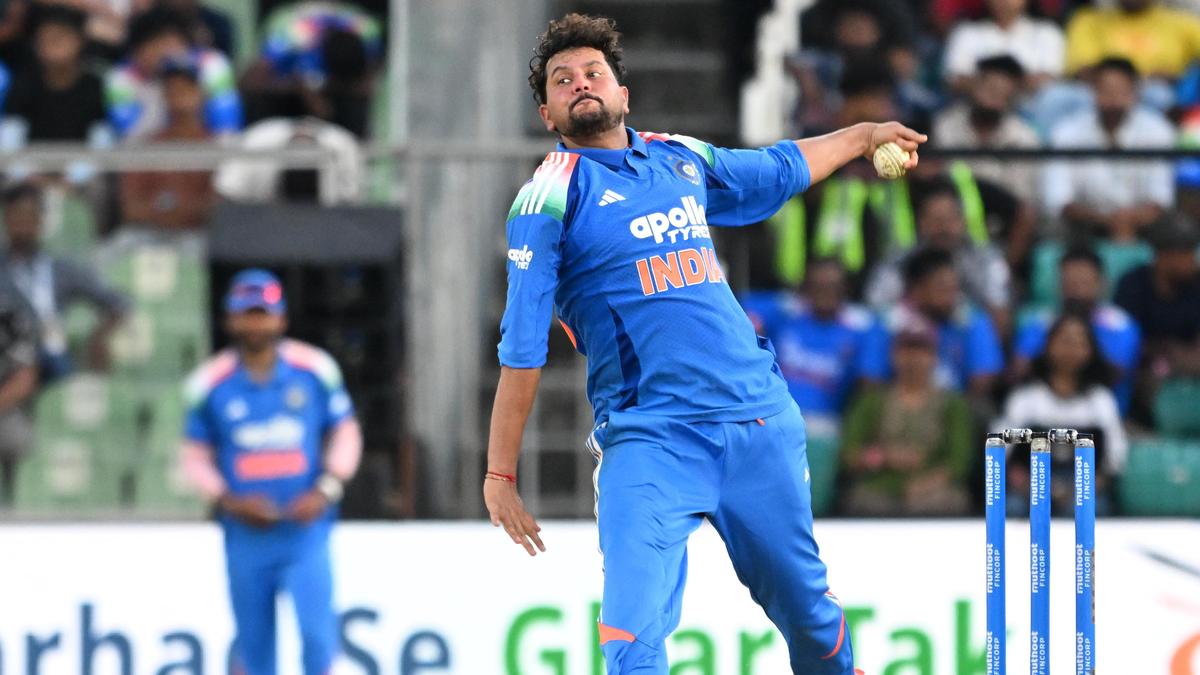
Kuldeep Yadav is a genuine wicket-taker.
| Photo Credit:
NIRMAL HARINDRAN
Through the first three of Australia’s four Tests in India in early 2017, Kuldeep Yadav was steadfastly ignored by Virat Kohli. An unfortunate shoulder injury to the captain forced him to miss the decider in Dharamsala – the series was tied 1-1 – and Ajinkya Rahane, the stand-in skipper, heeded his coach’s words and opted to throw the 22-year-old from Kanpur into the deep end.
Master’s advice
His first bowl is what we tend to call a ‘dream debut’. On a decidedly pacer-friendly day-one strip at the HPCA Stadium, he made Australia’s batters dance to his tune. Kumble had facilitated a conversation between Warne and Kuldeep before the match, and while English may not have been the latter’s strongest suit at the time, he showed that language is hardly a barrier when it comes to cricket by putting the master’s advice to great effect.
His first Test wicket was that of David Warner, with a flipper that Warne had talked about in detail. Then followed the sticks of Peter Handscomb, Glenn Maxwell – coming off a century in the previous game in Ranchi – and Nagpur as Kuldeep finished with four for 68 from 23 outstanding overs. A start had emerged, you told yourself, a star for whom the sky was the limit.
Kuldeep’s career has, as has been well chronicled, not taken off along expected lines. Nine and a half years after that stirring debut, he has only 19 Test caps. Somehow, he has been the most expendable of the spinners, ostensibly at the altar of batting depth. For a type of bowler who relies on confidence, trust, encouragement and backing, to be forced to look over his shoulder and wonder if he will get a second Test on the trot isn’t the ideal base from which to perform, as former India leg-spinner Narendra Hirwani agreed during a conversation with this writer a couple of weeks.
Pigeonholed more as a limited-overs bowler – 122 ODIs and 54 T20Is for 198 and 95 scalps respectively – Kuldeep has plugged away manfully in the two shorter formats. He must be hurting immensely at not playing more Tests, even on home patch, and sometimes, that feeling of hurt and maybe not being wanted has manifested itself in scratchy, underwhelming performances that infuriate because one knows that Kuldeep is capable of much, much more.
Turning a corner?
Perhaps now, the turnaround is imminent. Or perhaps, even now, that could be a false dawn. Only time will tell, but watching Kuldeep run rings around the West Indian batters in Thiruvananthapuram on Sunday in the first ODI, you couldn’t help but wonder why successive team managements haven’t invested more in this now mature, seasoned 31-year-old.
Put in on an excellent batting strip, the Caribbeans seemed on course for a total in excess of 350 on the back of sterling opening stand of 135 between Justin Greaves and John Campbell in just 19.2 overs. Enter Kuldeep, so send them tumbling to 198 for five, including wickets in successive deliveries of Greaves and Jewel Andrew, who had no answer to a ripping wrong ‘un that caught the splice of his bat and lobbed to Rohit Sharma at slip.
Kuldeep finished with four for 40, his best ODI figures since September 2023, when he took five for 25 against Pakistan in the Asia Cup in Colombo. Only thrice subsequently in the next 34 ODIs until Sunday did he manage a four-wicket haul, but there was something different about how the ball left his left hand in Thiruvananthapuram.
Flow and confidence
The pace was optimal, the control impeccable, the rhythm very, very evident. It certainly helped that he got a wicket early on because more than anyone else, Kuldeep thrives on flow and confidence, and once he realised that he was hitting the areas that he was targeting, he appeared so dangerous as to threaten a wicket almost every delivery.
Kohli produced another one of his trademark centuries in a chase, seeing the team home by eight wickets with plenty to spare, and Shubman Gill dazzled with a pleasing hundred of his own, but there truly was only one candidate for the Player of the Match award.
Kuldeep had single-handedly downscaled the West Indian total by at least 50 runs and while there is no gainsaying what the outcome would have been even if Shai Hope’s men had touched or crossed 350, the wrist-spinner pulled the chase down to little more than ordinary proportions with his mesmeric presence at the bowling crease.
Not the best of times
Across formats, Kuldeep hasn’t had the best of times of late. He hasn’t taken more than two wickets in a T20I innings for 12 months, while the last of his five five-fors in Test cricket came in October last year, also against West Indies. His last five bowls in the five-day game have brought him just four successes in 54.5 overs and he had a forgettable Galle Test last month, finishing with match figures of one for 103 from 25 overs as he was comprehensively shaded by finger-spinners Manav Suthar and Ravindra Jadeja.

Kuldeep Yadav found the going tough in the Galle Test.
| Photo Credit:
PTI
Kuldeep has found himself at a crossroads so often in his nearly decade-long international career that he must experience a sense of déjà vu whenever he is pushed to a corner. He has found a way to spring back several times, and one can only hope that Sunday is a seminal moment in that it will lead to a sustained expression of tricks and sleight of hand.
Over the next week, in the next two ODIs, and in the five T20Is to follow, he will get further opportunities to build on this grand start to the home season. If he can snare a bagful of wickets, it will put him in an excellent state of mind as India head to New Zealand in three weeks’ time for their first full tour there since January 2020.
Kuldeep is the kind of bowler who can make a decisive impact even on pitches that don’t offer him much help, a bank India will hope to dip into at the 50-over World Cup in the Africas in 12 months’ time.
For long, Kuldeep himself has been his worst enemy; that’s something he and the think-tank must work assiduously to arrest as Indian cricket enters an exciting phase pregnant with glorious possibilities.