






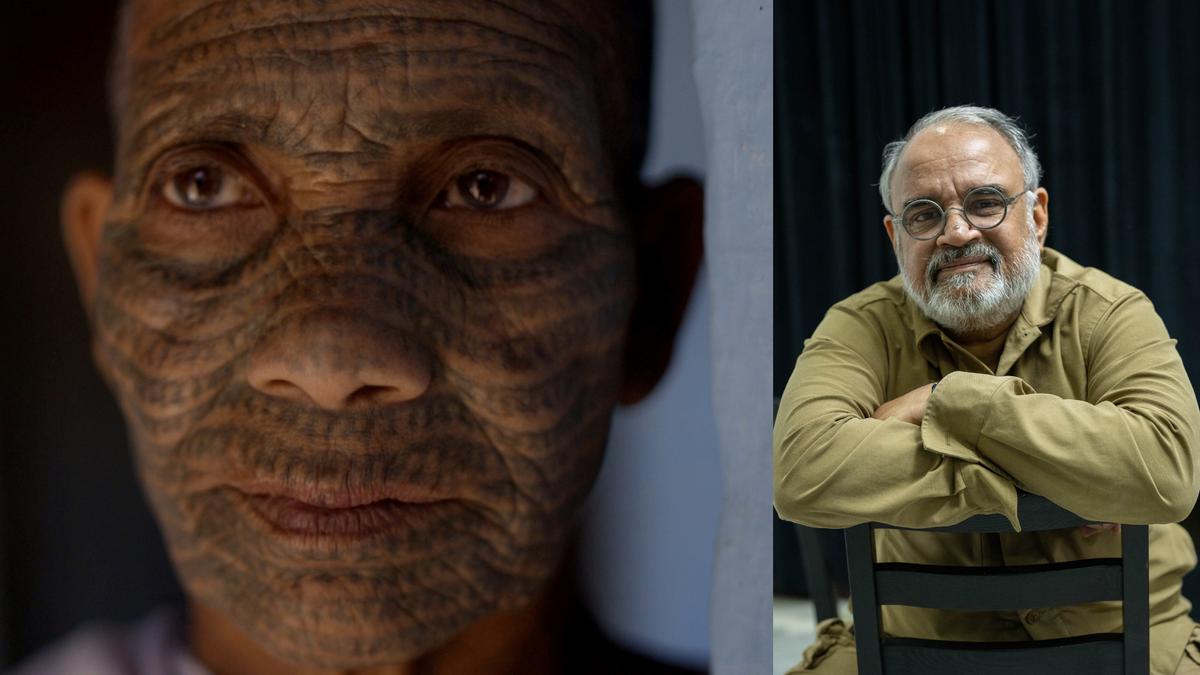


A still from Ramnami, directed by Bharatbala, a Chennai-based filmmaker
| Photo Credit: Special Arrangement
The story of this national award begins with one photograph.
Five years ago, Chennai-based filmmaker Bharatbala travelled to Champa in Chattisgarh, chasing the story of the Ramnami community, an ostracised devotional Hindu sect founded in the 1890s. Back in the 19th Century, they were barred from entering temples because of their caste. As a form of peaceful protest, they decided to immerse their bodies in streaks of carefully placed Sanskrit lettering spelling out the word ‘Ram’, a god in India in whose name miracles and unspeakable horrors alike, have been committed over the years.

Director Bharatbala receiving the national award
| Photo Credit:
Special Arrangement
Bharatbala says that he was not interested in politicising or marketing Ram when he first heard about the community. “Ram can market himself,” he says. Instead, he wanted to capture the tale of this community reeling from years of untouchability and a riveting history. “I was visiting my father-in-law in Auroville and stumbled upon a French photographer who had travelled around India. One of his images was of the Ramnami,” he says. The journey led him straight to Champa where the filmmaker travelled with a lean crew of about six to seven members and spent about 15 days trying to form a relationship and understand the Ramnamis who continue to tattoo themselves head to toe as a form of penance.

In six minutes, the filmmaker seemed to capture several people’s imaginations. Ramnami won the Best Documentary award at the 72nd National Film Award on September 22. Bharatbala received the honour from President Droupadi Murmu, and added that this was a moment of elation.
A mind of one’s own
This moment is not unfamiliar to the filmmaker though. In the years that Bharatbala has spent making 124 films to study India’s vast culture through a 1,000-film odyssey called Virtual Bharat, he seems to have achieved elation. “I feel the youngest now,” he laughs. “It’s a volcano of love, excitement and creativity. Suddenly I am a man in a hurry, because there is so much more to do.”
The pace has been relentless. “We are making three films a month. We are always in some place or the other,” he says, adding that they have just wrapped up a film on the production of Ajrakh block printing in Barmer, Rajasthan, and another on an idol maker in Swamimalai, Tamil Nadu. “It’s not just about making an idol. It’s what he has to shoulder, his devotion to creation,” he says.

A still from the film
| Photo Credit:
Special Arrangement
Bharatbala says that it is people who interest him the most. If one does not document them or several Indian traditions, it is likely that they may remain in the shadows, he adds. It is why he chose to tell the story of the Ramnami community through Manohar, the central subject. The film begins with the line “Hamen kuchh farak nahin padta, hamara tan aur man hi hai mandir.”
This placement of this dialogue and shot is important as it establishes Manohar and the rest of the community’s philosophy towards life despite the changing times. Bharatbala says that the elders in the community have maintained that they discover the God within. “They don’t need to go to the temple. They have found the temple lying within them. For them, this is penance,” he adds.

Yet, he also says that he has noticed an important shift. In the last minute of the film, we watch a young child in the community climbing over Manohar. The child remains tattoo-less. “That is where the spirit of the story lies,” he says.

A still from the film
| Photo Credit:
Special Arrangement
“They have of course watched the movie. Life has changed in the last five years for them. They have become a destination. Foreign crews have come and filmed the community after our release. They were even called by the Prime Minister. One member of the community gave him a shawl with Ram scrawled all over it,” he says.
Bharatbala is raring to tell many such other tales. He has just completed a feature film on the Maha Kumbh Mela shot in 2025 over 45 days. “The story is about Hindustani classical music, a patriarchal father, and daughters who are taking a legacy forward,” he says. Legendary music composer AR Rahman, who has worked with the director back in 1997 on the iconic ‘Vande Maataram’ song, has collaborated with him on nine out of 12 tracks, he says.
Has the tireless pace and the film made an impact on him? “I am a changed person. I am liberated,” he says. “If you are working for somebody, there is a studio, a producer, financial commitments. We have no such pressure. I am a servant of these stories. Nothing else.”
Published – September 30, 2026 01:31 pm IST