


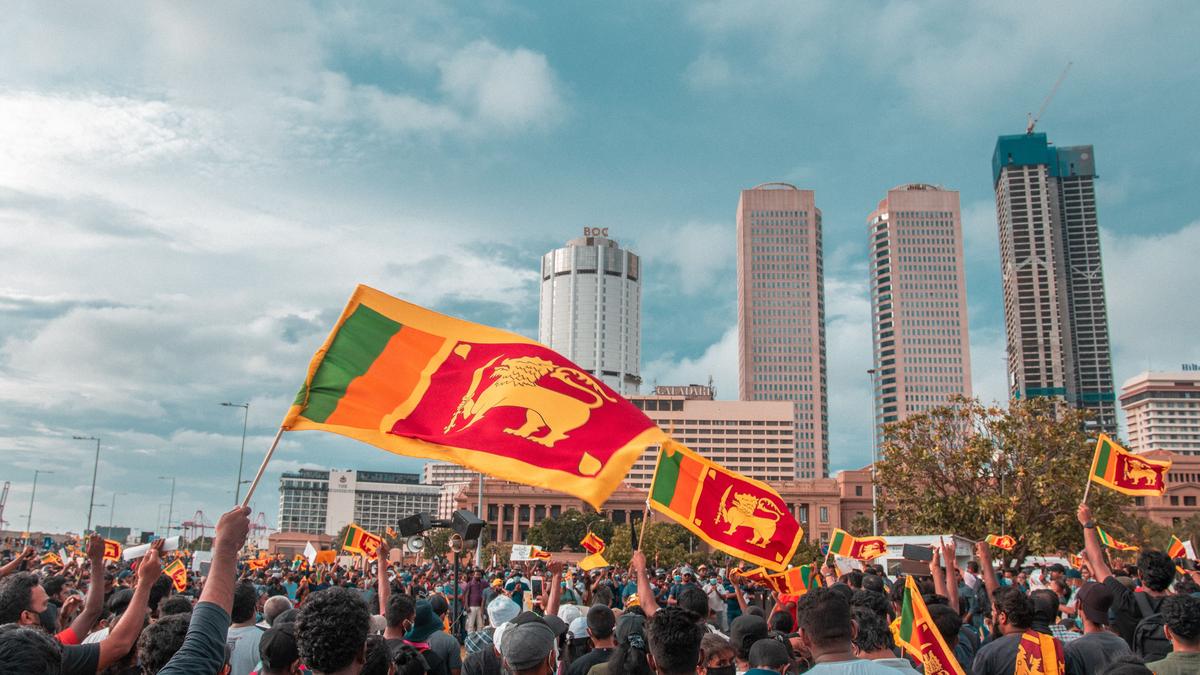

The mass uprising in Sri Lanka in the summer of 2022 had one unifying chant — “Gota go home”, reflecting the protesting citizens’ chief demand that then President Gotabaya Rajapaksa resign.
It was one of many diverse chants, their tone ranging from witty irreverence to daring dissent, that captured the spirit of the Janata Aragalaya, or people’s struggle. The protesters were emphatic in their rejection of Mr. Gotabaya, whom they held responsible for the country’s bankruptcy and their endless wait in queues amid acute shortages. They were unafraid to voice their anger with the Rajapaksa clan and their frustration with the entire political class.
But in that watershed moment, they were thirsty for something else, something new — “system change”, their posters screamed.
Once the Rajapaksas grudgingly quit office and Ranil Wickremesinghe took charge, with the Rajapaksas’ party backing him in an urgent parliamentary vote, the protests fizzled out. The many fragments of the movement had varied reactions to Mr. Wickremesinghe’s rule. To some, he was an experienced leader capable of facing the challenge of fixing the country’s battered economy. Others, however, saw him as embodying a continuation of the Rajapaksa rule, except in a suit. It was far from the political and systemic overhaul they had sought. That is why Anura Kumara Dissanayake’s campaign in 2024, promising to change the “corrupt political system,” found resonance with voters. It was the first election held since the economic crisis. Although led by the leftist Janatha Vimukthi Peramuna (JVP), a party tainted by its history of brutal violence, the broader National People’s Power (NPP) coalition Mr. Dissanayake founded (in 2019) and built up in the subsequent years emerged as a new force offering rare promise. Voters who had until then switched between one of two legacy political formations alternating at the country’s helm felt they had a real choice.
Two years on
Short of a clear majority in the three-cornered presidential race — he secured 42.31 % of the votes — Mr. Dissanayake made it with his tally of preferential votes. His impressive win propelled the NPP to a historic supermajority in the general elections that soon followed. Citizens who seemed torn or tentative in the September presidential polls were certain in November 2024. They were going to give “AKD” and his government a real chance.
“I am not a magician; I am not a miracle-worker. There are things I know and don’t know,” Mr. Dissanayake said soon after being sworn in on September 23, 2024. “But I will commit to always doing the right thing, and to lead a collective effort to rebuild our nation,” the new President said in his first address to the country.
Last week, President Dissanayake completed two years in office. He has been addressing rallies across the country as part of a series titled ‘People’s Rule — Two Years Strong. Progress for All’.
Leading a country struggling to recover from a financial crash was never going to be easy. A year into forming government, the Dissanayake administration faced the deadliest natural disaster the country had witnessed since the Indian Ocean tsunami in 2004. Cyclone Ditwah claimed nearly 700 lives and displaced several thousand people, even as nearly 1,200 landslides swallowed villages in the island’s hilly regions in late 2025. Within months, the West Asian crisis began, resulting in volatile fuel prices in the global market.
Wasting no time after it came to power, the NPP government prioritised economic stability and recovery.
The government opted to go ahead with the International Monetary Fund programme finalised by its predecessors, staunchly pursued fiscal discipline and macroeconomic stability as the IMF spelled them out, and achieved or even surpassed crucial targets set by the Fund. While the ruling administration initially referred to the IMF programme as a compulsion in the economic and social circumstances in the country, it gradually began following through with conviction. Meanwhile, studies have found that poor families are eating less, as they struggle to cope with crushing austerity.
“We surpassed the target revenue last year and cut down on unnecessary state expenses. It was because of this discipline that we were able to respond to Cyclone Ditwah and the West Asian crisis without passing on the burden to the public,” says Nihal Abeysinghe, General Secretary of the NPP and Member of Parliament.
Speaking to The Hindu at the JVP party headquarters on the NPP administration’s performance, Dr. Abeysinghe said it has “changed the political culture”. The Dissanayake government has made a series of high-profile arrests, especially of notorious suspects in the narcotics underworld and prominent politicians and bureaucrats accused of grand corruption. The arrest of a former intelligence chief in connection with the ongoing probe into the 2019 Easter terror bombings raised eyebrows. “Law enforcement is the same for all, whether it is a former president or anyone else,” Dr. Abeysinghe says.
Pending promises
According to him, the government will focus on the Provincial Council elections and drafting a new constitution in the three years that remain of its term. Both were among the key promises the NPP made to Tamil voters. While the conduct of the provincial polls remains stuck with a parliamentary committee, there has been no movement yet on the promised new constitution.
The government’s efforts to bring about legislative changes remain in sharp focus for both its eagerness in some respects and its lethargy in others. Its recent move to introduce a constitutional amendment extending judges’ retirement age drew flak from the political opposition and legal community, which accused the government of using the judiciary to serve its political interests. The NPP’s pledge to repeal Sri Lanka’s draconian anti-terror legislation and abolish the executive presidency, too, remains only in the manifesto. Rights defenders have slammed draft legislation replacing — and not only repealing — the Prevention of Terrorism Act for falling short of international human rights standards.
‘Mixed’ report card
Offering a “mixed” report card for the NPP rule over the last two years, Pradeep Peiris, a political scientist at the University of Colombo, says he is “100% pleased” that the country “finally has a civilised, dignified polity”. All the same, he is “frustrated that an important turning point increasingly looks like another lost opportunity to address structural issues in our democracy.”
The NPP government, in his view, looks more like a “government of good governance”, rather than one of transformation. “We must remember that 2024 was not just any other election, with its outcome bringing about a regime change. After 1948 [Independence], it was the first time citizens felt they could negotiate a new political structure”. Observing that the Aragalaya popularised a democratic imagination, Mr. Peiris adds: “While voters rejected the old political class in the 2024 election, it was not really a baptism of a new political class.” The electorate’s verdict, he cautions, was more a rejection of old politics than affirmation of the NPP’s programme. “While the country was very clear about what it did not want, it is not as clear about what it wants, and even less clear about how to get there. The NPP government needs to initiate a robust, inclusive conversation on renegotiating a new social contract with citizens.”
Contending that a cultural project is necessary for real political transformation, he notes that such a project is yet to take off. “In that sense, I feel instead of utilising this historic moment for system change, the NPP has simply become better rulers in the same system they inherited. In such a situation, the risk of the old political order returning always lingers,” he notes.
There is every indication that the NPP is hoping for a second term in office. “The opposition is weak, divided, and has no clear work plan. We don’t have a real political challenge yet, and we won’t until a new force better than us emerges,” Dr. Abeysinghe says with confidence.
Meanwhile, the NPP knows that it has its task cut out for it to ensure that its supporters across the country hold on to the hope they felt in 2024. Weeks before he was elected President, Mr. Dissanayake seemed fully aware of the challenge that awaited him if he won. “The people have very high expectations now,” he told The Hindu at the time.