







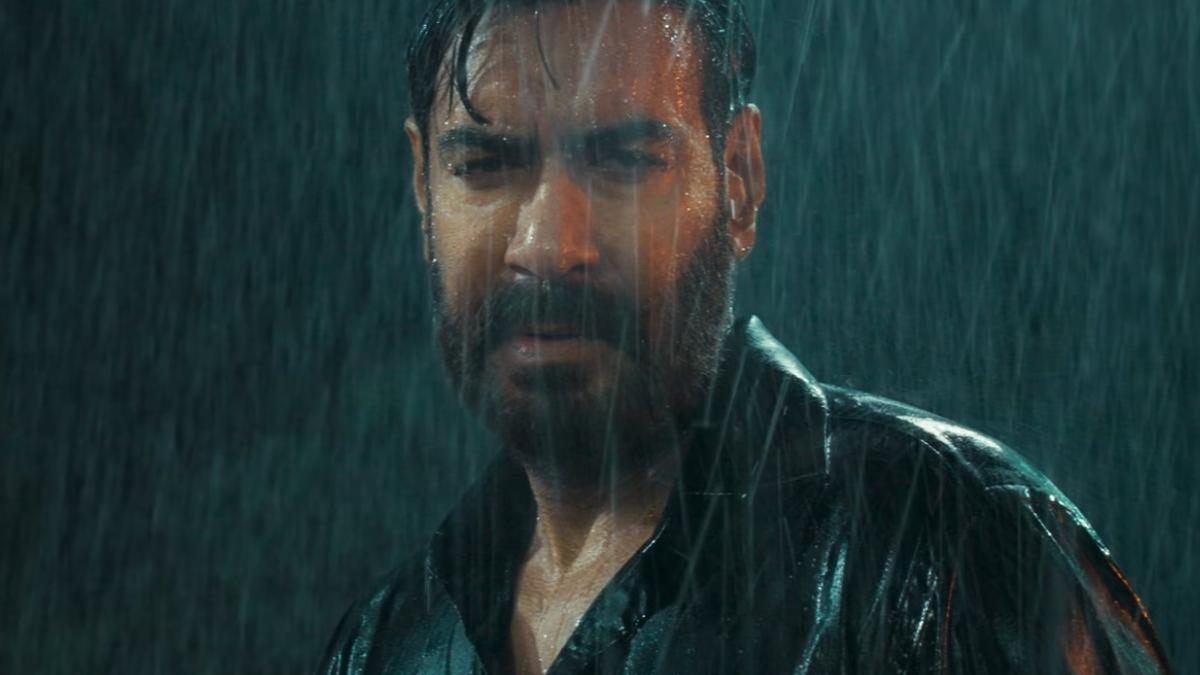


Ajay Devgn in ‘Drishyam The Conclusion’
| Photo Credit: Panorama Studios
(This piece may contain mild spoilers)
Truth becomes a deceptive weapon in Drishyam The Conclusion. Its trigger rests ably in the heart and mind of simpleton cable operator Vijay Salgaonkar, whose helpless middle-class appeal extends into a mythical overlordship, as he brews a spectacle to shield his family from the badgering tenets of power. In a subversive role reversal, it is the common man here who channels his inner authority to trick multiple levels of state machinery in a language that it is known to regularly use to shield its violence. In the hands of Vijay, truth becomes corrosive and endlessly mutable.
Vijay is no collective saviour. All that matters to him is protecting the honour of his family. That is what led to the crime in the first place as his wife, Nandini (Shriya Saran) and daughter, Anju (Ishita Dutta) murder Sameer Deshmukh, a top cop’s son for his obsessive misdemeanours. It is an act of instinctive self-defence but Vijay knows their reasoning would prove futile against the power-drenched reaches of Sameer’s family. He has seen how it ends for them in countless Hindi films that he watches each night. An uneven, biased path to justice makes Vijay carve his own.

At the heart of the story is a thoughtful reversal of the details of the crime. As opposed to stories of underdogs facing the system, the power resides here with the deceased, as his mother, IG Meera Deshmukh (Tabu) leads the investigation. Justice takes a vengeful turn for her. Even the idea of victimhood shifts from the two perspectives. Vijay’s family is the victim of their story while Meera’s son becomes the victim of hers. If she is using all her might to convict the family, Vijay is working overtime to hide evidences, build alibis and refute all responsibility of the murder.

Tabu in ‘Drishyam The Conclusion’
| Photo Credit:
Panorama Studios
He does the same even in Drishyam The Conclusion as newer evidences reopens the case. However, the scope here is widened and the gaze deepened to let metaphors symbolise Vijay beyond the singular virtues of the case to signify a larger outcome. Invoking the nature of a shrewd politician, Vijay claims, “Kahani ka sach hona zaruri nahi, sach lagna zaroori hai (A story doesn’t have to be true; it has to seem true)”. Using the logic, Vijay narratises truth to protect his family. The nature of his manipulation, however, is strongly rooted in the idea of restoring justice. That’s why, his gentleness wins easy support from churchgoers, as he slowly fuels anti-establishment angst in their minds, which ultimately aids him in sharpening his story. The extent of his manipulation extends to Whatsapp as he ably controls the minds of people with a constructed reality surrounding religion and chooses to channelise their artificial anger for his advantage. Vijay uses the emotions of the mob to strengthen the case for his justice.

The circumstances arising out of his intricate planning of dissemination of false information offer astounding parallels to reality. The twists and turns, which slowly reveal his mind-blowing schemes, also encapsulate the underlying absurdity of his actions, whereby upon repeating a lie multiple times, it takes shape of an undying truth. The role-reversal is filled with an esteemed sense of poetic justice. In a scene, two cops, a lawyer and a businessman surprisingly recount the names of top universities they have studied in only to get tricked by an uneducated man. Equipped with their machinaries and cultural capital, their tragedy lies in still being unable to outmanoeuvre Vijay. The state finds its own fascistic reflection in him, a supposedly naiive individual, who used familiar tools of deception to suppress their own truth.

Ajay Devgn and Jaideep Ahlawat in ‘Drishyam The Conclusion’
| Photo Credit:
Panorama Studios
Beyond the spectacle of his actions, there lies an unrealised cautionary tale against authoritarianism in Drishyam The Conclusion, where Vijay becomes a subversive representation of the state, as he uses the same doctrine of mass control to forge a different reality. There’s a chilling sense of déjà vu to his modus operandi. He is always one step ahead, battling the surveillance of police with his own set of eagle eyes. Yet, his definitive smirk against the powerful is rooted not in upholding power but dismantling it. That’s what sets him apart.

And that’s where the Hindi third part differs from the Malayalam version, as it ushers the legacy of Vijay’s memetic existence into a Bollywood entertainer, replete with satisfying dialoguebaazi and an intelligent punching up to power — which are also elements that fuelled through the traditional Hindi cinema of yesteryears. The Vijay then would shake up his fist in anger. But Salgaonkar is a product of the changing times. His truth is not as principled as Gandhi, even as the film ironically released on October 2. Rather, he is poised and calculated with his stony eyes of deception. This Vijay is an icon for the post-truth world.
Drishyam The Conclusion is currently running in theatres
Published – October 03, 2026 08:26 am IST