





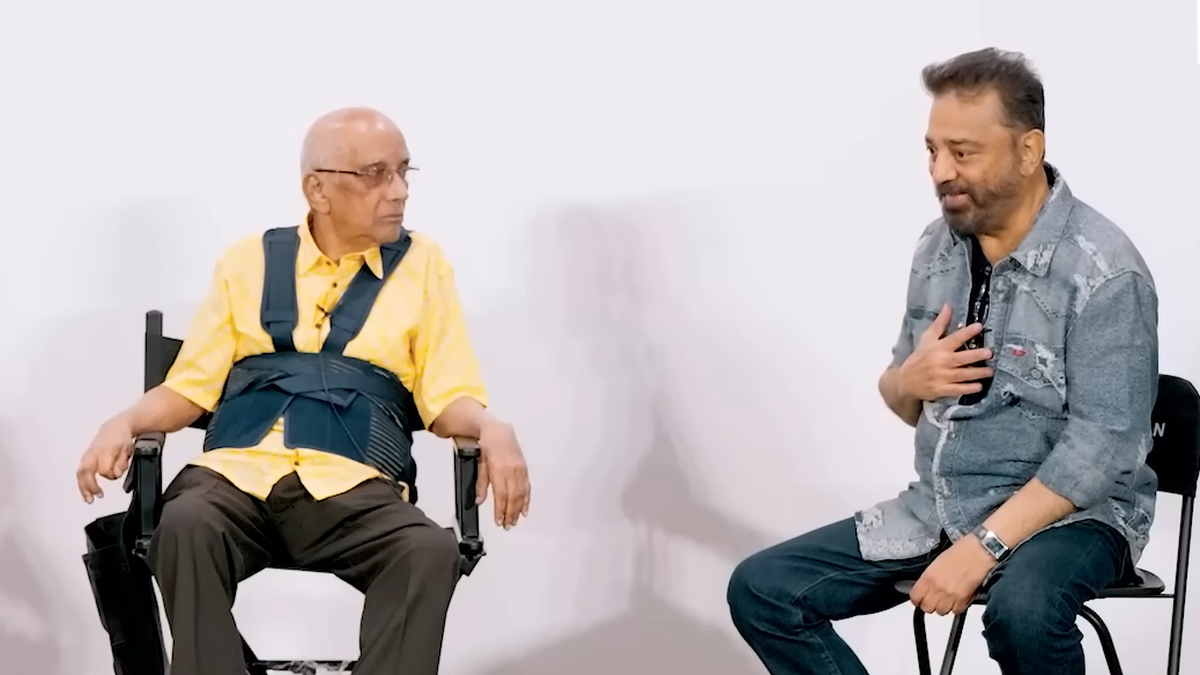

In a prolific career spanning six decades, auteur filmmaker Singeetham Srinivasa Rao, who passed away last night, made countless films with stalwarts of the Telugu, Tamil, Kannada and Hindi film industries. However, Singeetham’s career cannot be discussed without mentioning the films he made with Rajkumar and Kamal Haasan.
In particular, the filmmaker seems to have found a creative twin in Kamal, as their appetite for offbeat stories and aptitude for experimentation led to some of the greatest works in Indian cinema. They worked on seven titles together, starting with the 1979 Telugu action-comedy, Sommokadidhi Sokokadidhi, in which Kamal played dual roles (the double action becoming the foundation that would later motivate the duo to pull off four lookalikes in Michael Madana Kama Rajan). However, of the seven titles, four films clearly stand out to define the real value of the collaboration.

Raaja Paarvai
Two years after Sommokadidhi Sokokadidhi, in 1981 — by which time Singeetham had made four films, and Kamal had made a whopping 22 films — they reunited for a film that would gain cult status in Tamil cinema. Raja Paarvai was a milestone film for many reasons. The film, which marked Kamal’s 100th film as an actor, was the actor’s maiden production venture under his home banner, Haasan Brothers (later known as Raaj Kamal Films International).
The film also had a story written by the multi-hyphenate, marking the beginning of Kamal’s extensive creative role in Singeetham’s films. Raja Paarvai, which featured Kamal as a blind violinist in love with a Christian woman (played by Madhavi), was also Singeetham’s first collaboration with maestro Ilaiyaraaja. Notably, acclaimed art director Thota Tharani made his debut with the film.

Kamal Haasan and Madhavi in ‘Raaja Paarvai’
| Photo Credit:
The Hindu Archives

Pushpaka Vimana
The next collaboration between them requires a backstory. According to legend, Singeetham was piqued by a scene in which a character had to emote fear without dialogue, back when he was working as an assistant director. Years later, in 1987, he made the black-comedy Pushpaka Vimana (called Pushpak in Hindi regions and Pesum Padam in Tamil Nadu). As you can imagine, making such a film was no mean feat even in the ‘80s, but when has a challenge ever stopped Singeetham? In an interview with The Hindu on the 35th anniversary of Pushpaka Vimana, the director revealed how he responded whenever people asked him why he made a film without dialogues. “I ask them, ‘Why should a person climb the Himalayas and hoist the national flag there? They can comfortably sit at home and have breakfast. Why take the trouble?’ Because it’s an achievement.”
And it was an achievement indeed. Identity theft — a theme you would find in many Singeetham films — was at the core of Pushpaka Vimana, which told the story of all the troubles an unemployed graduate gets into after he assumes the identity of a drunk businessman. If you were to call it an unconventional experimental film, Singeetham would have corrected you. He called it the most commercial film of that day. “What is commercial? When you have a star like Kamal, it automatically becomes a commercial film; it doesn’t matter if it is made in Tamil or Telugu. Whereas a Kamalahasan film like Pushpak runs in all languages. Which is more commercial? A Tamil-language Kamal film or a no-language film with Kamal?,” he said in an interview with The Hindu. Pushpaka Vimana won the National Award for Best Popular Film Providing Wholesome Entertainment.

Kamal Haasan in the Tamil film ‘Pesum Padam’ (“Pushpak” in Hindi).
| Photo Credit:
THE HINDU PHOTO ARCHIVES
Apoorva Sagodharargal:
In 1989’s Apoorva Sagodharargal, the challenge was not that Kamal had to play triple roles. It was that one of the characters was a man with dwarfism. Interestingly, it was Kamal who took the idea to Singeetham after being dissuaded by his mentor, legendary filmmaker K Balachander. After all, they had quite the challenge in front of them from a technical perspective.
To pull off the role of a dwarf by Kamal, the duo opted for special shoes that were attached to the actor’s folded knees. However, that wouldn’t be possible for side-angle shots, and thus, the team had to dig trenches that could cover his legs from feet to knees. Of course, some special effects had to be employed, but a lot of credit also goes to Kamal for how accurately he ensured his body language mimicked that of a dwarf. With a story written by Panchu Arunachalam, the film had a screenplay written by Kamal and Crazy Mohan. It told the story of Appu, one of the twins who were separated during childhood, and his quest to seek revenge for the death of his father.
Kamal’s performance, the screenplay and its technical brilliance are all so fondly remembered, but Tamil cinema is deeply indebted to Ilaiyaraaja for his evergreen scores and songs for this film. After all, ‘Raaja kaiya vacha, adhu wrong’a ponadhilla’

A still from Apoorva Sagothargal (1989)
| Photo Credit:
The Hindu Archives

Michael Madana Kama Rajan
This is peak Singeetham-Kamal territory. Taking a leaf out of all of their hit combinations — like stolen identities and brothers being separated at birth — Kamal and Singeetham gave Tamil cinema its beloved, timeless comedy film, Michael Madana Kama Rajan. Inspired by a Pakistani film about quadruplet siblings separating at birth and reuniting later in life, the film had a screenplay written by Kamal and dialogues by Mohan. There’s a whole lot to be said about the film, which is widely regarded as one of the best Tamil films of all time, which is why we give you an exclusive piece about the enduring brilliance of this 1990 masterpiece: Singeetham Srinivasa Rao’s ‘Michael Madana Kama Rajan’, a timeless classic from a master filmmaker

Kamal Haasan in the Tamil film “Michael Madana Kamarajan”.
| Photo Credit:
THE HINDU PHOTO ARCHIVES
After Michael Madana Kama Rajan, Kamal and Singeetham went on to collaborate on Kathala Kathala and Mumbai Xpress.
Now, as we grieve the passing of Singeetham Srinivasa Rao, this also essentially brings to an end one of the most influential filmmaking duos of Tamil cinema. Across seven films, Kamal and Singeetham repeatedly pushed each other towards ideas that could have easily been dismissed as too difficult, too strange or simply impossible to pull off. But when a visionary filmmaker and a daring actor-producer decide to take on those ideas, they create enduring cinema.
A befitting send-off for the duo’s long partnership was Raaj Kamal Films International’s retrospective on Singeetham Srinivasa Rao, titled ‘Apoorva Singeetham,’ which was fronted by Kamal himself. It was Singeetham bidding adieu to the generational actor, and Kamal showing his gratitude to a filmmaker unlike any other. In Singeetham, Kamal found a filmmaker willing to dream as wildly as he did; more importantly, one who knew how to turn those dreams into magic.
Published – October 04, 2026 05:54 pm IST