




Gold. Silver. Bronze. Brass. It all gleams at you the moment you step inside. A towering cabinet blazes with medals, cups, and memorabilia, every piece neatly in its place. Flanking it stand trophies as tall as a small child, too big to fit anywhere and too important to hide. “Kabaddi gave me this house. Everything you see here is what the sport has given me. All of it is a result of my hard work,” declares Neeta Dadwe, pride lighting up her face.
To understand the woman behind that wall of silverware, step out of the house and onto the road that leads to it. A quiet bylane in the heart of the city, far from the roar of Hyderabad’s traffic, it tips steeply downhill, as if to remind you that you are indeed standing on the Deccan plateau.
At first glance, it’s unremarkable. Only, it isn’t. This is a roll call of Indian sport and power. Two-time Olympic medallist P.V. Sindhu, India’s first woman Grandmaster Koneru Humpy, and former cricketer Venkatapathy Raju all live in these bylanes. C.V. Anand, Telangana’s Director General of Police, is a resident too, while Karnam Malleswari, the first Indian woman to win an Olympic medal, once called it home.

Neeta Dadwe guided India to glory at the Aichi-Nagoya Asian Games.
| Photo Credit:
Special Arrangement
And somewhere amid all that star power lives Neeta, who has just led India’s women’s kabaddi team to gold at the Asian Games in Aichi-Nagoya, Japan.
The reinvention
An Arjuna Awardee with a stellar playing career, she reinvented herself as a coach and never looked back, guiding the national side to gold at the 2014 Asian Games and the 2016 South Asian Games.
Her name may not echo as loudly as those of her neighbours, but the shine of her achievements is every bit as bright. A day after she landed in the City of Pearls to a roaring welcome at the airport, The Hindu stepped into her cozy home for a conversation.
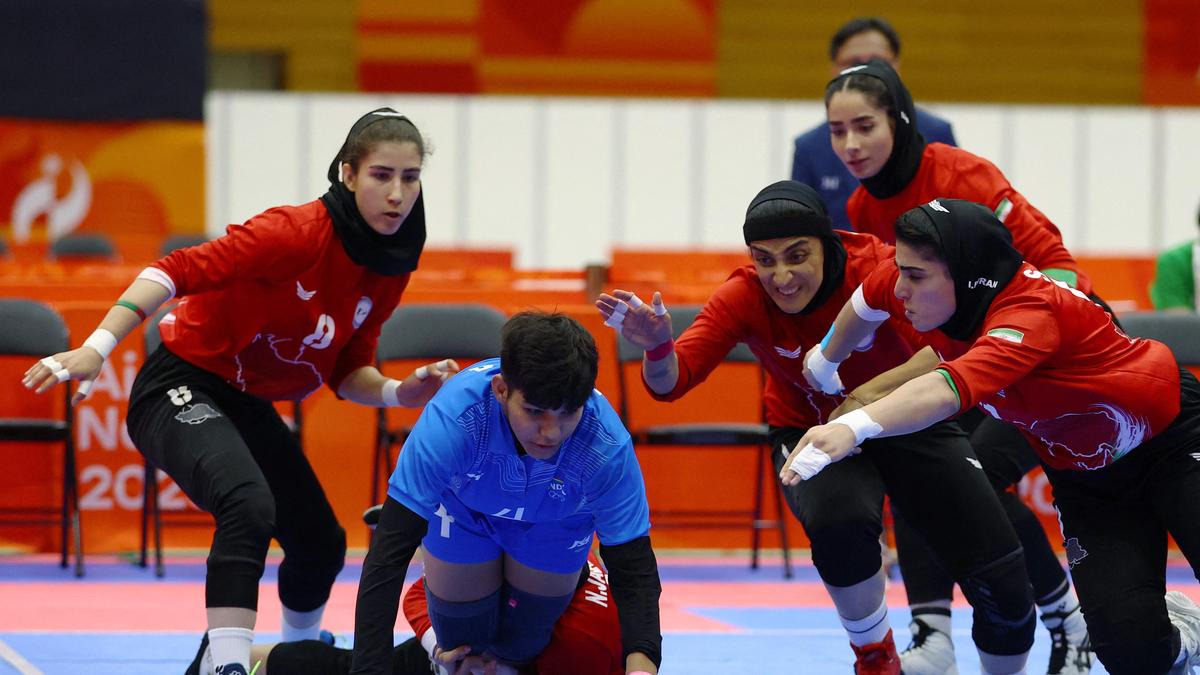
The Indian women’s kabaddi team defeated Iran 37-34 in a closely fought final, successfully defending the gold medal it won at the Hangzhou edition in 2022. As captain Pushpa Rana, all-rounder Jyoti Thakur and several other players revealed after the triumph in Japan, the groundwork for this success was laid at carefully planned training camps.
“Our first camp was at SAI Gandhinagar in May for one month. We had 42 girls and brought it down to 29 there, which was a tough task for us on the selection committee – which includes Mamata Poojary and V. Tejeswini Bai. The next camp was for 15 days, again at SAI Gandhinagar, while the third was at the JSW facility in Ballari,” Neeta recalled.
“We got stuff like a fitness trainer, masseur, sauna bath, ice bath, and more, which is not common for us in kabaddi. I was the coach in 2014 (Asian Games) and we didn’t have as many facilities as we got this time. The kids were very happy because our camps were like international ones. And because of that, for probably the first time, we barely had any injuries during the tournament.”
No mobiles, please
Besides physical and mental training, video analysis and tactical discussions, the team followed a ‘no mobile phones’ policy during the camps.
“We asked the federation and got their permission to do it. The more you use your mobile, especially later in the night, the more you will feel tired the next day. We got the players very much involved in it. One girl would take turns to collect the phones and deposit them. They would get them on Saturday and by Sunday’s end, they would be returned.”
What they could not prepare for, and what has since been widely reported, were the poor living conditions that awaited them. The entire contingent was put up on a docked cruise ship, and it wasn’t as luxurious as it sounds.
“The schedule was very tight for us, and the ground was very far from the ship where we were put up. To be honest, not everyone fits [in the accommodation provided] on the ship. Food was also an issue. Non-vegetarians didn’t have a problem, but the vegetarians faced many. However, the girls managed to face it all without many complaints,” Neeta explained, adding that bread became a staple of her diet there.
On the mat, however, things were largely smooth. The side breezed past its group-stage and semifinal opponents before running into a familiar rival, Iran, in the final. India made a bright start and raced to a 5-2 lead, before Iran levelled with a super tackle and surged ahead 7-5.

The Indian women’s kabaddi team members pose with their gold medals.
| Photo Credit:
R.V. MOORTHY
In the side’s closest contest in Japan, it had a vocal crowd behind it, including members of the Indian Olympic Association, headlined by its president P.T. Usha.
“P.T. Usha came to watch our match. The whole of IOA came. We were all very tense. I was so tense that I couldn’t even look back [at the stands]. The girls and I were under a lot of pressure, but we all had the same goal, which was to win the gold medal,” she admitted.
“In 2018 we won silver. Besides that, we won gold in 2010, 2014, and 2022. I was very scared and worried about how we would fare this time. Not just because of past results, but also because we selected a strong team this time and had good camps.”
Among the things that helped the team get past the Iranians was video footage of their time in India in the months leading up to the Asiad.
“They had been practicing in India for two months. They were in Himachal, played with two or three clubs in Haryana. We asked the federation for some of their videos, and we studied them well.”
For this Asian Games, Neeta was assisted by Mamata, someone she had coached extensively before, including at the 2014 edition of the continental competition. While that familiarity helped in discussing tactics, the two also shared the same nervous tension as the campaign kicked off.
“We used to sit at night and map on a piece of paper who should be played where. And on the first day there, neither of us slept because we were tense. If we used Ritu Negi in the corner pool, then they [the opponents] would’ve made a strategy for it. So we changed things up to give others some food for thought. In the end, we were working towards bringing the country a medal. We were not playing for our States or for Railways or anything. We were representing India.”
Neeta has coached the Indian women’s side to two Asian Games golds, but can’t bring herself to compare both. “Zameen aasman ka farak hai” (a world of difference) came the declaration.
“The emotions involved are very different. In 2018, Iran edged India narrowly in the final. They were coached by our very own Shailaja Jain, who taught them exactly how to play against us. Also, there is a lot more competition now. Look at how well Nepal (lost to India in the semifinals) did. No one expected that.”
Having excelled as a player and a coach, how does Neeta compare the two experiences? “A player and a coach are different. A player gets to enjoy more; I was one, I know it very well,” she grinned.

Neeta Dadwe has had a fantastic career both as a player and coach.
| Photo Credit:
NAGARA GOPAL
Neeta the player greatly helped Neeta the coach. She channelled those experiences to help gel better with the team and structure training sessions in ways that kept players wholeheartedly involved. That also included keeping the workload relatively light in the days leading up to the tournament.
Fitness, however, was one area where there were no compromises.
“When I was a player, we used to make a fitness schedule. And on the days we had to do fast training or speed workouts, those days we used to cry or make excuses. So I told my girls upfront that I did not want to hear any excuses. I said we are all working towards a common goal and that they can express their feelings freely. And to be fair, they also supported me well in this endeavour.”
Professional pathway
While interest in kabaddi took off with the launch of the Pro Kabaddi League in 2014, it is the men who have reaped the rewards, while the women’s ecosystem is yet to get an equivalent. A Women’s Kabaddi Challenge was held in 2016, but it was a flash in the pan.
“In 2016, we had the Kabaddi Challenge, but it took place in the men’s court. If there are three steps in a women’s court, there are five in the men’s court. And many argued that since volleyball and basketball have same-sized courts for men and women, why not kabaddi? But I believe that if that Challenge took place in a women’s court, it would have been a big success,” she opined, adding, “If Pro Kabaddi starts for girls, it will be beneficial as more kids will come out in the ecosystem.”
PKL’s format has allowed the best international stars to ply their trade in India, which has not only helped coaches here understand how they operate but also helped Indian players improve by rubbing shoulders with them. Neeta believes the same knock-on effect would carry over to women.
“Besides getting to know the foreign players better, we will also get better in terms of fitness, nutrition, and more. Pro Kabaddi also provides players with great facilities; I have seen it. In India, after cricket, it is kabaddi only.”
That said, Neeta explained that the women have enough tournaments to keep them busy all year round.
“We had the World Cup earlier. From 21st to 31st this month, we have the Commonwealth Kabaddi Championship in Ahmedabad. After that, we have the Indo-Asian Games in Dubai in November. After that, there’s the World Cup again. There is something or the other continuously; it’s not like before.”
“Kabaddi, as you know, is not a game for rich people. I have seen kids come from nothing. Take Aslam (Inamdar) and so many other boys and girls. He told me that there was a time when he did not even get to eat; only he knows what all his mother did for him. He told me his story. If kids benefit from [getting a professional league], it’s a matter of pride for them. They can then come up in life thanks to kabaddi.”
The Indian women’s kabaddi team has clearly benefited from a coach who has walked many a mile in their shoes, back when chances were rare, the spotlight was dim, and the money was thin. That road made Neeta who she is.
And as the interview wound down, she threw in a reminder that it wasn’t time for her to rest just yet. For she had already packed for the next stretch: a family road trip to her hometown, Nagpur, home to a local club, the Maratha Lancers, which first lit the fuse on her career.
Back in Hyderabad, the cabinet will keep blazing, and the trophies too big to fit anywhere will stand guard. Neeta, meanwhile, took to the highway, carrying her gold home to where it all began. Because for a champion, no stage shines quite like the place that made her.