





Image used for representational purposes only
| Photo Credit: The Hindu
UCIL chief Kacham Anand Rao has dismissed allegations that radiation from uranium mines and mills in Jharkhand’s Singhbhum region is causing health problems such as skin diseases, cancer and congenital deformities, saying such ailments are largely linked to “backwardness” and local conditions.
Also Read: NHRC notice on leak from uranium mine
The Uranium Corporation of India Limited (UCIL) chairman-cum-managing director said the uranium ore mined in the state is of very low grade, with only 200-300 grams of uranium extracted per tonne of ore, and claimed it has little health impact.
“Whatever skin disease or cancer is being attributed to some people is not due to uranium mines. They are due to local conditions and backwardness of the area. At least 10 scientific studies have been conducted by different organisations, which have proved that there is no link between uranium operations and the diseases found in the area,” Mr. Rao said during an interaction at Jadugora.
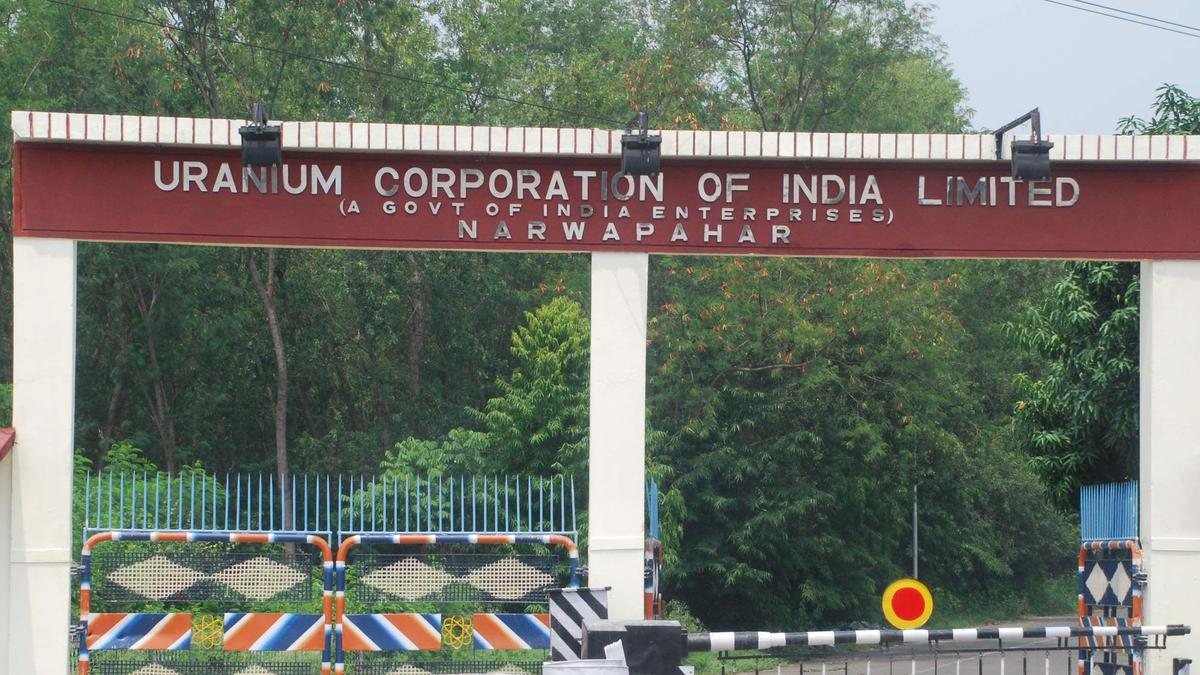
The UCIL operates seven uranium mines in Jharkhand – six underground mines at Bagjata, Jaduguda, Bhatin, Narwapahar, Turamdih and Mohuldih, and an open-pit mine at Banduhurang.
Local groups and social rights activists have for decades criticised uranium mining operations of the UCIL, alleging that radiation from the mines and mills is affecting surrounding areas and causing diseases such as cancer, tuberculosis and congenital deformities.
India’s first uranium underground mine was started at Jadugora in East Singhbhum in 1964 and ore processing plant in 1968.
“Uranium ores mined here are of a very low grade. The radiation here is lower than radiation on sea beaches. After uranium is recovered at the mill, most of the processed material is left as tailings, which have very low radioactivity and less than the limit,” the CMD claimed.
He said the UCIL has been conducting public awareness programmes among local people to dispel what he described as misconceptions about uranium mining.
“The best examples are the UCIL colonies, which are alongside existing uranium mine and mill operations. Nothing has happened there for the past several decades,” Mr. Rao said.
He said they are going to conduct a fresh study on health impact, as the previous studies were conducted around 7-8 years ago.
“We will shortly conduct a fresh study so that local people are convinced that nothing harmful is being caused by the UCIL operations,” he said.
The CMD, however, said finding a competent agency for such a study is a challenge, as very few organisations have expertise in the field.
Sai Prasad, 47, who is associated with uranium mining operations at Narwapahar for 18 years, claimed that he has not experienced any occupational disease.
“I have been working in the mine for the past 18 years. But neither my family nor I have experienced any radiation impact or occupational disease. I am a shift in-charge here. More than 700 people work here, and many of them have been working for more than two decades. They also did not experience such an impact while directly engaged with mining operations,” Mr. Prasad told PTI.
An assistant superintendent (safety), Rupai Mahali, told PTI that he had been working at the Turamdih Mill for the past 20 years, amid direct exposure to uranium-related activities, but had not experienced any health impact.
A uranium mill crushes, grinds, and chemically treats the raw ore to extract uranium and concentrate it into a solid product called ‘yellowcake’.
Dr. N.K. Setty, officer-in-charge of the health physics unit of the environmental survey laboratory under the Bhabha Atomic Research Centre (BARC), said studies suggested that radiological conditions in the uranium mines were safe and that the radiation dose received by occupational workers was well below the annual limit of 20 millisieverts.
“The environmental impact of six decades of mining activities is insignificant,” he said.
Published – October 06, 2026 02:59 pm IST