



The year 1932 began ominously for satyagrahis of the freedom struggle. The British Raj was no longer in any mood to keep the Congress in good humour. Amid the severe impact of the Great Depression, a “national” government assumed office in London in August, with Ramsay MacDonald of the Labour Party as Prime Minister and Stanley Baldwin of the Conservative Party as the virtual second in command. Liberals were also part of MacDonald’s Cabinet. In a few months, it scored a landslide victory in the general elections. In New Delhi, Willingdon had become the Viceroy, replacing Irwin, who struck a pact with Mahatma Gandhi in March 1931 and adopted a conciliatory approach towards Gandhi and the Congress.
Willingdon was no Irwin. By the time Gandhi returned to Mumbai on December 28 after a four-month visit to England, where he attended the Second Round Table Conference, the Raj had not only abandoned the pact but had also begun repressive measures in many provinces, including Bengal and the United Provinces (now called Uttar Pradesh). The rule by ordinance was in place, with 15 ordinances having been promulgated, under which, as recorded by Tara Chand in History of Freedom Movement in India (Volume 4), “it [the government] was committing harrowing barbarities and ruthless repression.” Two days before Gandhi’s arrival, Jawaharlal Nehru was arrested. A “Civil Martial Law” had been clamped.

Gandhi’s arrest
On January 1, 1932, Gandhi, after holding discussions with members of the Congress Working Committee, informed Willingdon about the resumption of the Civil Disobedience Movement. The response of the government was swift. The Congress was declared illegal. Gandhi was arrested on January 4, followed by Rajendra Prasad the next day. “By January 10, leading Congressmen all over India were behind bars,” wrote D.G. Tendulkar in Mahatma (Volume 3).
It was on that day that in Tiruppur town of the western region of Tamil Nadu, a satyagrahi was beaten to death and his martyrdom propelled him into prominence. He was one of the agitationists who staged, like lakhs of people elsewhere in the country, demonstrations to highlight the Congress’ policy of boycotting foreign cloth and liquor.

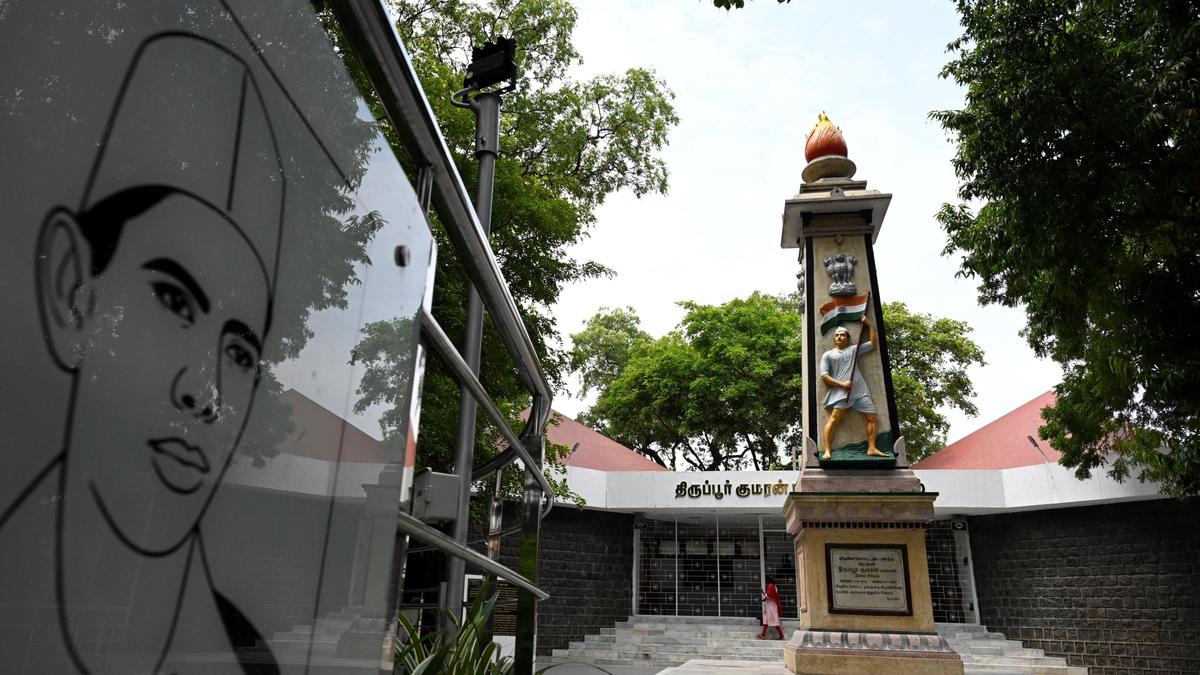
Paintings of Tiruppur Kumaran at the memorial hall near the Tiruppur railway station
| Photo Credit:
S. Siva Saravanan
While accepting the blows of the police, the Tiruppur satyagrahi upheld the tricolour flag that symbolised the national movement and refused to part with it. He was N. Kumarasami, also known as Tiruppur Kumaran. As he held the flag aloft without letting it touch the ground, he came to be called “Kodi Kaatha Kumaran (Kumaran who protected the flag).” He went on to become a symbol of those who laid down their lives for the sake of the political freedom of their fellow countrymen.
Who was Kumaran?
According to a Tamil biography authored by B.S. Sundaram, a freedom fighter and the leader of the agitation team that led a demonstration in Tiruppur on the fateful day (January 10, 1932), Kumaran was born on October 4 in Chennimalai, now in Erode district, to a modest weaving family belonging to the Senguntha Mudaliar community. He could study up to the fifth standard, after which he took to the traditional occupation. In 1923, the 19-year-old married Ramayee, who was aged 14. He migrated to Tiruppur, where he worked for six years as a clerk at a cotton ginning mill.

The biography, which was published on Independence Day in 1950, states that Kumaran, who wore only khadi clothes when he migrated to Tiruppur, was very eager to participate in the Vedaranayam Salt March of 1930, which was led by C. Rajagopalachari (C.R. or Rajaji) but was prevailed upon by his parents and employer not to take part in the event. However, his interest in the national movement was such that he started getting involved in various stirs. He became a member of the Tiruppur Desabandhu Youth Association. Noticing Kumaran’s growing interest in the freedom struggle, his friends and relatives taunted him for his acts. He continued to engage himself in the activity within a short period of the death of his father, Natchimuthu Mudaliar, in 1931.Yet, he remained unwavering in his focus.
In fact, the biographer Sundaram mentioned that at the time of the fateful agitation, only his mother, Karupayee Ammal, was in town and not his wife, who had gone to Kumarapalayam. “Had she been there, she would have attempted to prevent Kumaran from going ahead with his decision,” the biographer pointed out.

Fateful day
As has happened on many occasions, the person who was supposed to lead the agitationists in Tiruppur had dropped out on the morning of January 10. At about 5 a.m. that day, a couple, who had migrated from Gujarat for livelihood and were enthusiastic participants in the national movement, were picked up by the police and produced before a sub-collector in Pollachi. Eventually, the responsibility of leading the satyagrahis, numbering nine, fell on the shoulders of Sundaram.

Tiruppur Kumaran
Kumaran volunteered to be in the forefront of the processionists, who went around Tiruppur, which was still a small town of Tamil Nadu then. Women at a few places had performed “arati” (traditional way of welcome) and provided their moral support. When the satyagrahis reached the town’s police station on the main road, 30 police personnel and two officers pounced on them without giving any warning, recounted Sundaram.
What followed was a “rain of lathis.” Kumaran, having led the processionists, bore the brunt of the attack. The portion of the brain above the left ear was fractured. Some more blows were given on that spot. Even when he fell on the ground, he held the national flag tightly in his right hand. Another satyagrahi, who also received a lethal blow, was R. Raman Nair. Talking of the other martyr, Sundaram observed that it was on Nair’s suggestion that he agreed to lead the stir. Nair had also participated in the Civil Disobedience movement earlier and had been imprisoned. As Kumaran and Nair lay lifelessly on Tiruppur’s main road, the policemen, using their shoes, trampled on them. As a postmortem was conducted the next day, the government’s records state that the date of Kumaran’s death is January 11, 1932. His funeral was carried out almost in a clandestine manner, with the administration permitting only two persons to carry his body and not allowing other mourners to take it in a procession openly.
Tamil scholar M.P. Sivagnanam, popularly known as Ma.Po.SI, in his seminal work on Tamil Nadu’s role in the freedom struggle – Viduthalipporil Tamizhagam (Volume Two) – pointed out that the circle inspector, Mohammed, who carried out the attack, was transferred out of Tiruppur. “This was not a punishment to him. But it was protection to him from the people of Tiruppur who trembled with rage,” the scholar wrote.

A bust of Tiruppur Kumaran at the memorial hall
| Photo Credit:
S. Siva Saravanan
Memorial pillar
In no time, the Congress party had, in Coimbatore, Tiruppur, and many other parts of the State, begun holding events to perpetuate the memory of Kumaran. His birth anniversaries were observed as “Volunteers’ Day” and the death anniversaries as “Kumaran Day.” In January 1948, Cutchery Road, where Kumaran was beaten to death, was named after him and the local body decided to put up a statue too, according to a news item published by The Hindu on February 5, 1948.
On August 18, 1957, a pillar in memory of Kumaran was unveiled by then Chief Minister K. Kamaraj near the Tiruppur railway station. “The stately column is erected near the Tirupur Railway Station at a cost of Rs.[₹] 8,000. It is 25 feet in height with a torch at the top and depicting the picture of a volunteer holding the Congress flag. The pillar is erected in view of the centenary celebrations of the freedom struggle,” reported this daily on August 20. The event was attended by Finance Minister C. Subramaniam, Sundaram, and Kumaran’s nephew, Lakshmanan.

In January 1965, as part of the centenary celebrations of Lala Lajpat Rai, the wives of Kumaran and Vanchinathan, who assassinated, in June 1911, the then Tirunelveli Collector and District Magistrate Robert William D’Escourt Ashe, were honoured at an event at the Rajaji Hall, Chennai. A gold-plated silver medal and a white khadi silk saree were given to each of them. While Vanchinathan’s wife Ponnambal received the award, Ramayee did not make it, but her sister-in-law did.
In October 1979, while participating in a conference of freedom fighters on the Tamukkam grounds in Madurai, then Chief Minister M.G. Ramachandran announced that his government would give a grant of ₹10,000 to Ramayee, besides providing her with a monthly ex gratia grant of ₹300 to ₹500. In April 1991, the State government built a memorial, containing photographs and exhibits concerning Kumaran and freedom fighters of Tiruppur district.
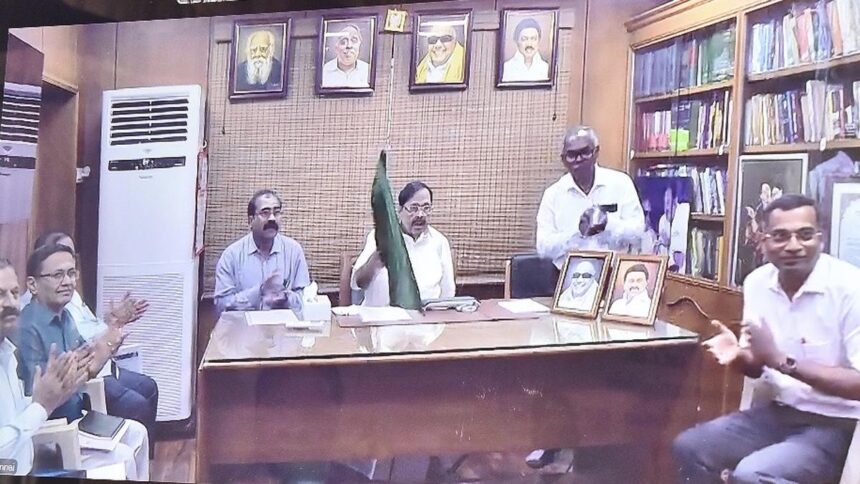
In April 1998, Ramayee died, and her mausoleum is located on the memorial complex. On the occasion of the martyr’s birth centenary in October 2004, the Postal department brought out a stamp on him. In October 2025, the foundation stone was laid in Chennimalai for a Kumaran memorial to be built at a cost of ₹2.5 crore.
Though 95 years have gone by, the legacy of Kumaran lives on.