






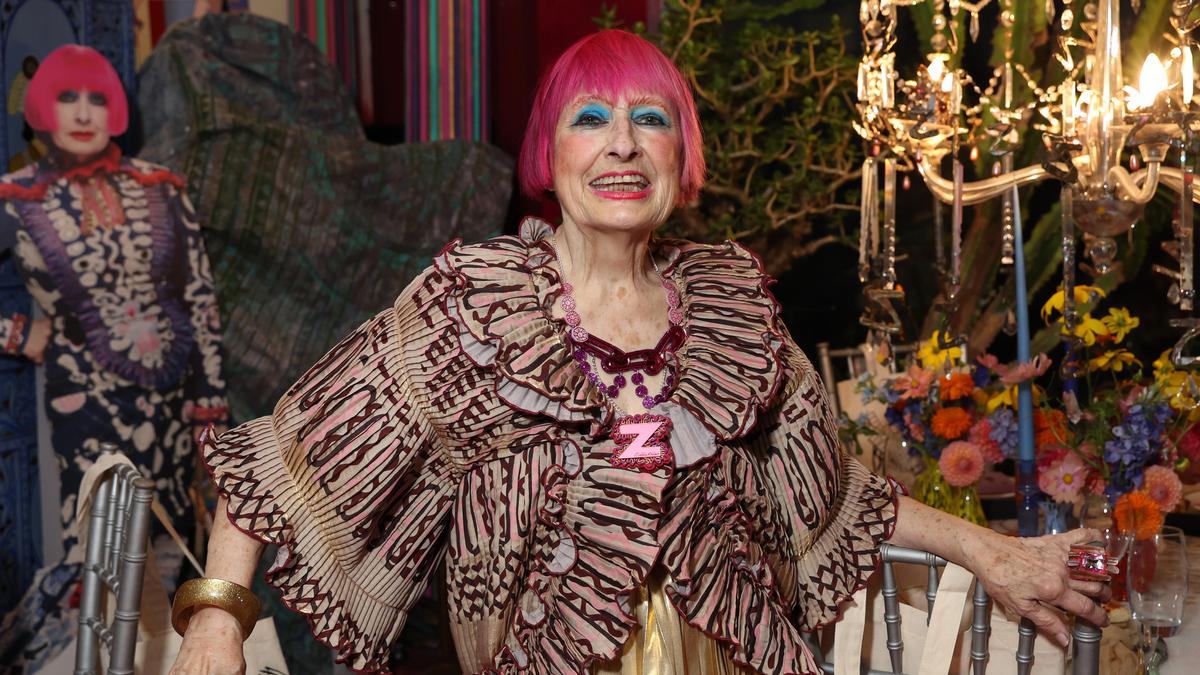

Zandra Rhodes has 100 pages of photos on Getty Images, each photo a lesson in chromatic flamboyance. It’s not just the signature hot pink hair and electric blue eyeshadow but the outsized rings and brooches, the kaleidoscopic prints and her appetite for life. When we get on a video call, she talks about her upcoming trip to India and Chennai in particular with the giddy anticipation of a first-time visitor.
One would never guess she was here in March for a talk at Bangalore International Centre (BIC), and a few months before that, for a textile and print-making workshop in Jaipur. In cheery yellow, with rings the size of quail eggs on her fingers and her hand-drawn prints as backdrop, Rhodes is curious and recalls details with startling precision. At 86, having stared down cancer, she has been known to work from 8 a.m. to 6 p.m. and is still making, exhibiting and collaborating – the last being the reason why she is heading to Chennai.

Zandra Rhodes and Elton John at The Devil Wears Prada Musical charity gala night in London
| Photo Credit:
Getty Images
Pashmina and poems
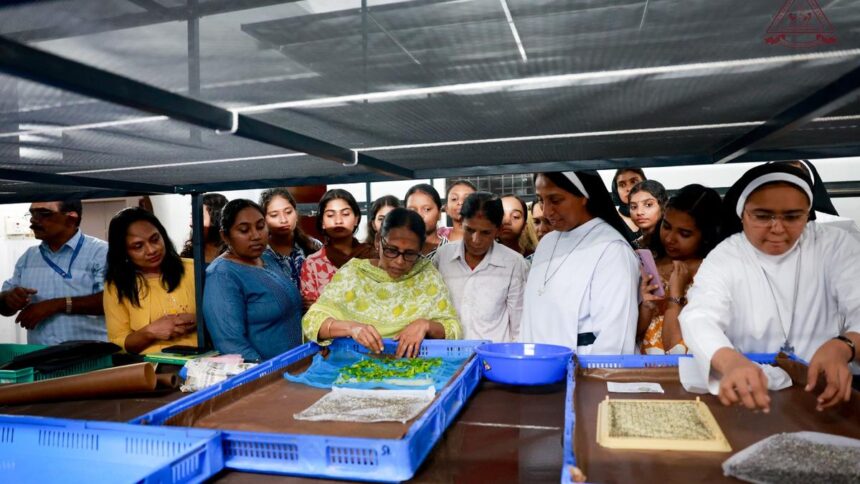
Rhodes has partnered with Tambour’s Annie Titus Mammen, whose embroidery expertise has been sought by leading European luxury houses, and with whom she has worked since 1985. Together they are presenting a limited edition of finely crafted Pashmina shawls, featuring five original Zandra Rhodes designs and translated across 35 colourways.

Annie Titus Mammen of Tambour
| Photo Credit:
Johan Sathya Das
I ask her about the first thing she will do when she arrives. Have a cup of Indian masala chai, she chuckles. But work will continue nonstop. She has an exhibition opening at De Montfort University in Leicester, where she has donated designs made for companies including Marks & Spencer, IKEA and Topshop so that students can study it. Her Zandra Rhodes Foundation is working through an archive of more than 8,000 garments, deciding where they should ultimately live. “I’m basically a textile designer who then kept finding jobs,” she says, recalling her early years.
She has often talked about being a “print designer who ended up making exotic caftans and shawls” initially, before her name became inseparable from exuberant prints, handwork, colour and sculptural clothes. Her Knitted Circle yellow felt coat from her first collection in 1969 remains her most beloved creation and an example of how her print determined the shape of her garments. Covered in beading, the coat became one of the pieces that carried her work across America and into American Vogue. This insistence on textiles as design was unusual at the time. “As I’m now quite old,” she says with a laugh, “I suppose you could say I was one of the first to point out how important textiles are.”

A beaded Manhattan dress from the AW 1985 ‘India Revisited’ collection. Rhodes donated it to The MET
| Photo Credit:
Robyn Beeche | Courtesy Zandra Rhodes Foundation
Lessons in saris
When Rhodes first came to India in 1981, she encountered something that she felt Britain was in danger of losing: the continued presence of handicrafts and handlooms. She was introduced to India not simply as an aesthetic but as a network of people and processes by designer and scenographer Rajeev Sethi, for the Festival of India. She tells me how the sari, in particular, “an art form in itself”, changed something for her. She later created a sari show that was chosen to represent India in Japan for the Festival of India there.
For Rhodes, the shawl has always offered a particular kind of theatre. “Shawls can give mystery,” she says. “You can get wonderful effects with them.” The new shawls being developed for India use some of her most recognisable motifs: ladies’ heads with elaborate hair and eyelashes, bows, flowers and words. There are peacock feathers, some drawn and some picked out with small amounts of beading. One design recalls A Field of Poems, her print of flowers and writing. The motifs come, as so much of her work does “from things in my sketchbooks that I’ve been drawing through the years”, she says.

‘Painted Lady’ from the Tambour x Zandra Rhodes collection
| Photo Credit:
Special arrangement

‘Jewelled Paisley’ from Tambour x Zandra Rhodes
| Photo Credit:
Special arrangement
Her archival designs are not necessarily there to be preserved exactly as they were. Having watched the industry pass through punk, elaborate embroidery, beaded dresses, the many cycles of fast fashion, and now the return of vintage and re-wearing clothes, she knows her archives are priceless both to design students and collectors. “We should all consider throwing away less and working out how to wear things differently so that they keep a long life,” she says.
Gen Z and Rhodes
We get talking about young designers and Rhodes says she is honoured to be still recognised for Freddie Mercury’s pleated cape that she designed. Or Princess Anne’s engagement dress, with machine embroidery and seashells. Or Princess Diana’s delicate pink dress worn when she announced her pregnancy in Japan. Rhodes’ employees are in their early 20s and when they find her old pieces online, they arrive to work excited. “The younger generation, I think, are much more curious,” she says.
Friendships and giving back
Her own history in India is inseparable from the people who made that handwork possible. Over the years, Mammen has become an important collaborator and friend. Now, she wants to return the favour, Rhodes says. “I want to give back to India what they’ve given to me because it’s widened the whole of my life.”

A photo from 1988 of Zandra Rhodes (centre, in a sari) with her models
| Photo Credit:
The Hindu Archives
That impulse is behind conversations she is having with museums in India, including MAP in Bangalore, about the heritage she and Sethi helped put together. In London, meanwhile, the Zandra Rhodes Foundation is working out the future of her enormous archive. The Victoria and Albert Museum has been giving them a wish list. The Metropolitan Museum in New York is another possibility.
Meanwhile, the pink hair
Rhodes says her pink hair and dramatic makeup was not a carefully constructed branding exercise. “It gradually grew into that,” she reveals with a smile. She first dyed her hair in 1973, liked how it felt and the colour became part of her visual identity — helped, perhaps, by Diana Vreeland’s famous observation that pink is “the navy blue of India”. Which brings us to Jaipur, where she has purchased jewellery for decades. And her most recent Indian adventure, which took her to Hampi for 10 days, sketching among the rocks.

Zandra Rhodes with American fashion editor Diana Vreeland
| Photo Credit:
Getty Images
Now Chennai beckons and she is busy planning her wardrobe for it. “When I’m in India, I have to try extra hard to make sure I can compete with all the beauty that’s going on,” she insists. The line is pure Rhodes: playful, self-aware and completely sincere. And we love her for it.
An Evening with Zandra Rhodes and Tambour at Evoluzione, Chennai, is on October 13. The collection is priced from ₹21,600.
Published – October 09, 2026 12:20 pm IST