



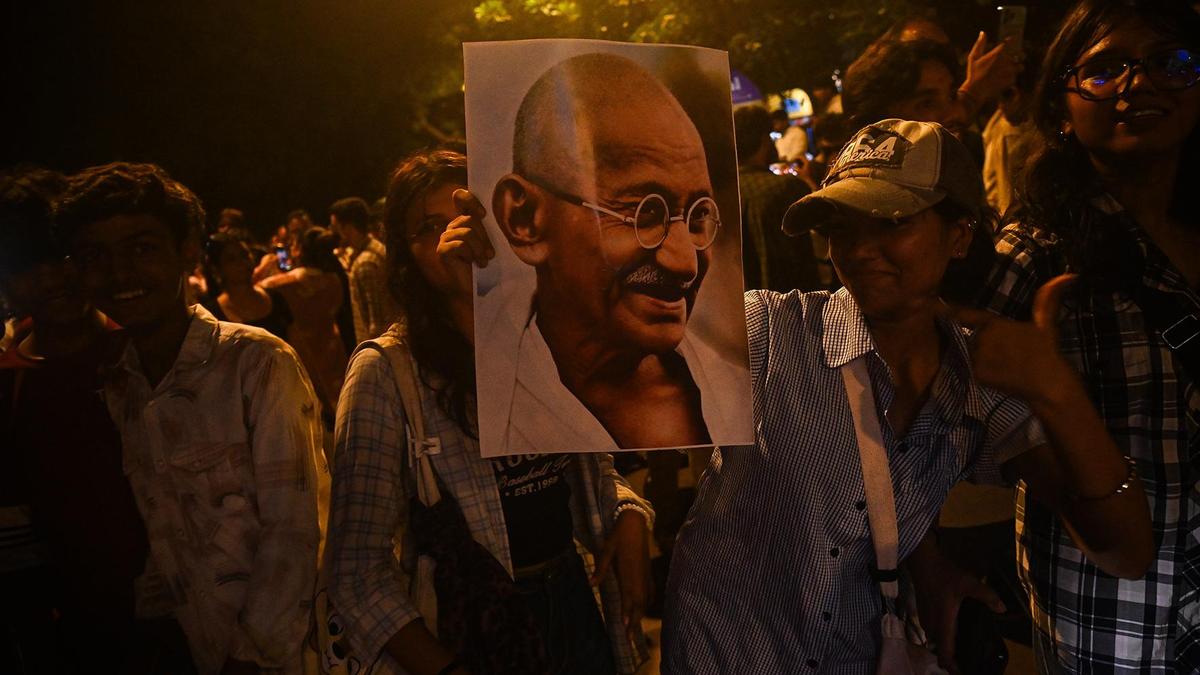

Mahatma Gandhi is back at the centre of India’s oppositional politics and public imagination. On the evening of 8 October, MPs from the INDIA bloc, including Leader of Opposition Rahul Gandhi, started a sit-in protest against India’s Chief Election Commissioner at Raj Ghat, the Mahatma’s memorial in New Delhi. At protests in Mumbai on the same issue on October 2, the Cockroach Janta Party (CJP) founder Abhijeet Dipke called Gandhi “the soul of India”. Protestors dressed as Gandhi have emerged across the country.
Citizen activists, such as the Uttarakhand resident “Mohammad” Deepak, who have defended members of the minority community against violent communal elements, claim to be inspired by Gandhi. And Prashant Kishor’s Jan Suraaj party, having opened its legislative account in Bihar and expanding to Delhi, uses Gandhi as its central inspiration alongside B.R. Ambedkar.

These are significant examples. The protests the country has seen in recent months are the strongest and potentially the most consequential in years. Mr. Rahul Gandhi and the INDIA bloc MPs appear to be effectively mobilising against the establishment. And Jan Suraaj’s focus on education and accountability is refreshing in a region where social justice has descended into cynical politics based on caste, religion, and patronage. The world’s largest democracy is experiencing a churn — as illustrated by cross-regional protests, mobilisation of Opposition lawmakers, courageous citizen action, and the emergence of a new party with a strategy to break the mould of regional politics in the Gangetic region. That Gandhi is at the heart of this churn speaks to his utility to those wishing to inject civility and decency into India’s public life, mobilise the masses for systemic change, and redefine electoral issues.
Gandhi has come back despite concerted efforts to diminish him. These efforts have come from the political right, and the purveyors of identity politics who dominate the progressive intellectual space in Indian universities, media, and public forums.

On the right, the ruling establishment recast Gandhi as the symbol of cleanliness of physical spaces — streets, offices, transport, and hospitals. The Swachh Bharat campaign put Gandhi on government letterheads. It made Gandhi visible but changed what he came to mean in the public imagination: not modern India’s tallest political leader and a source of political renewal, but a symbol for the country’s quest to cure itself of being at ease with its own filth. This was an attempt to depoliticise Gandhi, to erase the fact that he possesses ideas for radical political change.
A battle over legacy
The right wanted to replace Gandhi with V.D. Savarkar, the Hindutva ideologue, in the national public imagination. The establishment sought to elevate Savarkar’s status by diminishing Gandhi’s stature, mainly by projecting him as a weak figure who emasculated Hindu society and appeased Muslims, causing India’s partition, the loss of territory, and geopolitical disadvantage. In contrast, Savarkar was positioned as the champion of Hindu strength and uncompromising nationalism. A former Information Commissioner of India, Uday Mahurkar, has dubbed him the “father of national security”, claiming in 2021 that India had entered the “Savarkar era”.

Identity politics intellectuals and activists have trained their guns on Gandhi because of his views on race, caste, and women. Early Gandhi bought into the imperial notion of the hierarchy of humanity based on skin colour, placing the Black people below Brown Indians. On caste, while Gandhi opposed untouchability, he was unwilling to disown the varna system, which necessarily produced untouchability. And early Gandhi’s views on women, alongside his experiments in sexual restraint in old age, became associated with misogyny. To identity politics intellectuals, Gandhi is the most regressive public figure one can imagine: racist, misogynist, conservative upholder of caste, and hypocritical. His non-violence is held as a cover that sustains the ‘structural violence’ of racism, casteism, and patriarchy.
While both groups have wanted to diminish Gandhi’s global standing, the right in India has not succeeded, given that the establishment finds him useful in projecting India as a state that rejects war and promotes sustainable development internationally. They have also had to accommodate Gandhi’s appeal amongst foreign governments.
However, partisans of identity politics have successfully lessened Gandhi’s stature in academic and intellectual circles in India and abroad by placing him within intersectional politics. The claim is that European colonialism has produced a global structure of subjugation called the caste-race nexus, which Gandhi embodies most fully. Just as in the West there have been calls to dislodge statues and monuments of racist figures, like campus activism around ‘Rhodes Must Fall’, these critics have welcomed Gandhi’s fall. While the right has sought to replace Gandhi with Savarkar, for identity politics intellectuals and activists, that figure is Ambedkar. And yet Gandhi has made a comeback.

The case for relevance
India’s citizens need not deify Gandhi; they must assess him for things he said and did in his time, some of which are offensive in our changed context. But Gandhi is more than his problematic views. He had a public career of five decades. He remained relevant for that long not because of his views but because of his basic insight that to change politics, we must work on its foundations: society, community, and the individual. This is what the right in India has done vigorously, capitalising on the fact that Gandhi’s successors abandoned that space after independence. Forces that want decency and civility in public life, and accountability in politics, have discovered that they must start by changing what society should expect from politics, and that individuals should think of themselves as citizens with the right to demand accountability rather than subjects who must do as told. It is little surprise that they have found Gandhi useful. He is helping them develop those ideas and, most crucially, giving legitimacy to non-violent protest. It is proof that Gandhi survives in India’s collective consciousness. He remains relevant to any social force that seeks bottom-up political change, for which India’s neighbours too have shown a keen desire.
(The writer teaches international affairs at Shiv Nadar University, Delhi-NCR)
Published – October 09, 2026 08:30 am IST