




The Indian design fraternity gears up for its busiest time of the year, bookending the festive season. From Design Democracy in Hyderabad in September to India Design ID in Mumbai in October, and finally the AD Design Show straddling November and December across Bengaluru, Mumbai and Hyderabad. What does Indian design truly mean when materials, global design movements and markets meet in the middle?
Earlier this year, at 3DaysofDesign in Copenhagen, Indian designers confidently presented on the theme ‘Substance Over Surplus’ and ‘Make this Moment Matter’. The showcase featured 572 exhibitors from over 37 countries, with 894 events all across the city.

Pamaljeet S. and Srishti Y.
From India, Studio Pallavi, Kaikale, Amaresh Anand Designs x Magari, Naraina Studio, Morri Design, Marokk Tiles and Malai.eco presented a range of furniture and objects. Their collective showcase painted a picture of Indian design in a global context, where materiality, sustainability and the life of design objects, are intricately and inexorably intertwined.

Signe Byrdal Terenziani
We spoke to Signe Byrdal Terenziani, managing director and CEO of 3 DaysofDesign, and Pamaljeet S. and Srishti Y.of Punjab-based Studio Pallavi. The studio represented the country at this year’s showcase on how Indian design and its unique material memory add to the global design space in 2026. Edited excerpts:

In 2026 what did the participating Indian studios bring to the table?
 Terenziani: Creators and makers from India demonstrated that craftsmanship can inform the entire design process. We saw this in the work of Kaikale, where classic Indian carpentry merged with Scandinavian design principles. The featured work was manufactured with coconut, a non-forest timber, reflecting a cultural view that ‘every part of the tree finds a place in daily life’.
Amaresh Anand Designs x Magari referenced the monumental columns of Hampi’s temples and the stunning colour palette of traditional Channapatna lacquer work. Narania Studio launched their new India Collection with handmade ceramic tiles, using glazes from local artisans. Not to mention the initiatives on display as part of Material Matters, such as Malai Biomaterials, grown from coconut waste.
Pamaljeet: This year’s theme spoke the same language as us of slowing down, enjoying the present and really value what matters in the long run. It helped us [Studio Pallavi] get an insight into how the global audience reacts to our craftsmanship, widened our outlook of how perceptions change, and what connects with people irrespective of ethnicity.
Can the experience of objects reveal layers of craftsmanship, championing design aesthetics of unique craft languages?
Terenziani: The important thing is to create opportunities for people to understand the thinking, culture, people and craftsmanship behind the objects. Within the exhibition, at Asia House, The House of Making invited visitors to explore sketches, prototypes, raw materials and tools behind finished objects.
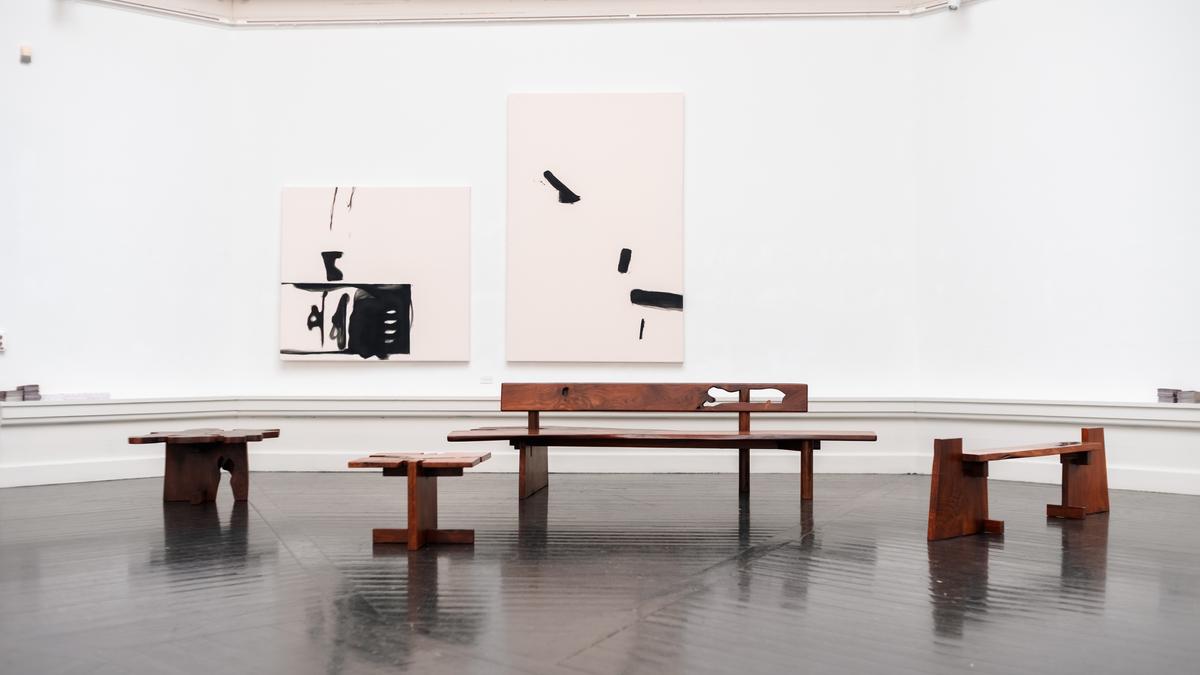
Srishti: [Studio Pallavi’s rosewood collection] pieces let you experience the tree, how it grew, from which point did it divide, its grains, the marks it earned in the course of its life and so much more with every next moment spent with it. We do not force orthogonal forms nor do we hide what is commonly labelled as ‘imperfection’; rather it is ‘ornamentation’ for us. Likewise, they don’t even dictate the function — one can sit, gather, lie, use it as a decor or place something on it. They do not tell the user which room or even the kind of setting they belong to. In this age when every answer is provided, the pieces urge us to slow down and let the body decide.
How did the work of Studio Pallavi make an impression on this year’s curation?
Terenziani: Studio Pallavi’s ‘Holding Space’ [collection] had objects made from aged rosewood sheesham, a tree native to Punjab. The collection celebrates the preservation of natural wood patterns and variations in tonality. The result is a series of low, organic forms that reflect traditional Indian ways of sitting, such as tables that double as resting place. In that sense, the work suggests that making a moment matter is about presence and creating objects that intuitively connect us to spaces and each other.
Pamaljeet: The four pieces — Rafaq, Chaukor, Matsya and Aks — showcase scale, single versus flat-pack pieces, different joineries, etc. As one does a deep dive into the history of India, it was always maximal in expression but minimalist in how lives were lived before colonisation. There were conscious choices, large families shared sparse resources and found a multiplicity of uses for the same object.
What does craftsmanship mean in today’s design syntax ?
Terenziani: In my opinion, an object becomes much more meaningful when you understand the hands of the maker. The time-honoured skills, the history, heritage and cultural significance. Most of all, the care involved in creating it. Craftsmanship is, to a great extent, intrinsic to Asian aesthetics. It’s a story worth telling, adding value to people’s experience and the emotional connection to a design.
Srishti: This event puts Indian furniture design on the global map, not mass produced nor carrying the surface-level interpretations of historical forms…
The freelance writer is based in Chennai.
Published – October 09, 2026 05:04 pm IST