




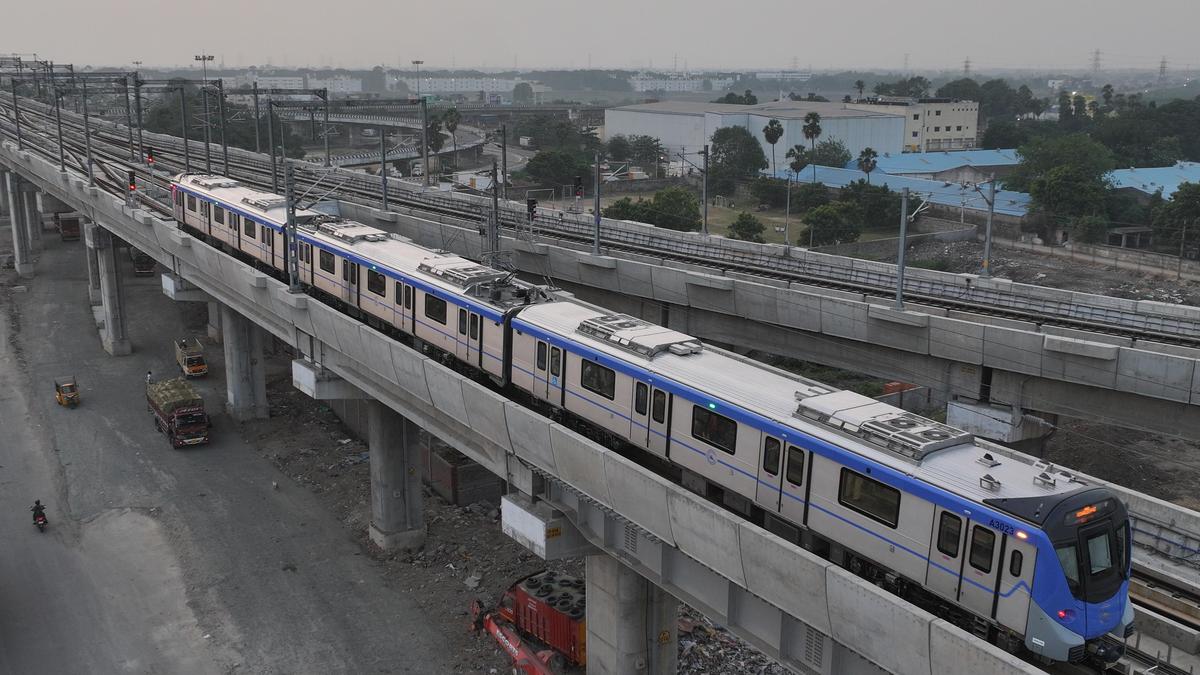


The phase II network from Poonamallee to Vadapalani is set to improve mobility significantly.
| Photo Credit: JOTHI RAMALINGAM B
A journey between Poonamallee and Vadapalani, which used to take nearly an hour by road in peak-hour traffic, can now be covered in a little less than 40 minutes on the newly-inaugurated Poonamallee-Vadapalani stretch of the Chennai Metro Rail’s phase II network.
The initial euphoria was seemingly high, with thousands of commuters from various parts of the city looking to take a ride on the 14.6-km stretch, not only to experience the newly-inaugurated phase II network, but also to gauge how fast one could commute between the two localities.
Be it travelling for work, shopping, or watching a movie, or shuttling between the western suburbs of the city or its core areas, the phase II network from Poonamallee to Vadapalani is set to be a game-changer for commuters, as mobility will improve significantly.
Thiruvikraman, a resident of Kattupakkam, had been eagerly awaiting the opening of this stretch and tracking its progress for quite some time now. The Kattupakkam Metro Rail station is less than five minutes away from his residence. “Earlier, I would dread commuting to Vadapalani during the peak hours, since it would take me an hour. During weekends, I wanted to go to the mall in Vadapalani with my family. It was not only a difficult commute owing to traffic congestion, but also the cab ride cost me ₹300-₹400. The new stretch would be quite convenient for me,” he said.
Engineering students Harshita B. and Boomika D. were among the first to arrive at the Poonamallee Bypass station. They often commute from their residence in Nazarathpet to Vadapalani and Anna Nagar by bus. “The bus ride will take about an hour owing to traffic. But now, we are excited that this new stretch is operational. The fare is reasonable, and the travel time is significantly less,” Ms. Harshita said.
The phase II network has several new features, such as charging points, half-height platform screen doors in the elevated stations, and digital route maps. Unlike the phase I network, in which the trains had a separate ladies coach, the phase II network has three-coach trains, with half a coach demarcated with a pink-coloured belt and hand grips.
Published – October 11, 2026 11:26 pm IST