






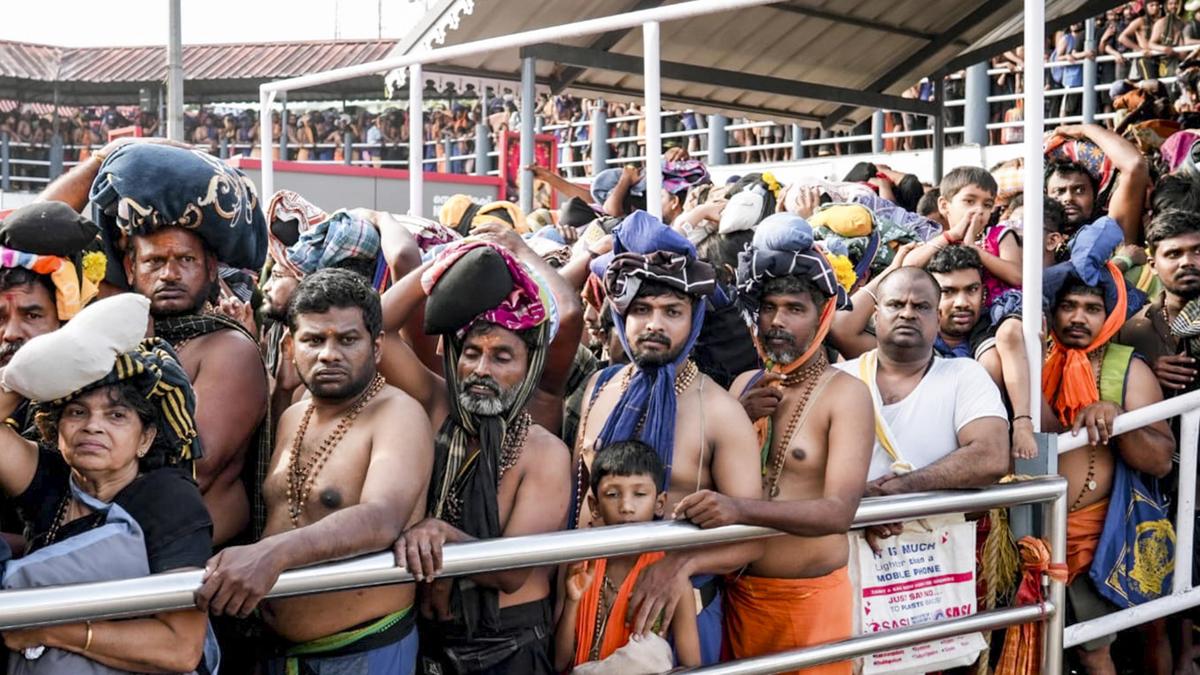

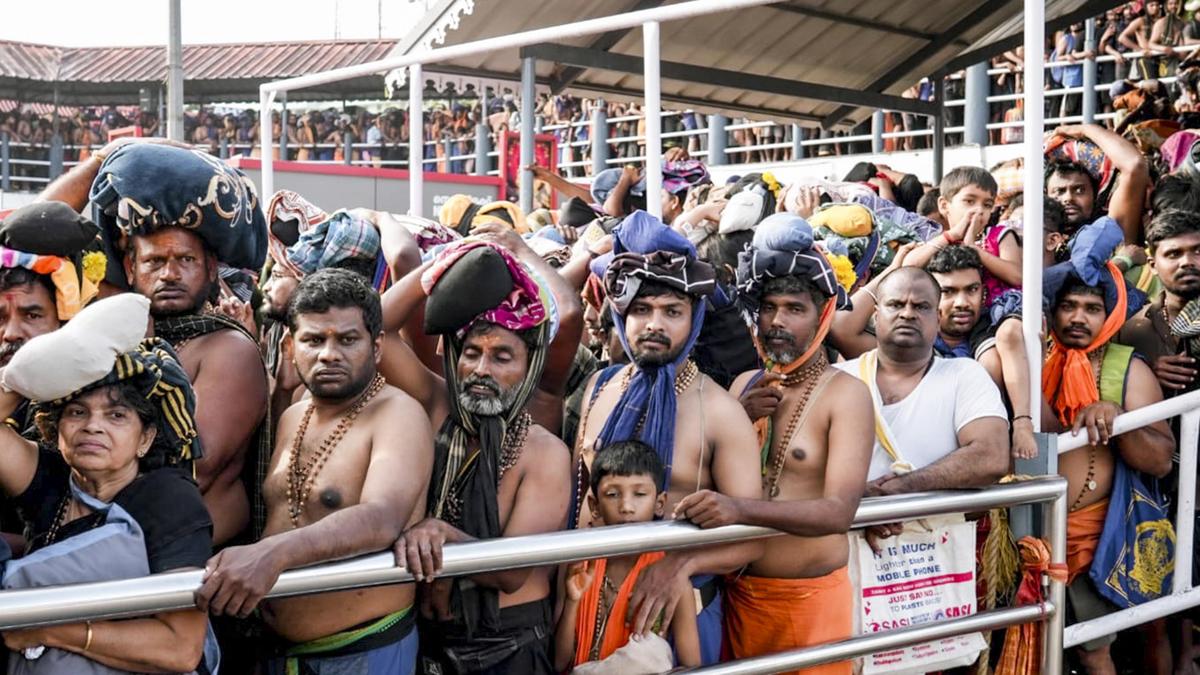
People wait in queues to offer prayers at the Sabarimala temple on Tuesday.
A significant number of lives are lost following cardiac arrest or heart attacks during Sabarimala pilgrimage every year even though the Health department does its best to provide all possible emergency cardiac care facilities as well as the expertise of cardiologists.
This year, however, what has been unusual is the pace at which cardiac deaths seem to be happening, which has the authorities particularly concerned.
“Every year, lakhs visit Sabarimala. Our figures over the years reveal that during every pilgrimage which lasts over two months, on an average, some 150-odd cardiac events occur, resulting in about 40-42 deaths. This year, in the first eight days of the pilgrimage itself we have had eight cardiac deaths and another death by drowning,” says Bipin Gopal, a senior health official in charge of the Sabarinmala arrangements this year.
“We have looked at our data over the years and while there are some common factors — comorbidities, uncontrolled risk factors and an age group generally ranging from 40 to mid-60s — all acute cardiac events were triggered by exertion. In almost all cases, the persons just collapsed and were brought dead to the hospital. However, we have also managed to save at least double the number of lives that we lose every year,” says Dr. Gopal.
Cardiologists point out that sudden and strenuous physical activity can precipitate heart attacks, during the exertion or within an hour after the activity. Most of the cardiac events during the pilgrimage are triggered when people try to climb briskly and the unusual strain can lead to angina or heart attacks or sudden arrhythmic deaths.
Breaks during steep climb
“People are almost on a run from Pampa and many of them try to make it to the top at one stretch, which is extremely dangerous, especially if they generally lead a sedentary lifestyle. The Neelimala-Appachimedu stretch is quite steep and strenuous and it is always better that one takes as many breaks as is required so that there is no over-exertion,” health officials say.
The Health department has printed and disseminated a detailed health advisory this year also in six languages, which stresses that people who undertake the pilgrimage should not discontinue their medications and that they should take plenty of rest during the trek.
Cardiologists also point out that people who have suffered cardiac events are very careful during the pilgrimage and it is people who are apparently “healthy”, who disregard commonsense advice who end up suffering acute cardiac events.
Deployment of care facilities
The Health department has full-fledged cardiac care ICU facilities, including with thrombolysis facility at four places enroute the trek, at Appachimedu, Neelimala, Pampa and at Sannidhanam and in between there are 24 emergency medical centres, all with AED machines (automated external defibrillators). Full medical teams, including cardiologists, surgeons, pulmonologists, general medicine, anaesthesiologists and orthopaedics are also available here
However, cardiac deaths continue to happen because much time is lost between identifying the problem to be serious, informing the police, transmitting the message to volunteers and then getting the individual to one of the cardiac facilities. The crowd and the terrain makes it all the more difficult. Acute emergencies which require high-end care are stabilised and sent to the Kottayam Medical College Hospital in ambulances.
“We have seriously contemplated introducing a stricture that people who come for the pilgrimage produce a recent medical fitness certificate but that poses a lot of practical issues, given that people come in lakhs and that they reach the hill shrine taking various routes. It was suggested this year that we set up a full-fledged Cath lab at Sannidhanam hospital. But one should remember that these elaborate medical facilities are operational just for these two months,” a senior Health official said.
Precautions
Some diligence and caution can make the pilgrimage safer. People should start preparing themselves for the strenuous trek at least a month ahead by taking regular walks; not defaulting on their regular medications and ensuring that they take the trek at a steady,comfortable pace. Taking rest in between and not attempting the trek on a full stomach helps. Signs of exertion such as excessive sweating or vomiting should not be ignored and help should be sought immediately.
Published – November 25, 2025 08:28 pm IST