






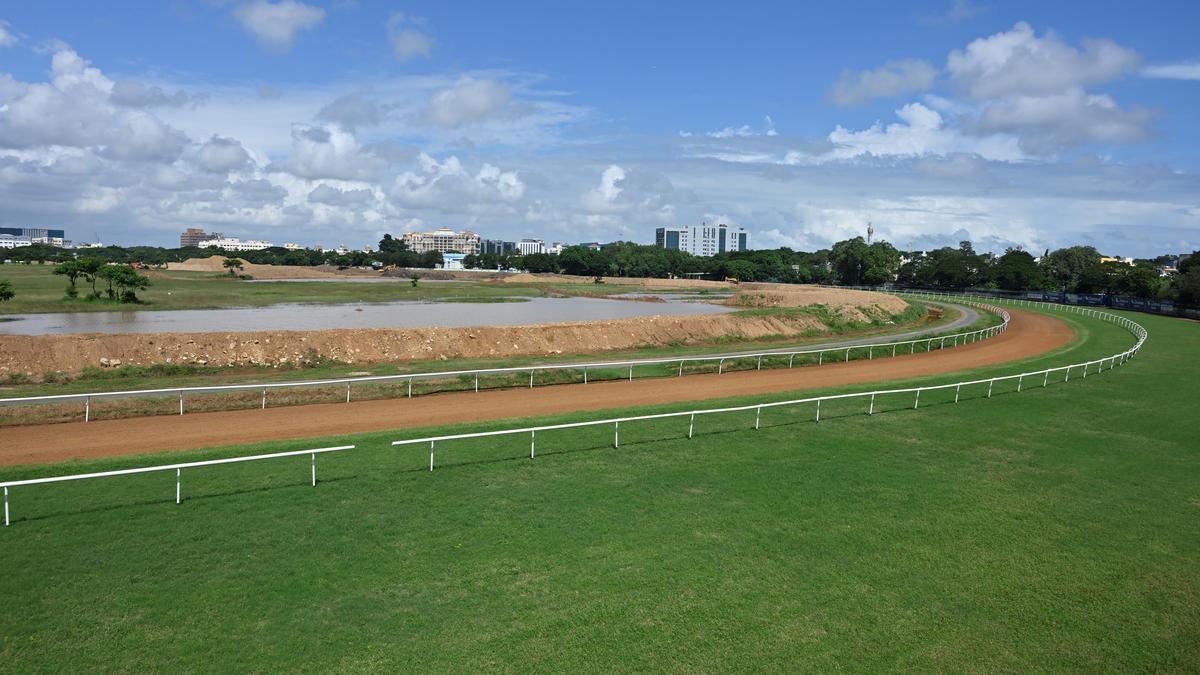

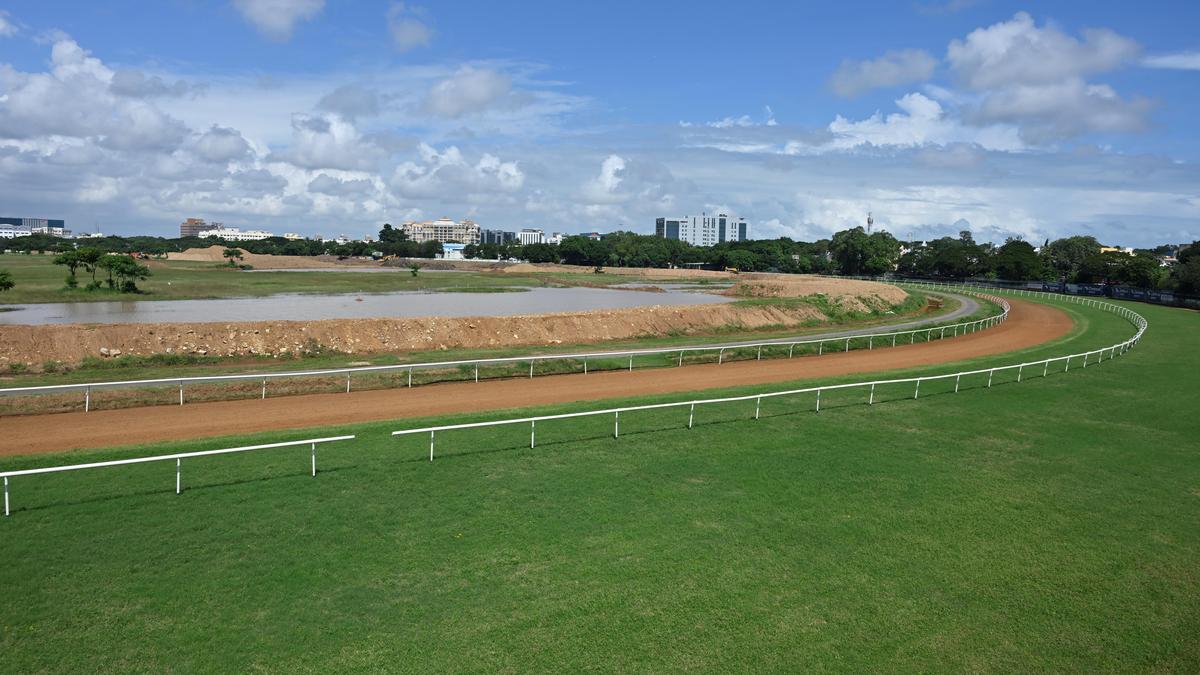
Chennai, Tamil Nadu, 04 December 2024: View of pond at The Guindy Race Course after the Northeast monsoon preparedness work in Central and South Chennai by Greater Chennai Corporation. photo: Akhila Easwaran/ The Hindu
| Photo Credit: Akhila Easwaran
Chennai desperately needs the proposed eco-park and multiple ponds on the sprawling 160.86 acre government property, that had been leased out to Madras Race Club (MRC) during the British era, at Guindy to prevent catastrophes such as the massive damage caused to the city during the 2015 floods, the Madras High Court has said.
A Division Bench of Justices S.M. Subramaniam and Mohammed Shaffiq wrote: “Eco park is intended to serve multiple purposes. Firstly, it is intended to mitigate the risk of flooding, which the city increasingly faces with each passing monsoon. Secondly, it is necessary to reiterate the grave concerns surrounding air pollution and Air Quality Index (AQI) levels, reduction of which forms a central part of the rationale behind the eco park.”
Stating air pollution was not merely an environmental issue anymore, the judges agreed with senior counsel P. Wilson, representing Tamil Nadu government, that it had become a public health emergency. “The experience of the citizens of Delhi in the recent past is a stark reminder, where escalating AQI levels have led to lockdowns, closure of schools, disruption of public life, and severe health impacts,” the Bench said.
Allowing a State appeal against a status quo order passed by a single judge in favour of MRC, the Division Bench said, the establishment of the eco-park on the Guindy property would also promote tourism and serve as a natural habitat to several species of flora and fauna. The Bench agreed with the State that the eco-park and ponds had been conceived in public interest and therefore, the status quo order could not stand in the way.
Authoring the verdict, Justice Shaffiq pointed out that a report titled ‘Chennai Floods 2015 – A Rapid Assessment,’ prepared by the Interdisciplinary Centre for Water Research, Indian Institute of Science (IISc) in Bengaluru in May 2016, had highlighted the adverse impact of rains and consequential damage caused by the 2015 floods due to mushrooming constructions on marshlands/wetlands in Chennai.
The report sated the large scale devastation across Chennai, Kancheepuram and Tiruvallur districts had claimed more than 400 lives in November-December 2015. Over 4 million people were affected due to the floods and nearly 1.8 million were displaced. Around 1.7 million had to be accommodated in 6,605 relief camps and the estimated economic loss was approximately $3 billion.
More than 3.042 million families suffered damage to their dwellings and nearly 30% of Chennai households incurred individual losses ranging between ₹2 lakh and ₹20 lakh. “The report further records that industrial and commercial operations came to a standstill with the Chennai airport remaining closed between December 1 and 6 and losses arising solely from halted industrial production was nearly ₹15,000 crore.” the Bench said.
The judges recorded the submissions of Mr. Wilson that the four ponds that have already been dug on the Guindy property would mitigate adverse impact of floods in future in Velachery, Adambakkam, Madipakkam, Guindy, Pallikaranai and other adjoining areas in the city. Further, the proposed eco-park on 118-acres would provide the much required lung space.
“The above submissions on the objective behind development of ponds and eco park as part of flood mitigation measures to alleviate the adverse impact of floods would serve and promote larger public interest. This underscores prima facie the need to ensure that the above works are not hindered in any manner, moreso by judicial orders,” the Division Bench said and modified the order of status quo.
Published – December 01, 2025 01:36 pm IST