






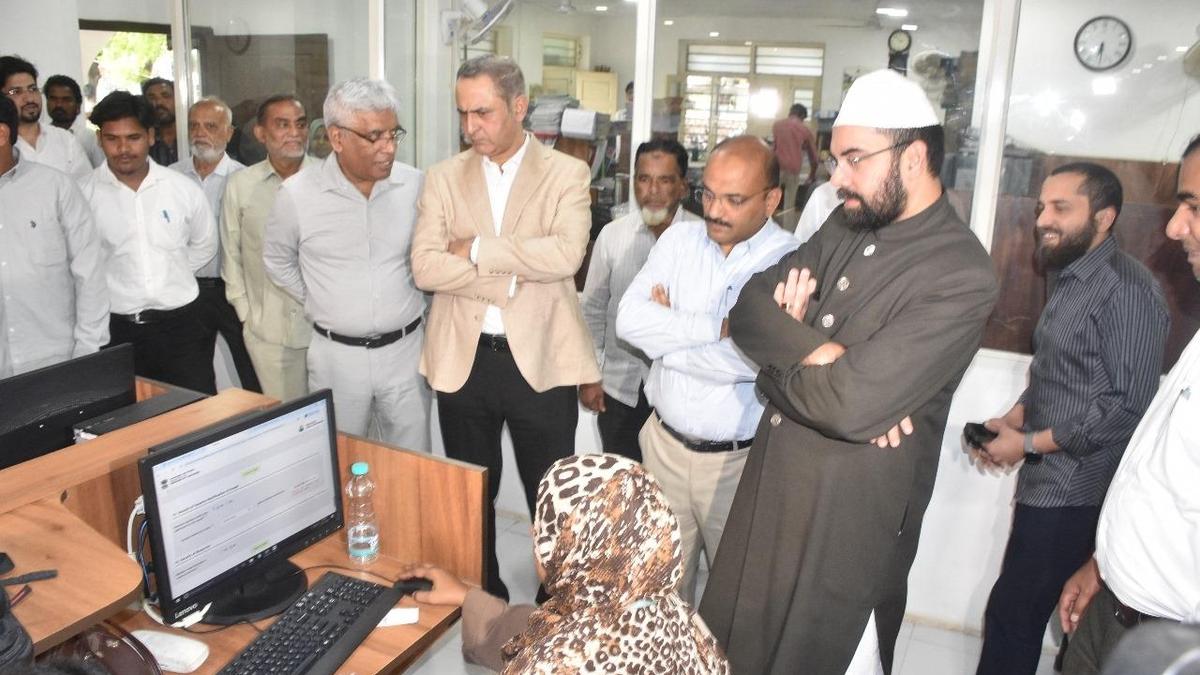

The chairman of the Karnataka State Wakf Board Syed Muhammad Ali Al-Hussaini taking stock of the ongoing work of digitising Waqf properties under the UMEED Portal. (Image used for representative purpose only)
| Photo Credit: Arun Kulkarni
The Supreme Court on Monday (December 1, 2025) refused to intervene in a batch of petitions seeking extension of time for the mandatory uploading of registered waqf properties, including ‘waqf by user’, with the UMEED portal.
A Bench comprising Justices Dipankar Datta and Augustine George Masih gave petitioners liberty to approach the waqf tribunal concerned.
The Centre had launched the Unified Waqf Management, Empowerment, Efficiency and Development (UMEED) portal on June 6 to create a digital inventory after geo-tagging all waqf properties. According to the mandate of the UMEED portal, details of all registered waqf properties across India are to be mandatorily uploaded within six months.
The petitioners argued that the portal was faulty and was not recording details when uploaded. They said the deadline was coming to a close on December 6, and there would be a huge loss of property unless the Supreme Court intervened.
The Bench said it cannot re-write Section 3B(1) of the Unified Waqf Management, Empowerment, Efficiency and Development Act, 1995 by extending the time of uploading the details of waqfs by another six months.
Senior advocate Kapil Sibal sought liberty to file an application in future in the Supreme Court if the process ran into a hiccup again. Justice Datta remarked that they were free to move the Supreme Court if they ran into a problem.
In September, the Court had refused to stay the Waqf (Amendment) Act of 2025 in its entirety.

The September judgment, however, did not prima facie favour the petitioners’ arguments against the mandatory registration of waqfs.
“Right from 1923, in all the waqf enactments we have referred to, there was a requirement of registration of waqfs. We are, therefore, of the view that if Mutawallis for a period of 102 years could not get the waqf registered, as required under the earlier provisions, they cannot claim that they be allowed to continue with the waqf even if they are not registered,” the Supreme Court had observed.
Published – December 01, 2025 01:29 pm IST