





Every time she looked at her incessantly buzzing phone, Nafisa (name changed), 23, a college student in Delhi, found either a graphic rape threat, an Islamophobic slur, or hundreds of missed calls from unknown numbers. It was before her examination in 2023 and since all her documents were linked to the same phone number, she could not do away with it. “They said they knew where I live. I even stopped going out to the balcony,” she recalled. Two years on, she added, “I don’t ever want to go back to Delhi.”
The phone calls and text messages started after she said something that “some men did not like” on her Instagram handle, a screenshot of which was shared widely along with her phone number and photos. “There were groups of men which would specifically target Muslim women, and I became their prey. They circulated my phone number and photos with captions like ‘call her for a good time’. I received 800-1,000 calls a day,” she said.
Still reeling from the trauma, Ms. Nafisa is not alone in her struggle. From cyber stalking, doxxing (circulating private information), morphed images to rape threats and slurs, women in Delhi, particularly those from marginalised communities, said that the Internet is becoming a scarier place each day.
The concerning trend, however, is not reflected in national data.
The National Crime Records Bureau (NCRB) data released recently for 2023 recorded only 36 cyber crimes against women, of which 28 were linked to publishing or transmission of sexually explicit material, and eight were in the category of other women-centric cyber crimes including blackmail, defamation, morphing and fake profiles.
Few cases reported
For the same year, Delhi surpassed all other metropolitan cities in terms of overall crimes against women, with 13,366 cases. The second on the list was Mumbai with 6,025 crimes recorded against women. Among the metropolitan cities, Delhi led in almost all categories of crimes against women – from dowry deaths, rape, and kidnapping to abduction of women. The comparatively lower incidence of cyber crime, especially when the police say that they are constantly receiving such complaints, shows that the problem is not reflected in its entirety.
According to the police, this is primarily because many women do not want to take the complaint forward after an incriminating post has been taken down. Conversations with victims, however, reveal a mix of mistrust in the system, insensitive comments from officers, as well as fear and shame attached to cyber crimes, which often prevent them from going ahead with the complaints.
Vinit Kumar, Deputy commissioner of Police, Intelligence Fusion & Strategic Operations, which works on cyber crimes, said the department receives complaints every day. “We regularly receive complaints of artificial intelligence-related morphing and deepfakes, as well as abuses and harassment of women online. On our portal, women have the option of reporting it anonymously, following which, we take such content down within 36 hours. Since they are mostly anonymous complaints, we cannot go ahead and file FIRs.”
Another police officer said there would be hundreds of complaints every year in every district, but not many go ahead with an FIR, adding that the numbers will increase in the coming years as they are working towards spreading awareness. Across university campuses, such as Jamia Millia Islamia and Delhi University, the police and the universities have been conducting cyber safety drives.
In some cases, the crime isn’t limited to online harassment. Last month, a student from South Asian University (SAU) was assaulted by four men on campus, according to her police complaint. The incident began with an email with a morphed photo of her. Threatened that the photos would be shared with the entire campus, she agreed to meet him and that is when the physical assault took place, she said in her complaint.
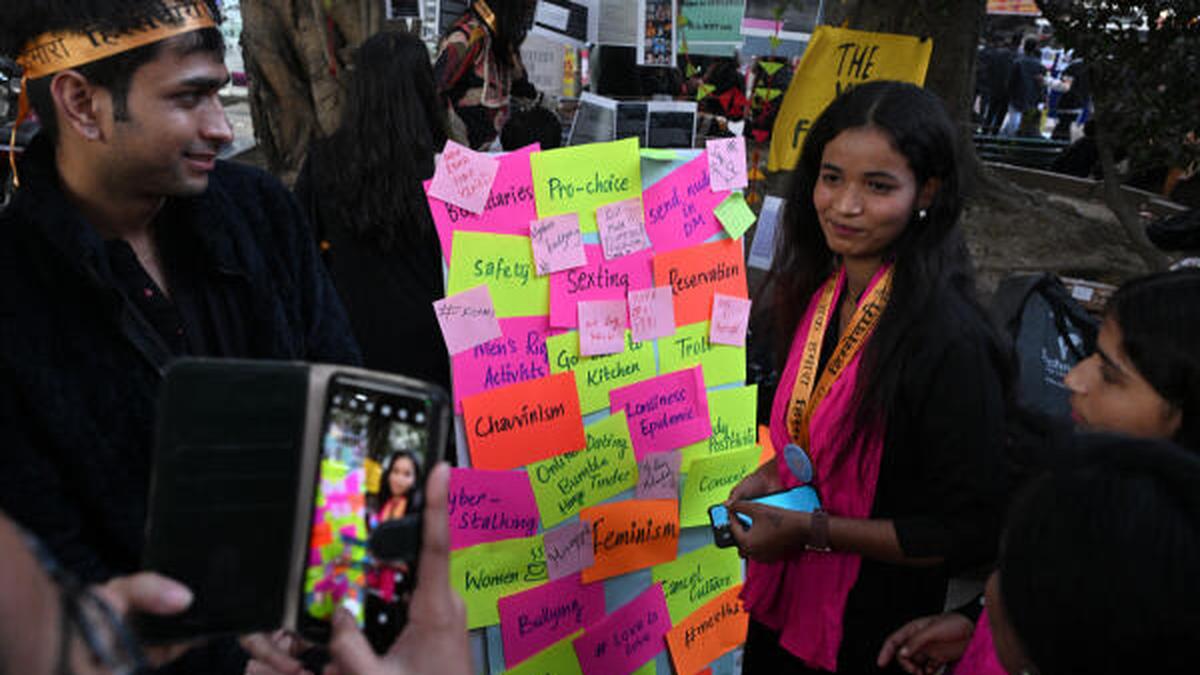
An increasing number of such incidents led a group of NGOs, feminist and queer groups to choose technology-facilitated gender-based violence (TFGBV) as the theme for an annual gathering on November 25, which took place at PVR Anupam Market in Saket. Lora K. Prabhu, managing director, Centre for Equity and Inclusion, the organiser of the event, said, “We chose this theme because it is critical to discuss it. Even as organisations working in the sector, we are still not clear on what counts as TFGBV.” What is clear, she adds, is the fact that such cases are on the rise.
“What happens in the outside world, is only reflected online. We also need to look at the fact that for many women who have never expressed themselves, social media becomes a safe space to do so, which is a good thing. But this is what makes them so vulnerable,” she added.
‘Attacked because of my identity’
When a 26-year-old bisexual woman in Delhi was non-consensually added to a sex chat on Facebook, she did not know what to do about it. She said, “I stayed on the chat because the ID was of a woman, and I was afraid that if I left, they would reveal my sexual identity to my family…” She later realised that it was a man, or a group of men pretending to be a woman. Now, she is afraid of checking her inbox altogether.
Another queer Dalit woman, aged 25, said that her being opinionated online, invites daily casteist slurs and hate. “I go online because I love memes. But every time I say something, I get hate because of my identity. There was one time when a person started abusing my parents and using slurs for them too. When I complained to the police, I was told, ‘Don’t interact with such men.’”
In Nafisa’s case, physically exhausted from the calls, at a time when her examinations were approaching, going to the police itself was a challenge. Hazy on the details, she said, “I don’t remember much of it. I did not get a copy of the FIR, but the police did help in other ways. They informed the university, and after the administration got involved, the calls eventually stopped.”
But that was not the only reason why the calls stopped. She added that a friend got added to a group chat to keep an eye on what the men were saying, “Eventually, they said that I do not belong to their religion, and am already going to hell, so they should move on to someone else…”
While the police ensure that the photos or videos are taken down, the low number of recorded cyber crimes also means that the culprits remain scot-free, moving on to their next victim.
(The author is a Laadli Media Fellow. The opinions expressed are those of the author. Laadli and UNFPA does not necessarily endorse these views.)