




Activists Gulfisha Fatima, Umar Khalid, and Sharjeel Imam told the Supreme Court on Tuesday (December 2, 2025) that the Delhi Police’s claim of a coordinated “regime change operation” behind the February 2020 Delhi riots finds no mention in the chargesheet, even though it is now being projected as a central plank of the prosecution’s case.

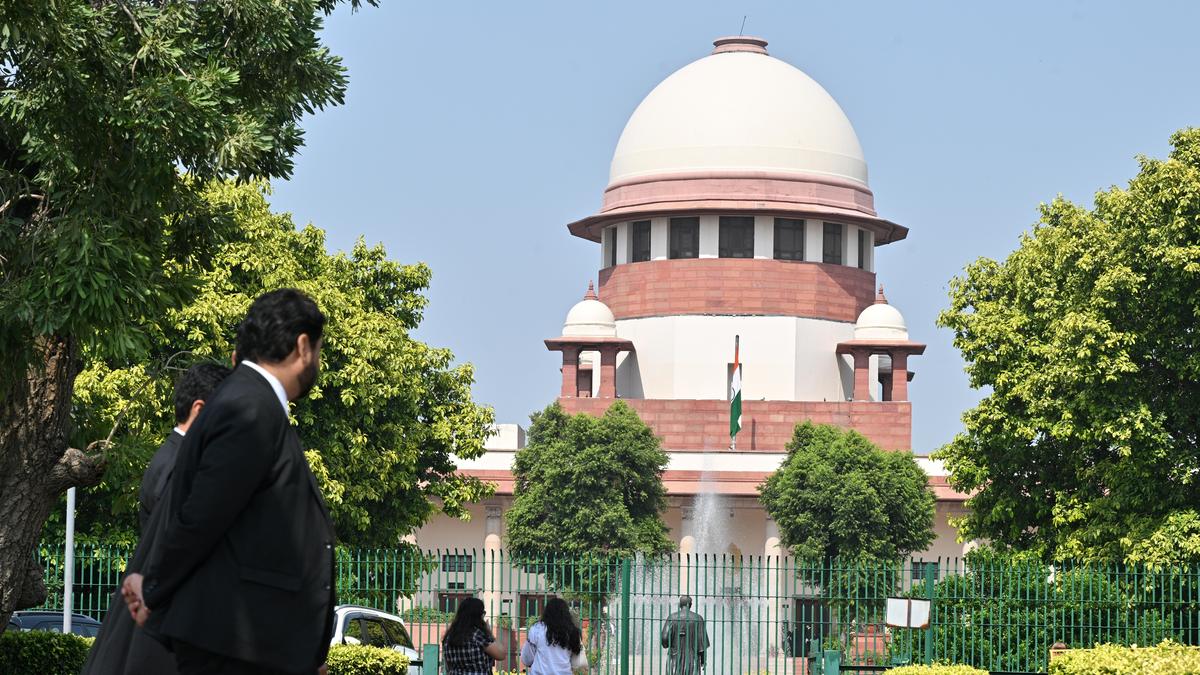
A Bench of Justices Aravind Kumar and N.V. Anjaria was hearing the bail pleas of the three activists, along with Meeran Haider, Shifa-ur-Rehman, Mohammad Saleem Khan, and Shadab Ahmed, all accused of conspiring to orchestrate the unrest, and charged under the Unlawful Activities (Prevention) Act, 1967 (UAPA).

The accused have assailed the Delhi High Court’s September 2 order denying them bail. The High Court had described their roles as “grave” and said that the evidence on record suggested a coordinated plan behind the riots, which left 53 people dead and hundreds injured in the national capital.
Commencing his rejoinder arguments on behalf of Ms. Fatima, senior advocate A.M. Singhvi submitted that his client had already spent nearly six years in custody, and described such prolonged pre-trial detention as “astonishing and unprecedented”. “Where have you alleged regime change as the heart of your chargesheet?” he asked, adding that the prosecution’s assertion of a pan-India conspiracy “to separate Assam from India” was equally unfounded.

Additional Solicitor-General S.V. Raju, appearing for the Delhi Police, had earlier argued that the scale of the violence, its degree of preparation, and the intent behind it left “no doubt” that the conspiracy extended far beyond civil demonstrations against the Citizenship (Amendment) Act, 2019. According to the prosecution, the violence formed part of a coordinated “regime change operation” executed under the guise of civil dissent.
Mr. Singhvi further stressed that Ms. Fatima is the only woman still in custody in the case, and questioned what “public interest” her continued incarceration served. “By keeping her in jail and objecting so vociferously to bail, which public interest are you serving? … How can she flee in the eyes of the Supreme Court and the whole world? What will she do?” he asked.
‘Misplaced consideration’
Mr. Singhvi also apprised the Bench that charges against Ms. Fatima were yet to be framed, and contended that such “endless custody” effectively amounted to punishment before trial. “This will make a caricature of our criminal justice system. Nobody needs to be punished like this unless they are convicted. This is a pre-trial conviction,” he argued.
The senior counsel took strong objection to the High Court’s observation that a “hurried trial” would be detrimental to the accused. “…the pace of the trial will progress naturally. A hurried trial would also be detrimental to the rights of both the Appellants and the State,” the Division Bench had held.
He likened this reasoning to the Supreme Court’s infamous Emergency-era judgment in A.D.M. Jabalpur v. Shivkant Shukla, in which the court had upheld the President’s order suspending citizens’ access to judicial remedies. Referring to Justice M.H. Beg’s widely criticised remarks in that case, describing the state’s treatment of detainees as “care which is almost maternal in nature”, Mr. Singhvi argued that the High Court’s approach reflected a similarly misplaced paternalism.
“This is misplaced consideration [by the High Court] for the petitioner. I would rather not have this consideration by the High Court,” he said.
Not ‘inflammatory’
Appearing for Mr. Khalid, senior advocate Kapil Sibal played in court the activist’s February 17, 2020 speech delivered in Amravati, which the Delhi Police has cited as evidence of conspiracy. Mr. Sibal argued that nothing in the address could conceivably attract charges under the UAPA, noting that Mr. Khalid had urged the audience to “respond to violence with peace, and to hatred with love”.
“You cannot attribute someone else’s speech to me and say that I am responsible for the riots… Nobody can call his speech inflammatory in any sense of the word,” Mr. Sibal submitted.
Justice Kumar then referred to the Delhi Police’s contention that the speech was “provocative” and had instigated people.
“I have placed the speech. If this is inciting, then many of us are liable to go to jail,” Mr. Sibal responded.
He further contended that such prolonged incarceration amounted to a “punitive act” by the State, aimed at deterring other university students from protesting.
“Ultimately, what is the public interest? First, if I come out, I should not do activities that endanger the state. Your Lordships have enough power to ensure that I don’t. This is punitive… What have these kids done? They were protesting… You cannot say that it is a terrorist act,” the senior counsel stressed.
‘Presumption of innocence’
Echoing such a contention, senior advocate Siddharth Dave, appearing for Mr. Imam, questioned the Delhi Police’s characterisation of his client as a “dangerous intellectual terrorist” without a full-fledged trial or even a single conviction.
“I am being labelled as a dangerous intellectual terrorist. The Additional Solicitor General said intellectual terrorists are more dangerous. Not one conviction against me. The words were used against a citizen of this country. I can understand after a full-fledged trial because I lose the presumption of innocence. But this label has caused anguish to me,” Mr. Dave submitted.
He further pointed out that Mr. Imam had been arrested on January 28, 2020, before the riots occurred, and that his speeches, by themselves, could not constitute the offence of criminal conspiracy. “This FIR (First Information Report) was registered in March 2020. For over a month, I had already been in custody. Of course it rules out my physical presence in the riots because I was in custody,” he said.
At this juncture, Justice Kumar said, “Can we take your argument that these speeches won’t constitute a terrorist act?”
Mr. Dave responded that the speeches could not satisfy the ingredients of “criminal conspiracy”, and that the prosecution would have to demonstrate an “overt act” to establish the offence.
The Bench took note of the submissions and said the hearing would continue on December 3. The Bench is expected to continue hearing the rejoinder submissions on behalf of the accused.
Published – December 02, 2025 10:24 pm IST