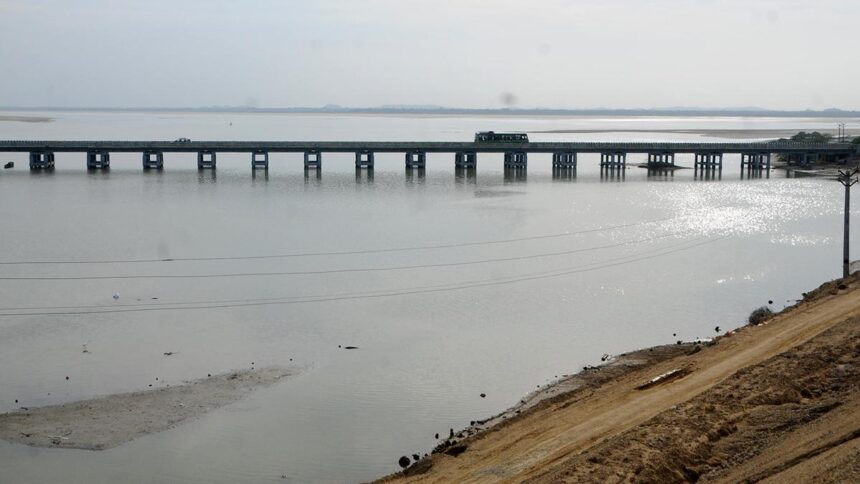







Low-pressure area intensifies over Bay of Bengal, as Chennai braces for heavy rainfall due to impact of the severe cyclone Ditwah.
| Photo Credit: B. Jothi Ramalingam
Cyclone Ditwah and its remnant stalled for several hours and moved slowly as it became trapped in a calm ‘col’ zone between two opposing anticyclonic circulations in the upper atmosphere, resulting in prolonged rainspell, noted meteorologists.
While the system was expected to move away from T.N. coast by Monday (December 1, 2025), it remained stationary for several hours and drew in more moisture, generating fresh bands of rain-bearing clouds that hit the stretch near Tiruvallur and Chennai, they said.
Read:Cyclone Ditwah LIVE updates
B. Amudha, Head (Additional in-charge), Regional Meteorological Centre, said the system, which was lodged between the two anticyclonic circulations was oscillating under the push and pull of the surrounding winds. “It is difficult to forecast such microphysical changes that happen continuously in the atmosphere, much ahead and rapid changes can be tracked only over short periods. The interactions between land, ocean and atmosphere changes contribute to cloud dynamics in a complex manner. Our understanding of the internal dynamics of tropical cyclones is not complete,” she said.
Meteorologists noted that forecasting such behaviour in the tropics is challenging, especially since weather models have limitations. Sometimes, weather models cannot predict when weather systems’ movement stalls.
Y.E.A. Raj, former Deputy Director of Meteorology, Chennai, said cyclone Ditwah was a marginal cyclone with wind speeds reaching up to 40 knots. The remarkable slowdown of the system was unexpected and movement was slow at 2-3 kmph.
Typically, depressions or cyclones slow down before recurving. This system recurved towards southwestwards instead of the usual north or east direction, which is a rare occurence for tropical cyclones. When they move northwards, the systems would pick up speed.
During the period between 1981 and 2024, only three weather systems recurved and moved towards southwest direction in November 1996, November 2013 and December 2018, he added. The delay in rainfall was due to vagaries of weather, as the system’s behaviour was influenced by rapidly changing atmospheric conditions.
Published – December 02, 2025 08:46 pm IST