






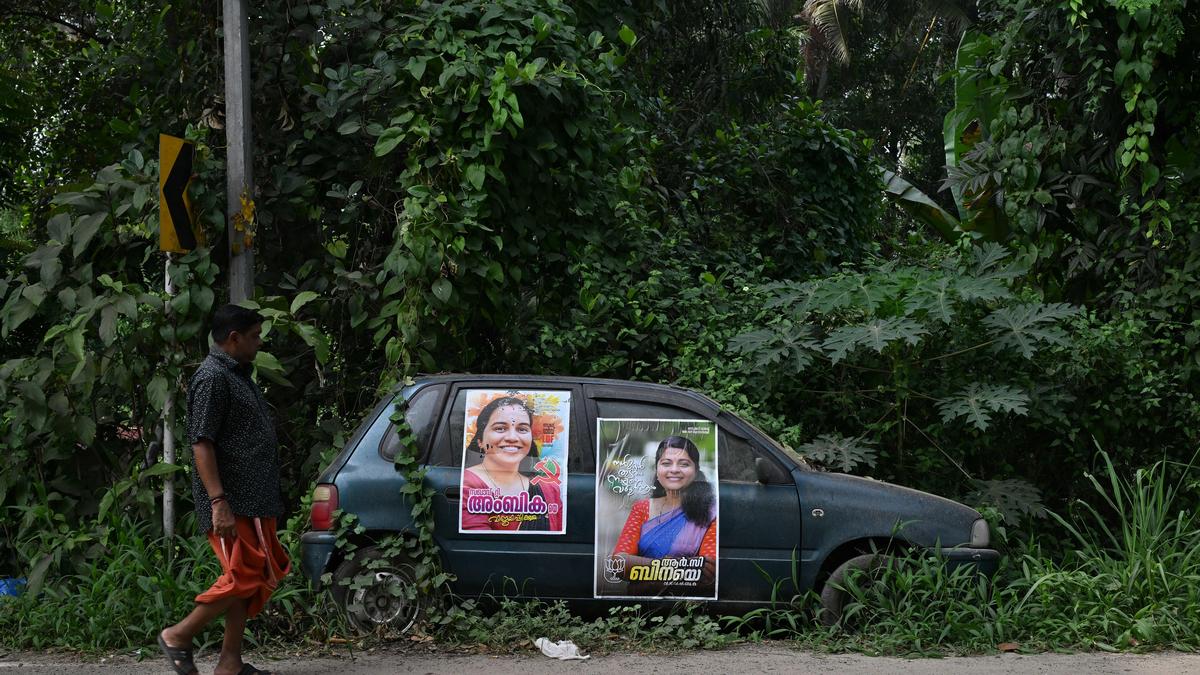

In play are six Corporations, 87 municipalities, 14 district panchayats, and 941 grama panchayats for the two-phase local body elections on December 9 and 11 in Kerala.
With less than nine days for the polls, cautious optimism appears to be abundant in the corridors of the Congress-led United Democratic Front (UDF) Opposition.
Having been shut out of power for nearly a decade, the UDF is acutely aware that the local government polls will provide, arguably, the first real-world measure of how public opinion towards rival political fronts has shifted since the Lok Sabha polls in 2024 and the subsequent Assembly byelections in Palakkad, Chelakkara, and, more recently, Nilambur (2025).
The UDF leadership generally feels that its political identity as a cohesive coalitionis at stake in the local body polls, a precursor to the 2026 Assembly elections. It seeks to negate the Left Democratic Front (LDF) campaign that the Opposition is a shaky coalition built on protest against development rather than one capable of exercising power effectively.
The UDF has sought to recalibrate its election strategy to dodge the image trap set by the ruling front. It has presented a damning charge sheet against the government, along with a local body election manifesto that projects a credible and bankable alternative to nine years of the LDF rule.
Leader of the Opposition V.D. Satheesan says the UDF is speaking focussedly about the decline in public services, chiefly health, and spotlighting roads in disrepair, clogged canals, failed garbage disposal, sewage contamination, seller inflation, unemployment and the cost of living crisis.
“At the same time, we are not dialling down our volume on corruption, such as the Sabarimala gold theft, and other major political issues, including the LDF’s deference in matters such as the PM SHRI and Labour Code to the Bharatiya Janata Party (BJP)-led Union government.”
Mr. Satheesan says the financial crisis “gripping” local bodies would advantage the UDF. “The treasury is bone dry. The government owes contractors hundreds of crores of rupees, and most are unwilling to execute even emergency civic works. The state of roads and other infrastructure in local bodies paints the picture of a State in decline,” he says.
When asked why the UDF, at least according to the LDF, was “monomaniacally focussed” on the Sabarimala issue under the High Court scanner, former Kerala Pradesh Congress Committee (KPCC) president Mullapally Ramachandran says: “The election rationale is clear. Sabarimala theft is emblematic of the LDF’s misgovernance, nepotism and corruption. The crime is a demonstrative symbol of a government gone off the rails. Sabarimala resonates strongly and emotively among voters, perhaps more than other issues.”
However, what Mr. Ramachandran seemingly left unsaid was articulated by a Congress insider. “The UDF seeks to stymie the BJP from usurping the Sabarimala issue to further its communally polarising rhetoric. It views Hindutva as a latent threat that could potentially upset the LDF-UDF duopoly in Kerala politics if given space,” he says.
The UDF has repeatedly claimed that the rebel menace was one-off and could hardly threaten the Opposition’s winning prospects. It has pointed to Malappuram, where Congress and the Indian Union Muslim League have rapidly resolved seat-sharing disputes in 35 panchayats.
However, coalition arrangements appear far from optimal at the grassroots level. The UDF has constituted ward and division-level committees. However, they remain on paper in many localities, according to several insiders. “The mustering is more evident in winnable local bodies,” one says.
Moreover, coalition partners feel that the calculus of a political alliance goes beyond the arithmetic of seat sharing.
G. Devarajan, national general secretary of the Forward Bloc, a UDF ally, says many coalition parties feel that the Congress has left them to their own devices at the hustings during the campaign phase.
“Sadly, the Congress workers do not often feel the necessity to give a leg-up to their allies on the campaign trail. The Congress should take a page from LDF’s strategy in the 2021 Assembly polls. The LDF workers ensured Antony Raju’s win from Thiruvananthapuram West. It did not matter to then Communist Party of India Marxist [CPI(M)] State secretary Kodiyeri Balakrishnan that Mr. Raju’s party was a minor constituent, with scarce boots on the ground. He told the CPI(M) cadres that they are fighting for an LDF win and individuals and parties do not matter,” he says.
Published – December 03, 2025 08:29 am IST