



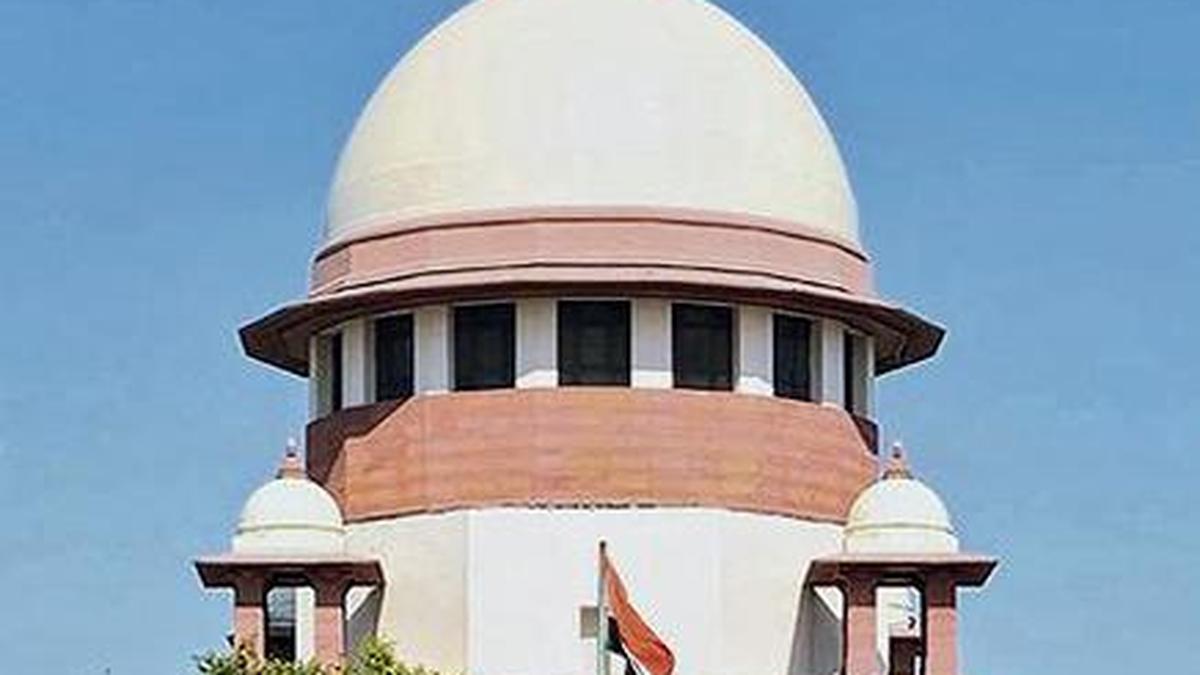

Supreme Court of India.
| Photo Credit: The Hindu
Observing that the Constitution envisions persons with disabilities participating in the nation’s collective journey on an equal footing, the Supreme Court on Wednesday directed the easing of the procedure for changing scribes in examinations conducted by the Union Public Service Commission and mandated the deployment of screen-reader software for visually impaired candidates.
A Bench of Justices Vikram Nath and Sandeep Mehta was hearing a petition filed by Mission Accessibility, an organisation working to advance disability rights, which sought a modification of the UPSC’s timeline for scribe registration and permission for eligible candidates to use laptops equipped with screen-reader software and accessible digital question papers during the Civil Services Examination.
“The UPSC, being the premier constitutional body entrusted with upholding the values of merit and fairness in public recruitment, must ensure that its processes are accessible, transparent, and sensitive to the needs of every segment of society. It is therefore imperative that the directions issued herein are carried out with utmost earnestness, sensitivity, and expedition, so that the constitutional vision of equal opportunity and meaningful participation of persons with disabilities is not reduced to a distant aspiration, but is realised as a living, enforceable, and enduring reality in the conduct of all public examinations in the country,” the ruling, whose pronouncement coincides with the International Day of Persons with Disabilities, held.
The court mandated that every UPSC examination notification must include a clear provision permitting eligible candidates to request a change of scribe up to at least seven days before the examination. Such requests, it added, must be decided through a reasoned order within three working days.
The Bench further noted that although the UPSC had earlier resolved to introduce screen-reader software for visually impaired candidates, the infrastructure required for its rollout remained incomplete, leaving the initiative “in a state of uncertainty.” The Commission was directed to file a comprehensive compliance affidavit within two months, outlining its plan of action, timelines, and modalities for deploying the software in all forthcoming examinations.
“The affidavit shall also specify the steps proposed for testing, standardisation, and validation of the software and related infrastructure across all or designated examination centres, and shall further indicate the feasibility of ensuring that the said facility is made operational and available to all eligible candidates from the next cycle of examinations,” the Bench said.
Additionally, the court directed the UPSC to work with the Department of Empowerment of Persons with Disabilities and the National Institute for the Empowerment of Persons with Visual Disabilities to frame uniform protocols for the use of screen-reader software and other assistive technologies. The protocols must ensure standardisation and security of the examination process across centres.
Urging the Commission to implement the directions “in both letter and spirit”, the court observed that the true measure of inclusivity lies not in the framing of progressive policies but in their effective execution. “The rights guaranteed to persons with disabilities are not acts of benevolence, but expressions of the constitutional promise of equality, dignity, and non-discrimination enshrined in Articles 14, 19, and 21 of the Constitution of India,” the court stated.
The Bench listed the matter for February 16 next year to receive the UPSC’s compliance affidavit.
Published – December 03, 2025 09:43 pm IST