


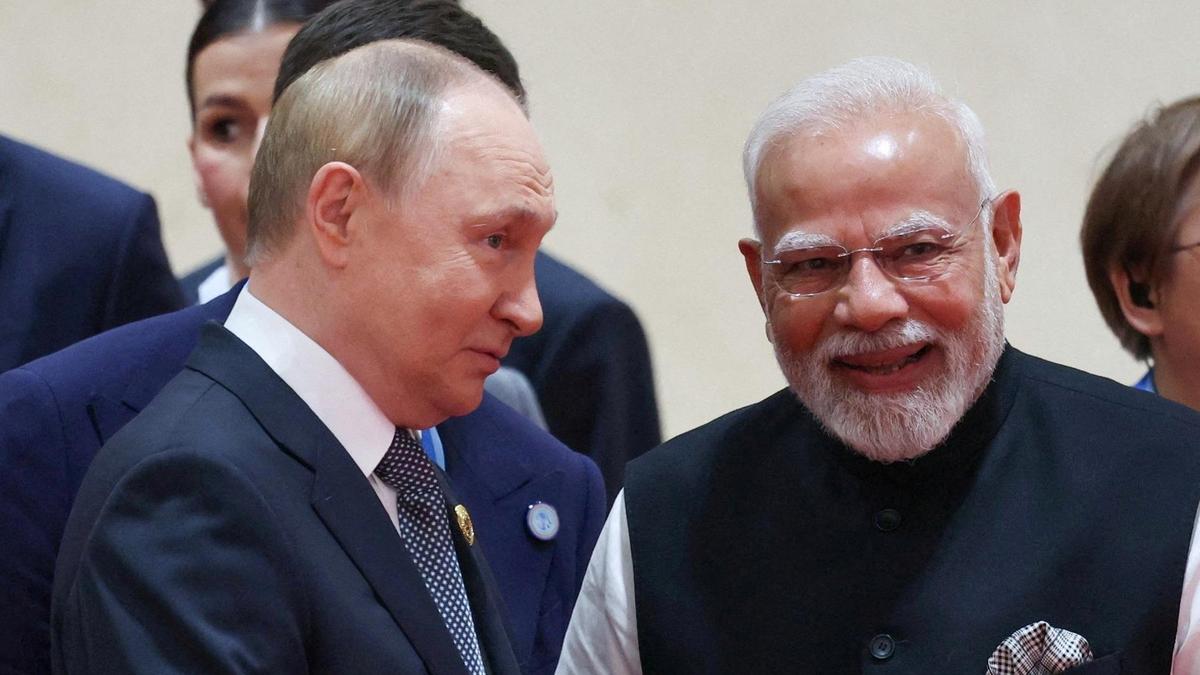

Brushing aside concerns about the arrest warrant by the International Criminal Court (ICC) against Russian President Putin ahead of his visit to Delhi, Ministry of External Affairs officials said this didn’t affect India, as it is not a signatory to the ICC.
Even so, the two-day visit starting from Thursday (December 4, 2025), the first by Mr. Putin since the war in Ukraine began in 2022, is not without some anxious moments for New Delhi. The government manages a tense tightrope walk between Russia and Western countries, particularly Europe, on a number of issues including the optics of the visit, oil imports and trade, defence, nuclear cooperation and a mobility agreement.

Optics
Nothing explains the tussle the government faces more than this week’s controversy over an editorial piece written by the envoys of France, Germany and the United Kingdom to India criticising Mr. Putin over the war and accused him of delaying peace talks.

While European envoys have written editorials in Indian media on the subject before, the officials said the piece just a few days before Mr. Putin’s State visit gave the appearance of criticising India for inviting him.
However, with New Delhi expecting to host German Chancellor Friedrich Merz in early January, followed by E.U.’s top leadership Ursula Von Der Leyen and Antonio Costa as guests for Republic Day, and hopes to finalise the E.U.-India FTA at the E.U.-India Leaders’ Summit at that time, the government could not be too harsh in its response.
As a result, MEA officials expressed their displeasure to the media, saying it was “not acceptable” for envoys to comment publicly on a third country, but did not demarche the envoys themselves. With Russian Ambassador Denis Alipov writing a rebuttal piece the next day, “Europe’s war” now extends to a battle for Indian public opinion as well.
Oil
Russian oil is by far the most contentious piece of the visit’s puzzle, as after a rapid expansion in India’s oil purchases, that went from less than 2% of its oil basket prior to the war, to 40% last year, taking India-Russia trade from its average bilateral trade of $10billion to $68.7 in 2024-25.
This is entirely due to oil purchases, and given India, under the threat of sanctions from the U.S. is now drastically cutting its import of Russian oil, the question will be how the two sides can meet their goal of $100 billion in the next few years?
The cut in India’s oil purchases, while welcomed in Washington and Europe, will be seen as a loss of face for the Modi government in Moscow, and other capitals closer home, as India’s decision to give up Iranian and Venezuelan oil in 2018, also under pressure from the U.S.
In Focus Podcast | How U.S. oil sanctions are testing India-Russia ties
Mr. Putin put it in unusually harsh terms in October, when he said India would lose 9-10 billion dollars whether it gave up Russian oil, or it braves sanctions. “The people of a country like India, believe me, will closely monitor the decisions made by the political leadership and will never allow any humiliation in front of anyone,” he added in an unusually blunt tone.
Trade
As a result, the two sides will discuss replacing at least some of the trade figures with other commodities from Russia, as well as boosting Indian exports to Russia of produce and processed foods, apparel, and some machinery, especially over the newly developed “Eastern Maritime Corridor” from Chennai to Vladivostok.
This may become more necessary as Indian exporters are facing severe losses over the U.S.’s harsh 50% tariffs, the highest for any country in the world, since August.
While a U.S. trade delegation is expected to visit next week, to finalise a trade deal that could see the tariffs drop as low as 15%, many exporters worry that getting back U.S. orders could take many more months, and the search for new markets like Russia will be important. Both sides will also push for more progress on the FTA between India and the Eurasian Economic Union (EAEU) during the visit.

Labour
The India-Russia labour mobility agreement to be launched as the “centrepiece” of the visit on Friday (December 5, 2025), will also be crucial for Indian skilled and semi-skilled workers, who are seeking jobs as other Western markets tighten immigration controls.
Meanwhile war-weary and heavily-sanctioned Russia is facing a labour shortfall of what is estimated to be about 3.1 million jobs by the end of the decade, and is seeking Indian workers in construction, technology and manufacturing sectors.
Defence and nuclear
Given the particular sensitivities in the West over military hardware, the visit will be watched most closely on defence agreements concluded. In the past, the U.S. had threatened to impose sanctions under the Countering America’s Adversaries Through Sanctions Act (CAATSA) after India finalised a deal for the S-400 air defence systems.
Any further deals over the S-400 could incur more American sanctions, which the U.S. had spared India on before (Turkiye and China, however, were sanctioned for the procurement of S-400s). The other purchases being contemplated, on fighter jets to be made in India, missiles etc, more necessary in the aftermath of Operation Sindoor, may mean a loss for U.S. defence hardware, which Washington will look askew at.
In addition, Russian technology transfer is key for India as no other country thus far has agreed to share its most sensitive technologies. With the Russian Duma now clearing the RELOS military logistics pact with India, more engagement and exercises with Russia, which led to protests from the EU earlier this year, could be expected.

The same is true for nuclear power cooperation, which CAATSA also covers.
Parliament is expected to pass amendments to the Civil Liability for Nuclear Damage Act (CLNDA) in the ongoing winter session and Prime Minister Narendra Modi announced a major push for nuclear power ahead of that.
On December 3, in an answer to Parliament the government said the Department of Atomic Energy (DAE) held talks with Russian Rosatom over India’s plans for five indigenous Small Modular Reactors (SMRs), something France and other E.U. member states are bidding for as well.
As a result, India’s task is to ensure that Russia is satisfied enough by the agreements announced on Friday (December 5), while ensuring its Western partners, especially those who will visit next month, and are watching the visit keenly, don’t object too much to.
Published – December 04, 2025 08:47 am IST