

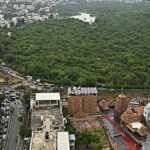




The merger of the 20 municipalities and seven corporations in the Greater Hyderabad Municipal Corporation (GHMC) is set to present several conundrums before the corporation and the government.
While the government is projecting uneven development patterns, regulatory disparity and rising urbanisation pressures in peri-urban areas as grounds for the merger, addressing some of these issues might not be a cakewalk. For instance, disparity in property tax calculation could be one sticking point while enforcing uniformity across the circles. As part of the property tax reforms pushed forth by the Central government, several erstwhile municipalities and corporations have adopted value of the property as the basis for calculation of tax, as against the plinth area of the property. The present rates of tax are said to be between 0.12-0.2% of the registered market value of the properties across the erstwhile ULBs.
Inside the GHMC purview, tax is still charged on the annual rental value (ARV) for calculation of which, plinth area is the basis. For calculation of ARV, ₹1 per square foot has been fixed as the constant for residential properties in all circles except Jubilee Hills and Banjara Hills where ₹1.25 per sft is the criteria. ARV of three months, combined with the library cess is being charged as property tax here.
Due to this disparity, property tax in corporations such as Nizampet is way higher than that in GHMC, while facilities provided are not even comparable. If uniformity is to be enforced, GHMC has to work out a formula to bring the newly appended areas on a par with the GHMC in terms of taxation.
Enforcing GHMC’s criterion across the board is not feasible now, as the corporations where the property tax reforms were implemented had already availed the sops from the Centre in return. Enforcing the reforms in GHMC could have negative consequences for the government in the upcoming GHMC elections. Officials under the condition of anonymity opine that the government may not want to upset its apple cart at this point of time, hence is likely to maintain status quo.
One more challenge could be with regard to implementation of the 20 kilo litres free drinking water scheme for households. The scheme was introduced by the erstwhile BRS government, in fulfilment of its promise to the city residents before 2020 GHMC elections that domestic drinking water up to 20,000 litres will be free of cost. The scheme was not applied to consumers in the peripheral municipalities/corporations which were drawing water from the Hyderabad Metropolitan Water Supply & Sewerage Board. Whether the government would extend the scheme to all the newly added circles in the name of fairness and equity is yet to be seen.
Published – December 04, 2025 08:31 pm IST