



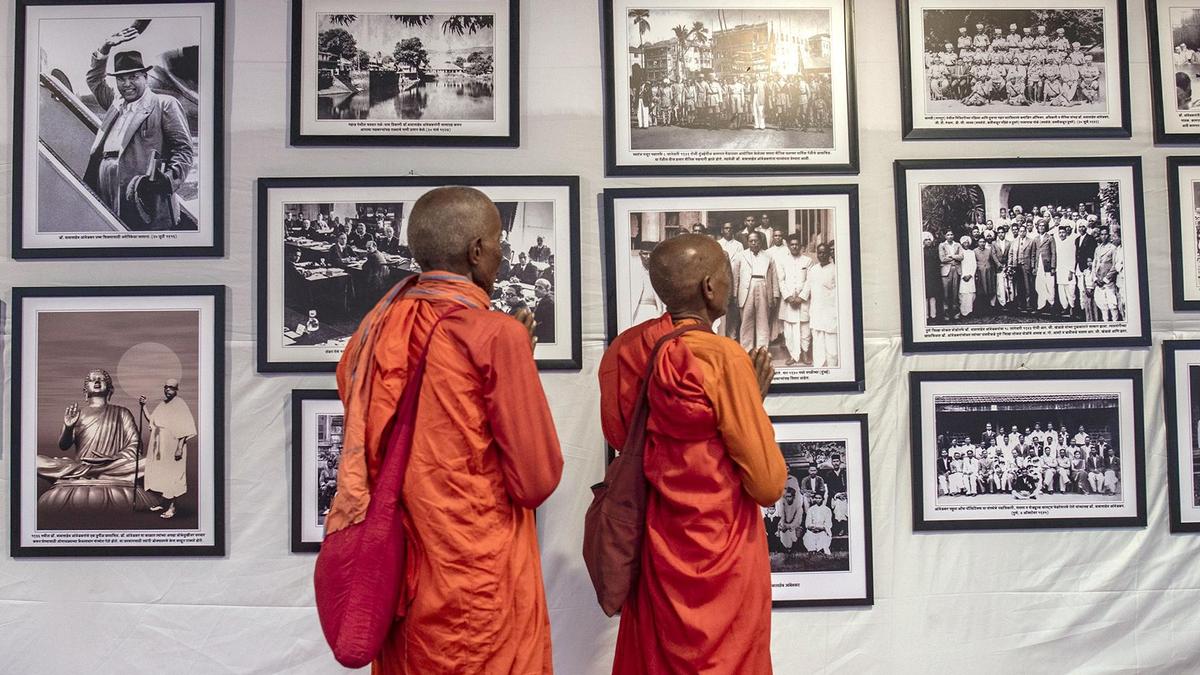

The Mahad tehsil, in pre-Independent India, was a part of the Bombay Province and a significant economic centre, providing labour to the industrial sector of the Bombay Presidency. In Mahad, imitation of caste norms led to widespread acceptance of caste discrimination, with high-caste individuals treating Dalits with contempt. Untouchability, a result of casteism, represents systemic social exclusion that reinforces the hierarchical nature of the caste system. In Mahad, the exclusion of Dalits was evident in their denial of access to drinking water from public tanks, such as the Chavadar Tank.
Mahad was a key site for one of India’s first rights movements, which paved the way for human rights discourse and its lessons absorbed in constitutional ethics.
Understanding the legacy
The movement for human rights and water democracy started with a resolution, passed in the Bombay Legislative Council in August 1923, initiated by S. K. Bole. It stated, “The council recommends that the untouchable classes be allowed to use all public watering places in dharamshalas, which are built and maintained out of public funds administered by parties appointed by the government or created by statute, as well as public schools, courts, offices, and dispensaries”.
This resolution challenged Brahmanical dominance and prompted social change efforts at Goregaon and Dasgaon near Mahad. In 1926, Ramchandra Chandorkar, a leader from the Chambhar caste, jumped into a public reservoir in Goregaon, which sparked attacks on untouchables’ — Chambhars and Mahars — properties by villagers. In Dasgaon, the Mahar Samaj Seva Sangh, which aimed to unite the depressed classes for equality, saw Chandorkar, R. B. More, Ramji Potdar, and others drink from a local lake and wells. Communist R. B. More’s memoir highlights how the region was eager to support Ambedkar’s struggle for equity and equality, seeking to restore the rights of untouchables. Additionally, this region was renowned for being the birthplace of activists like Gopalbaba Walangkar, N. M. Joshi, Sambhaji Gaikwad, and others. Thus, Mahad was selected by Dr. B. R. Ambedkar as the site of one of India’s first human rights movements.
Mahad 1.0 and 2.0
Dr. Ambedkar and his anuyayis (followers) conducted a satyagraha on March 19-20, 1927, by asserting the rights of untouchables to drink water as per the Bole Resolution of 1923. The anuyayis of Ambedkar thronged to the event with their meagre belongings, empty stomachs, and lathis (traditionally carried by Mahars, except those who came from the then Bombay presidency) to assert their rights. However, the satyagrahis were denied water by the locals; hence, water worth ₹40 had to be purchased specifically for this purpose.
After the Mahad 1.0 satyagraha, purification rituals were performed, because Dr. Ambedkar and his anuyayis had touched and consumed the water, which aimed to reinforce the caste system over human rights. Consequently, Dr. Ambedkar planned the Second Mahad conference for December 25 and 26, 1927. Meanwhile, the courts issued a stay restricting water access for outcastes, claiming the Chavadar tank was privately owned.
During this period, Dr. Ambedkar launched his fortnightly publication, Bahishkrut Bharat, which discussed democratic truths and ideals while emphasising human rights. He also participated in the Ambabai Temple satyagraha, initiated by Dr. Panjabrao Deshmukh in November 1927, following violent attacks on Dalits after the Mahad incident, which led to the formation of the Ambedkar Seva Dal for their protection. Since the Chavadar Lake case was still pending, Dr. Ambedkar decided against launching a satyagraha after consulting his followers. However, on December 25, he burned the Manusmriti following a resolution from Gangadhar Sahasrabuddhe, Rajbhoj, and Thorat. In Mahad 2.0, he specifically addressed women, asserting that human rights should include gender equality.
The Mahad revolution
Dr. Ambedkar stated that the Mahad 1.0 and Mahad 2.0 satyagrahas embodied the zeitgeist of the French Revolution.
In Dr. Ambedkar’s speeches during the Mahad satyagraha, he promotes an enlightened ethos of dignity and self-respect. In Mahad 2.0, Dr. Ambedkar discusses the French National Assembly of 1798. These two historical events, which defined the two eras, Mahad 1.0 and 2.0, were instrumental in shaping the idea of India and the ethics of its Constitution.
However, the French Revolution, didn’t encompass women in its idea of rights. So, neither their National Assembly nor further developments base their substantive egalitarianism by including the living bodies and souls of women. It was Mary Wollstonecraft’s intervention via her pamphlet “A Declaration of the Rights of Woman and the Citizen” that questioned the exclusion and the place of women in the French Revolution.
Dr. Ambedkar, in his 1916 paper, had proposed a novel gendered understanding of caste(s), questioning the approach of Indian sociologists to understand the making-remaking-unmaking of women to grasp the issue of caste, as well as the non-workability of the silos approach to annihilate it. The end can be achieved through gendered means only. The speeches and actions at Mahad 1.0 have the partnership of women and men, irrespective of their gender, geography, class, and caste(s). They gathered there as the National Assembly to break free from the imposed Brahmanical hegemony and chart their own course, just as the Third Estate did during their Tennis Court Oath after being denied permission by King Louis XVI. In Mahad 2.0, although preliminary, the resolution passed appears to be influenced primarily because it inflicts injustice on Shudras. However, even an initial understanding of dogmas, as well as the period of the Manusmriti, suggests that it treated women as Shudras. Contemporary literary and historical texts provide ample evidence to support this.
Dr. Ambedkar’s actions in Mahad 2.0, especially the burning of the Manusmriti and addressing the gathering of women, try to foreground a new discourse on human rights whose liberty, equality, and fraternity principles are derived from non-violent Buddhism.
Dr. Ambedkar introduced a new concept of a gendered nation whose enlightened nationalism was based not on essentialism but on existentialism, rooted in the body of the people and their natural, legal human rights. Thus, December 25 is also celebrated in India as Indian Women’s Liberation Day. The only essentialism it strives to seek is the Manuski, based on Maitri, which is a true democracy lived rather than a mere idea of governmentality. This reflects the foundations of constitutional morality derived from the ethics learned during the Mahad Satyagraha, institutionalised in the Constitution of India.
Nikhil Sanjay-Rekha Adsule is a Senior Research Scholar, IIT-Delhi
Published – December 05, 2025 08:30 am IST