


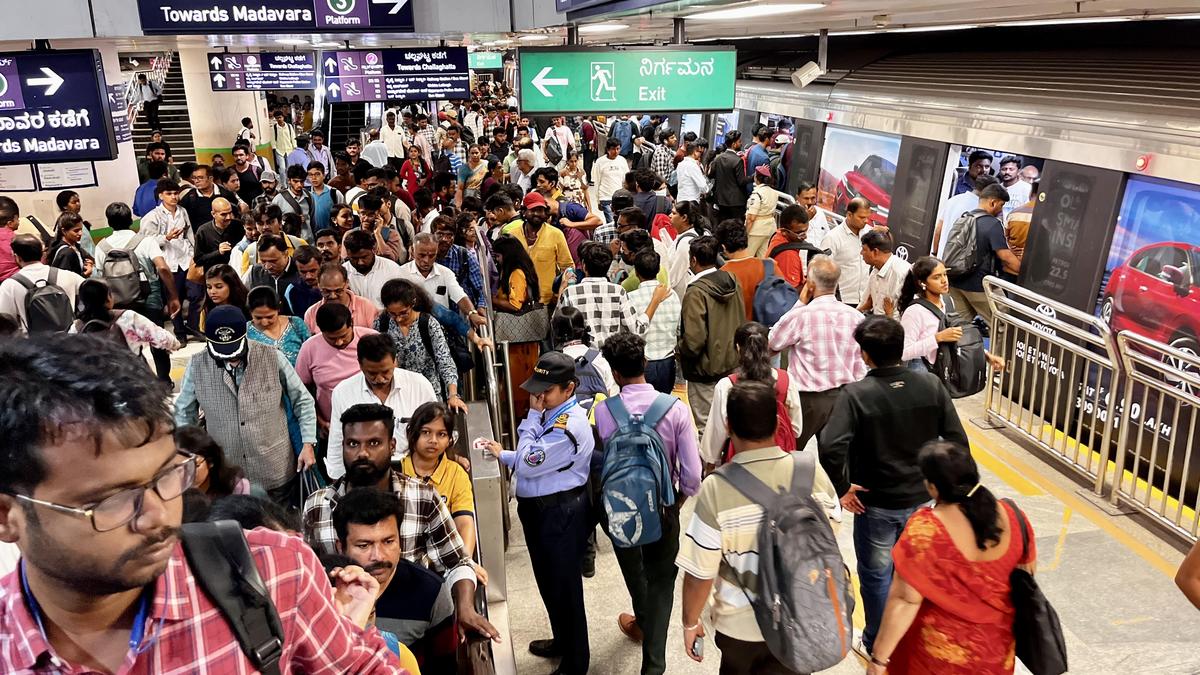

So far, only Majestic, the newly operational Yellow Line, and the R.V. Road Interchange have received similar railings.
| Photo Credit: SUDHAKARA JAIN
:
Following yet another fatal incident on the metro tracks, commuters in Bengaluru are renewing demands for the installation of Platform Screen Doors (PSDs) across all Namma Metro stations, a safety feature they believe has now become indispensable. However, officials from the Bangalore Metro Rail Corporation Ltd. (BMRCL) maintain that the technology remains difficult to incorporate into the existing network due to high costs and complex engineering constraints.
The latest case occurred on Friday, when a man allegedly jumped onto the tracks at Kengeri station, leading to a major service disruption and the loss of his life. This incident has sparked ongoing concerns around passenger safety and prompted fresh appeals for physical barriers along platforms.
Regular metro users said the city’s rapidly growing ridership, which averages 10 lakh daily, makes such safety measures unavoidable. Ramprasad K., a metro user from Rajajinagar, said crowded platforms have become increasingly difficult to manage. “During rush hour, even standing in line feels unsafe. The Bengaluru Metro must make Platform Screen Doors a standard feature on all future routes before opening them to the public,” he said.
Another commuter, Nayana Rao from J.P. Nagar, stressed that platform protection serves a purpose far beyond enhancing station design.
“These barriers are essential not only to deter suicide attempts but also to protect passengers from overcrowding-related hazards. The BMRCL should roll them out across the network to avoid avoidable incidents and service delays,” Ms. Rao said.
Only interchanges have metal railings
In February 2024, the BMRCL installed metal railings along parts of the interchange platforms to limit track access. The corporation has since been studying the effectiveness of these installations, especially at high-traffic stations. So far, only Majestic, the newly operational Yellow Line, and the R.V. Road Interchange have received similar railings.
Officials said the corporation has begun integrating PSDs into its upcoming expansion projects. Contracts have already been awarded for their installation on the Pink Line, the Phase 2A Blue Line (Central Silk Board–K.R. Pura), and the Phase 2B airport extension. As per the tender specifications, 13 underground stations will receive full-height PSDs, while 37 elevated or ground-level stations will be equipped with half-height platform screen gates.
Why PSDs can’t be added on existing lines
High installation costs
Major engineering modifications required
Extended service shutdowns needed
Phase 1 stations not designed for PSD systems
Earlier focus on train frequency and staff management
PSDs prioritised only for Phase 2 and new lines
High costs, technical hurdles block PSDs
However, questions linger over why the older Purple and Green lines Phase 1 of the network were never considered for PSDs. The BMRCL sources told The Hindu that the early phases of the metro were built with limited budgets and focused primarily on core infrastructure, leaving no room for expensive safety technologies like PSDs. “Retrofitting them now, especially in stations as large and complex as Majestic, would require shutting down parts of the network for long durations, severely affecting operations,” official added.
According to officials, the initial focus was on improving frequency by running trains every three minutes and deploying additional staff for crowd control. The PSDs have only recently become a priority, especially for Phase 2’s underground sections.
The PSDs operate in sync with train doors and act as a physical barrier to the tracks.
“Globally, the PSDs are viewed as an essential safety tool. They separate crowds from the tracks, aid the signalling system, and support smoother train movement. So far in India, only the metros in Delhi and Chennai have adopted them,” another official explained.
Published – December 05, 2025 10:37 pm IST