



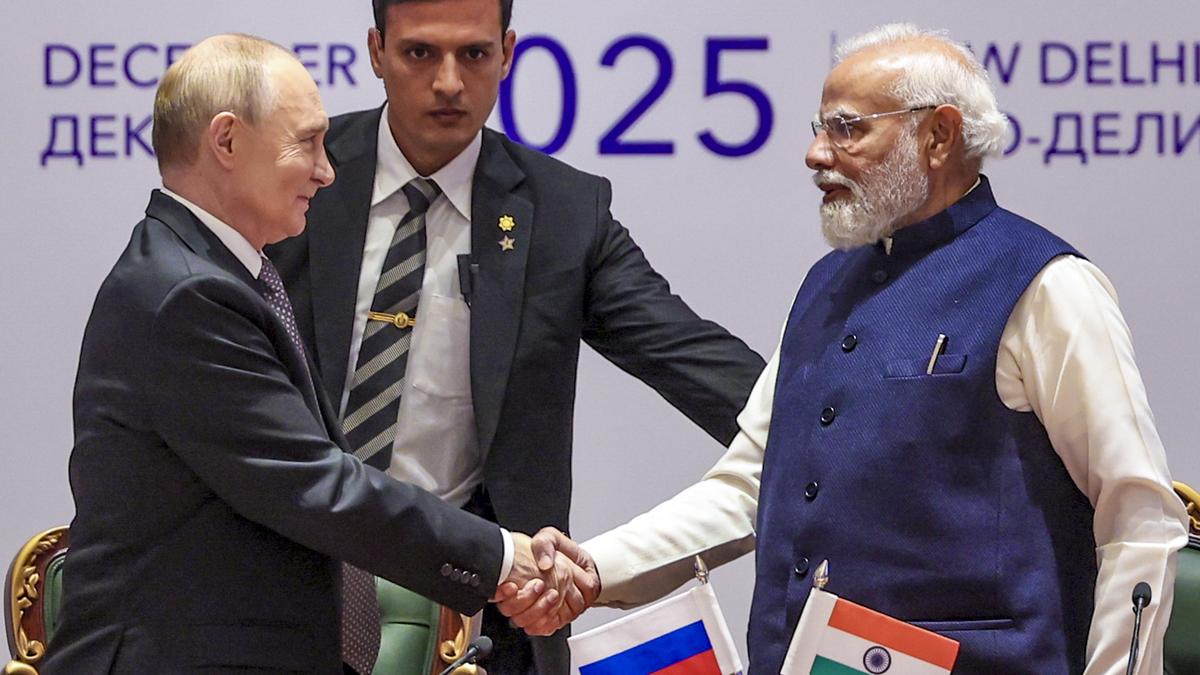

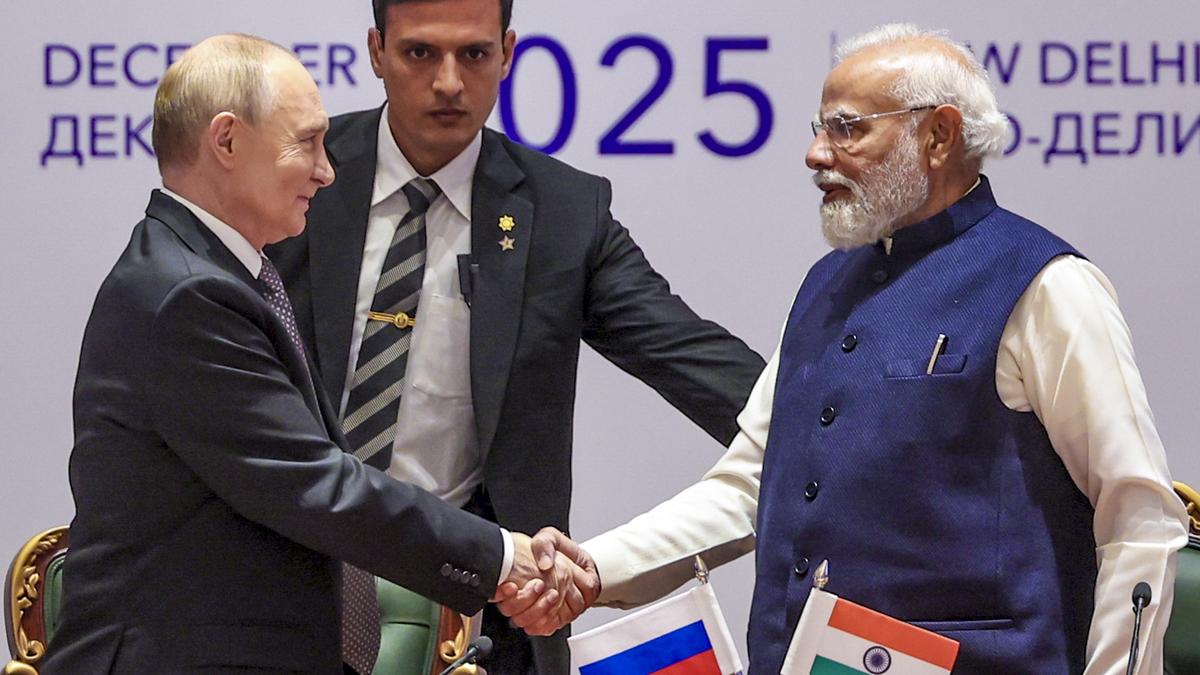
Prime Minister Narendra Modi and Russian President Vladimir Putin during the India-Russia Business Forum, in New Delhi, on December 5, 2025. Photo Credit: narendramodi.in via PTI.
India and Russia committed to “regular bilateral consultations” on “Arctic-related issues” and welcomed the progress made in multi-faceted bilateral cooperation on the Northern Sea Route, according to a joint statement following the India-Russia summit on Friday (December 5, 2025).

India has had a scientific interest in the Arctic region predating its existence as an independent country, when the British Government signed the Svalbard Treaty in 1920. While this granted Norway sovereignty over the Svalbard archipelago, it also permits citizens and companies from 48 signatory nations equal rights to conduct non-military, commercial, and scientific activities like hunting, fishing, and mining, while prohibiting fortifications and military bases.

Arctic exploration
In 2007, New Delhi launched its first scientific expedition in the Arctic and established Himadri, its first Arctic outpost in Svalbard. Indian researchers have been monitoring the Arctic glaciers for their mass balance and comparing them with glaciers in the Himalayan region. India has also been actively involved in studies related to the Arctic oceanography, atmosphere, pollution, and microbiology. Over 25 institutes and universities are currently involved in Arctic research in India.

About a hundred peer-reviewed papers have been published on Arctic issues since 2007. 13 nations are observers in the Arctic Council: France, Germany, Italy, Japan, the Netherlands, China, Poland, India, Singapore, South Korea, Spain, Switzerland, and the United Kingdom.
In 2014 and 2016, India’s first multi-sensor moored observatory in Kongsfjorden and the northernmost atmospheric laboratory in Gruvebadet, Ny Alesund, were launched in the Arctic region. Until 2022, India has successfully conducted thirteen expeditions to the Arctic. With global warming accelerating the melting of polar ice, large-scale geological changes are expected in the future that will enable the opening of new sea routes as well as the potential for minerals and metals.
Second nuclear plant site
India and Russia also committed to broadening cooperation in the nuclear energy sector, including fuel cycle and life cycle support to operate the Kudankulam nuclear power plant, constructing the remaining nuclear power units at the site, as well as timelines for supplies of equipment and fuel. Two units of 1,000 MW capacity each are already in operation, and the remaining four units of 1,000 MW each are under construction. The full 6,000 MW capacity of the Kudankulam site is expected to be achieved by 2027.

The countries also agreed to have “further discussion” on another nuclear plant, with India saying that it will “strive to” allot a second site in line with earlier signed agreements. The two countries also agreed to accelerate technical and commercial discussions on the VVER (Vodo-Vodyanoi Energetichesky Reaktor) Russian nuclear reactors for design, research, and joint development of nuclear plants.
Both countries also welcomed the “enhanced partnership” between the Indian Space Research Organisation and the Russian State-owned space corporation Roscosmos in the use of outer space for peaceful purposes, including in the human spaceflight programmes, satellite navigation, planetary exploration, and rocket engine development.
Published – December 05, 2025 09:10 pm IST