




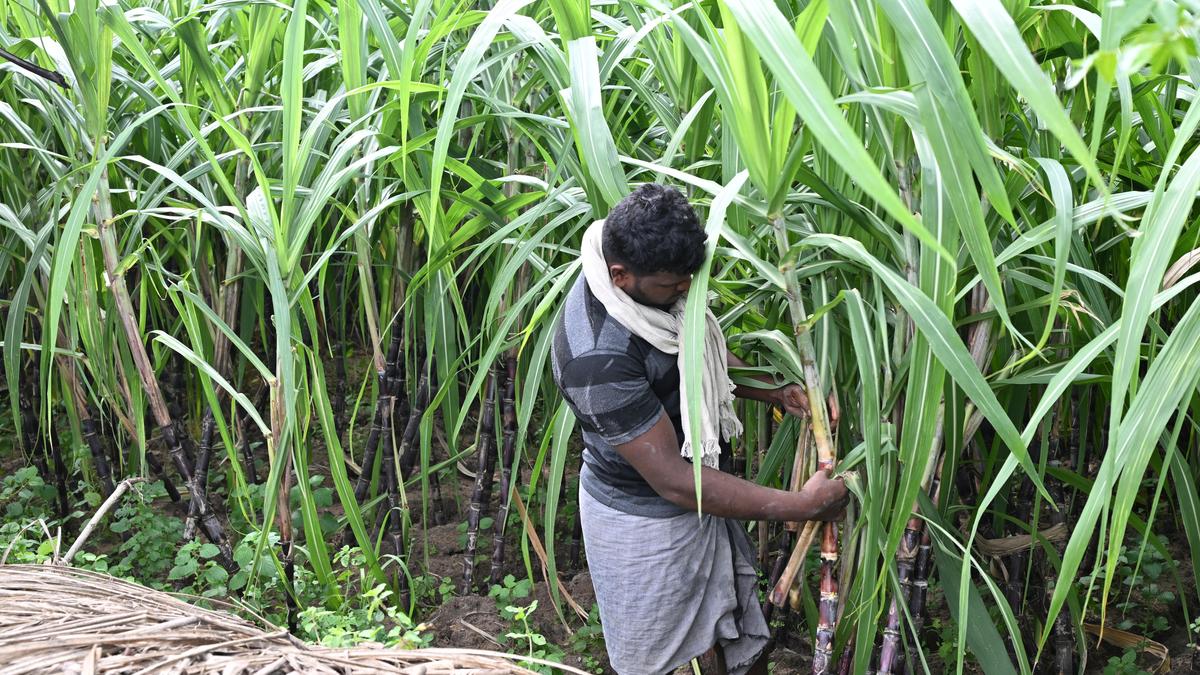

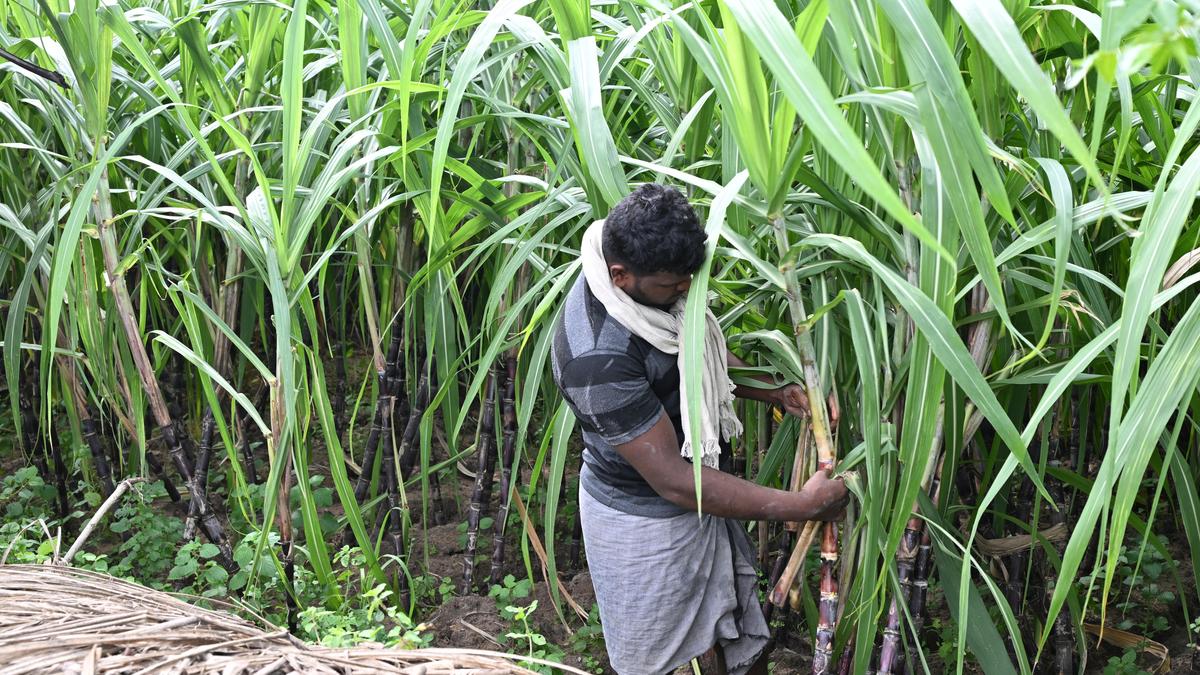
A farmer de-tops sugarcane plants on a field in Valamirankottai near Thanjavur.
| Photo Credit: R. VENGADESH
Cyclone-related rain and lodging of sugarcane across parts of the Cauvery delta have lowered expected yields ahead of Pongal, raising concerns among growers about both the crop’s quality and the viability of this season’s market returns.
In Varagukottai village under Kattur panchayat in Thanjavur taluk, sugarcane farmer S. Prabhakaran was preparing his fields on Thursday, removing the tops of the maturing canes—a final step before harvest.
He said the season had become financially stressful after the cyclone. Prabhakaran, who has cultivated a quarter acre this year, said the economics of sugarcane were tight even in normal times, with the cost of cultivation on one acre ranging between ₹1 lakh and ₹1.5 lakh. Under favourable conditions, about 22,000 canes can be planted on an acre, but the heavy rain and wind last week caused extensive lodging in his field.
“Once the cane falls, the quality goes down immediately and the recoverable yield reduces. This time, a good portion of the stand has been affected and the total output will certainly be lower,” he said. Sugarcane for the Pongal market is usually raised over a ten-month cycle—from the Tamil month of Panguni to the Thai harvest—and any disturbance at the maturity stage results in direct economic loss.
This season’s price trend has intensified farmers’ worry. According to Mr.Prabhakaran, the current rate of ₹15,000 for 1,000 canes is unviable, especially since harvesting alone costs not less than ₹2,000 per acre. “To stay afloat, we need at least ₹20,000 for 1,000 canes. But for years, the government has never purchased directly from us. Only agents and middlemen buy from the field and supply to the government. Farmers are paid the least in the chain,” he said.
“This year’s Pongal gift hamper must be revised to ensure farmers get a fair return,” said Sundara Vimal Nathan, Secretary of the Tamil Nadu Cauvery Farmers’ Protection Federation, speaking to The Hindu. “Every ration cardholder should receive two sugarcanes instead of one, and the hamper must include traditional jaggery—achu vellam or urundai vellam—sourced only from Tamil Nadu farmers. No procurement should be made from outside the State.”
He said the government-fixed price of ₹35 per cane in recent years had not reached growers fully, with many receiving only ₹13 to ₹15 due to the involvement of intermediaries. “This year, the procurement price must be ₹45 per cane, and the full amount should be credited directly into farmers’ bank accounts to prevent any irregularities,” he added. He urged the government to issue the Pongal package order quickly and to follow the Madurai Bench of the Madras High Court’s guidance from last year while finalising procurement.
According to officials in the Agriculture Department, sugarcane is grown on roughly 2,000 hectares in Thanjavur district, of which around 200 acres are under ‘Panneer Karumbu’, the traditional variety preferred for Pongal celebrations. With the cyclone striking at the end-stage of the crop, officials expect the marketed surplus of festival cane to tighten, particularly in pockets where the lodging was severe.
Published – December 06, 2025 09:03 pm IST