



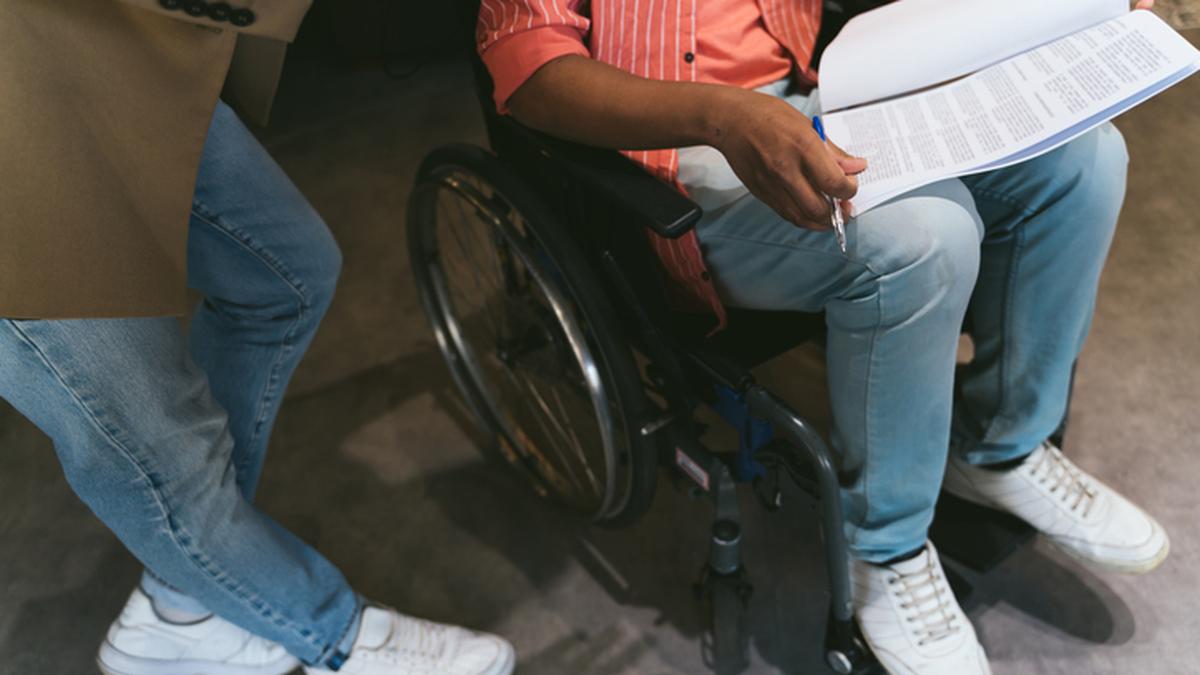

Prisoners with disabilities must be able to “carry out their daily activities with dignity without compromising institutional safety”, the court ordered.
| Photo Credit: Getty Images/iStockphotos
The Supreme Court has held that prison authorities who abuse disabled prisoners will be penalised under the Right to Persons with Disabilities (RPwD) Act.
A Bench of Justices Vikram Nath and Sandeep Mehta, in a 15-page order, directed all States and union ierritories to change their prison rules, draw up new modalities to ensure that disabled prisoners with special needs were provided assistive devices to aid mobility, specialised medical care and enhanced visitation rights to access sustained family support.

The court directed the creation of facilities in prisons to allow prisoners with disabilities “meaningful access to inclusive education”. “No inmate shall be deprived of the opportunity to pursue educational programmes solely on account of disability,” the apex court underscored in the order dated December 2 but published on Saturday (December 6, 2025).

The order has come across as a significant gesture of benevolent judicial legislation with the court bringing disabled prisoners under the statutory protection and framework of the 2016 Act. The judicial intervention afforded prisoners with benchmark disabilities the same rights as a free disabled person.
Prisoners with disabilities must be able to “carry out their daily activities with dignity without compromising institutional safety”, the court ordered.
The order was based on a petition filed by Sathyan Naravoor, represented by advocate Kaleeswaram Raj and Thulasi Raj, highlighting the traumatic and inhumane prison conditions suffered by Professor G. Saibaba and the elderly Stan Swamy.
The demise of Prof. Saibaba, a scholar and human rights activist with disabilities, was directly attributable to his deteriorating health, exacerbated by prolonged incarceration and the inhumane conditions of his detention.
Swamy, who suffered from Parkinson’s syndrome, was denied a sipper cup in prison.
Two aspects
Prisoners with disabilities are punished on two aspects, namely the crime for which they have been convicted, and the “crime” of being handicapped, the plea said.
The court learnt that the prison manuals of most States did not provide for most ramps and other accessibility measures. Disabled prisoners were lodged with non-disabled inmates and given the same treatment, which even affected their basic mobility.
With this order, prison officers who violate the RPwD Act would have to pay, under Section 89, a fine of ₹10,000 for their first offence. They would be liable to pay a fine from ₹50,000, which may extend to ₹5 lakh, if they were found guilty of subsequent abuse of disabled prisoners.
The court directed States and union territories to provide a complete report on the “structured institutional mechanism” proposed to ensure the regular availability of assistive devices, mobility aids and other disability-support equipment available to disabled prisoners.
The Supreme Court ordered States and union territories to make the necessary changes in prison manuals to ensure that disabled prisoners were entitled to “enhanced visitation rights”.
The court directed that the directions and guidelines laid down in the L. Muruganantham case judgment earlier in 2025 to uphold the rights of prisoners in Tamil Nadu must now be extended to prisons across India.
The series of judicial directions in the judgment include a complaint redressal mechanism for disabled prisoners suffering from neglect and abuse; their prompt identification at the time of admission; wheelchair-friendly spaces, accessible toilets, ramps, and sensory-safe environments to ensure universal accessibility; necessary therapeutic services; periodic audits to be conducted in accordance with the Harmonised Guidelines and Standards for Universal Accessibility in India (2021), etc.
Published – December 06, 2025 09:59 pm IST