






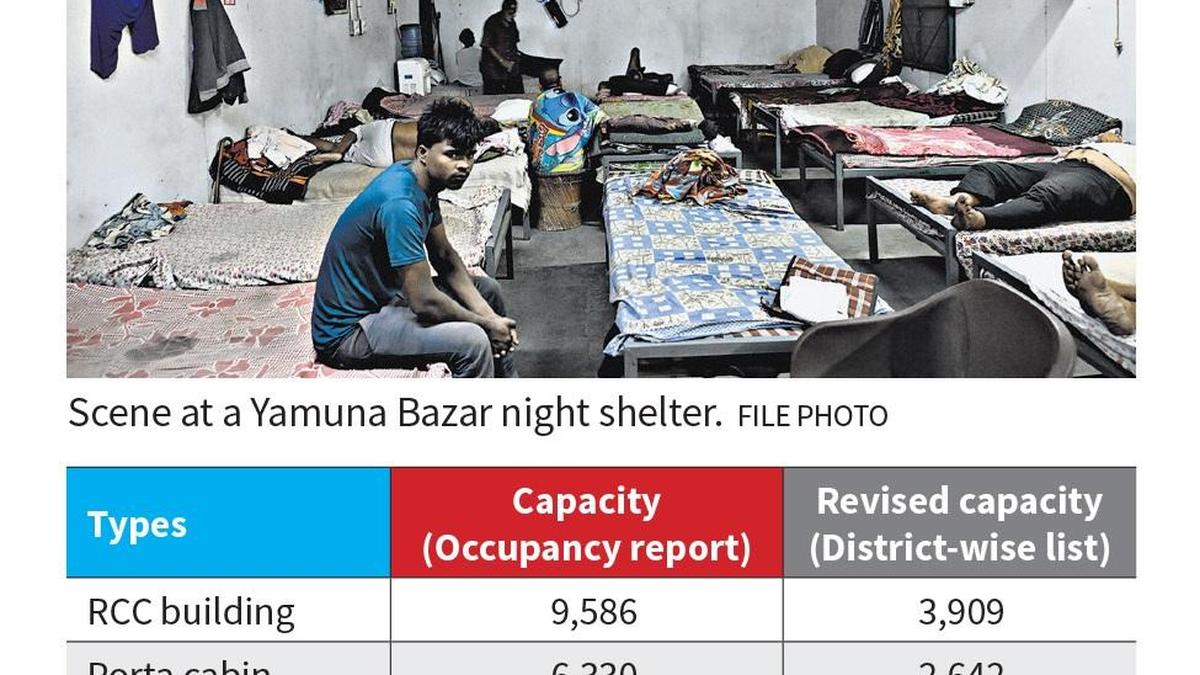

The official capacity of night shelters for the homeless in the city, as reported in Delhi Urban Shelter Improvement Board (DUSIB) daily datasets, appears to be outdated and inflated, The Hindu has found.
According to DUSIB’s shelter homes occupancy report, the total capacity across 186 permanent shelters is 15,916 people, with less than 30% of the capacity used over the past week. A separate DUSIB district-wise night shelter list shows a capacity for 6,551 people under the ‘revised category’. The mismatch poses a stark question about the apparent underutilisation of such shelters during winter in Delhi, which has a homeless population of over three lakh.
When reached for comment, the shelter board did not respond.
‘Inflated figure’
A former DUSIB official said even the capacity in the occupancy report is “inflated and not updated”. The official said that two years ago, the occupancy figure was revised in accordance with the National Urban Livelihoods Mission (NULM) norms to ensure that each homeless person in a shelter home has at least 50 sq. ft. of space. The officer said the occupancy figure was based on the number of people sleeping on the floor. However, with the introduction of cots in the shelter, the occupancy figure sharply reduced, which is not reflected in the report.
Ground checks by The Hindu found that shelter homes at Lodhi Road, Kalkaji, Kashmere Gate, Sarai Kale Khan, Mori Gate, and Yamuna Bazar were operating below or above capacity, contradicting DUSIB records.
Contradictions aplenty
At a Sarai Kale Khan porta cabin shelter, the total capacity is listed as 20, but the occupancy reached 46 last week. Nearby, a family shelter with 16 beds lists a capacity of 20. Another porta cabin near the Sarai Kale Khan bus terminal shows a capacity for 72, but only 54 beds are available, with occupancy exceeding 100 last week.
At a shelter home in Phool Mandi, Mori Gate, the capacity is 100, but the report lists 250. The shelter has around 30 single beds, some of which are combined to accommodate more people.
These contradictions suggest that both the original and revised capacities are not updated to reflect the actual infrastructure, thereby providing an inaccurate picture of actual occupancy.
Meanwhile, among the shelters that show no occupancy data over the last 30 days are two children’s shelters at Kashmere Gate. However, their caretakers told The Hindu that “they are operational, and they send attendance reports daily”.
‘NULM guidelines flouted’
Jatin Sharma, former director of the Centre for Equity Studies, an NGO that works with the homeless, said the NULM guidelines on locations and capacity are not followed. “Many permanent shelters and porta cabins are now moved to low-concentration and far-off areas such as Narela, Rohini, and Dwarka without any survey,” he said.
Mr. Sharma added that the homeless population in Delhi is concentrated in central and Old Delhi and near railway stations, places of worship and factories, where instead of expanding, shelters are being shut down. “The homeless work in small eateries or markets, or as waiters, and shifting them to remote locations is not an option,” he said.
Mr. Sharma said since 2023, nine shelters have been demolished and five shut down, mostly along the Yamuna. Eight more proposed demolitions at Sarai Kale Khan and Anand Vihar are being contested in the Supreme Court, as the proposed relocations remain full in winter.
DUSIB has planned to install 200-250 temporary tents with a capacity of 2,500 this winter.
Published – December 07, 2025 01:03 am IST