

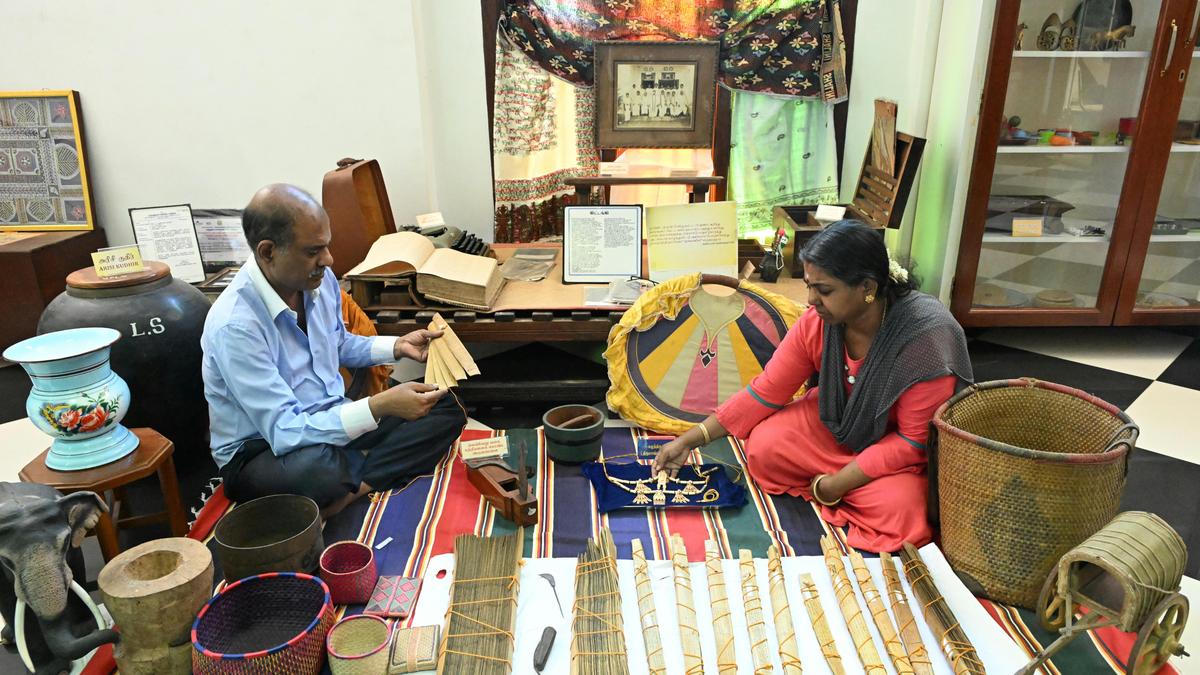


S. L. S. Palaniappan and his wife Malathi, with the palm manuscripts and artefacts at their museum at N. Vairavanpatti near Tirupattur in Sivaganga district.
| Photo Credit: L. BALACHANDAR
While in the bylanes of Karaikudi, antique hunters fret out vintage artefacts like teak wood doors, exquisite statues and intricately carved furniture, S. L. S. Palaniappan and his family have been painstakingly taking efforts to preserve these antiques.
The endeavour began with building a house replicating the syncretic Chettinad mansions at N. Vairavanpatti near Tirupattur. In this building, he, along with his wife, Malathi, have preserved articles that narrate the history of the Chettiar community and in turn has shaped the socio-fabric of the region. Amidst elegant glassware, luminous porcelain ware, brassware and unique thali lie the palm manuscripts and ledgers that unravel the socioeconomic status of the early times.
“According to oral tradition, Chettiars shifted base to the region around Karaikudi after the Chola-era tsunami destroyed Kaveripattinam, where they were the royal financiers and into maritime trading, doing business in pearls and other gems. For centuries, our community has been dealing with finance and keeping a ledger of all business transactions. Earlier, it was on palm manuscripts but due to ignorance much of these have been destroyed,” says Mr. Palaniappan.
Now, people like him have taken the help of the State Archaeological Department to digitise the palm manuscripts that are still available. One of the manuscripts that he has in the museum records the gifts given during a wedding. Others are horoscopes of various family members and one a literary work.
The museum also has ledgers from the early 20th century, where record has been made of the owner paying ₹2.60 paise as tax at the office at Karaikudi. During this period, most of the men were primary financiers, providing crucial credit for Ceylonese, European planters, and cultivators in Sri Lanka, then called Ceylon.
A close-knit community, as V. A. Subramaniam in his article ‘Rise and fall of Nattukottai Chettiars in Sri Lanka’, says “Trust was the foundation of Chettiar finance…. Chettiar firms were established by partnerships of individuals joined based on marriage, village ties and other loose forms of kinship. In addition, the inter-firm lending or deposit system among Chettiars was also based on this trust and it was one of the major sources of capital of Chettiar firms. The collective ‘caste’ responsibility helped to maintain the trust.”
The money from there was invested in Karaikudi by building palatial houses and acquiring lands. The business of ‘trust’ was also seen in the region here, Mr. Palaniappan, has kept various ledgers in his museum that tells of a time, when farmers who got loans from these traditional bankers repaid the amount in the form of paddy and haystacks for the cattle.
An official from the State Aracheological Department says that the palm manuscripts would reveal more such early business practices as the community was diligent in keeping accounts.
“As of now we have digitised some of the manuscripts but there is more to be done especially, those that we have got from temples in the region. This will throw light on the donations and also how the maintenance of temples were being done,” the official added.
As most of these palm manuscripts are in archaic Tamil scripts, they would have to be read by an expert. For people like Mr. Palaniappan, it is another step they will be taking in their journey to learn and preserve what their ancestors had preserved for posterity.
Published – December 07, 2025 07:41 pm IST