

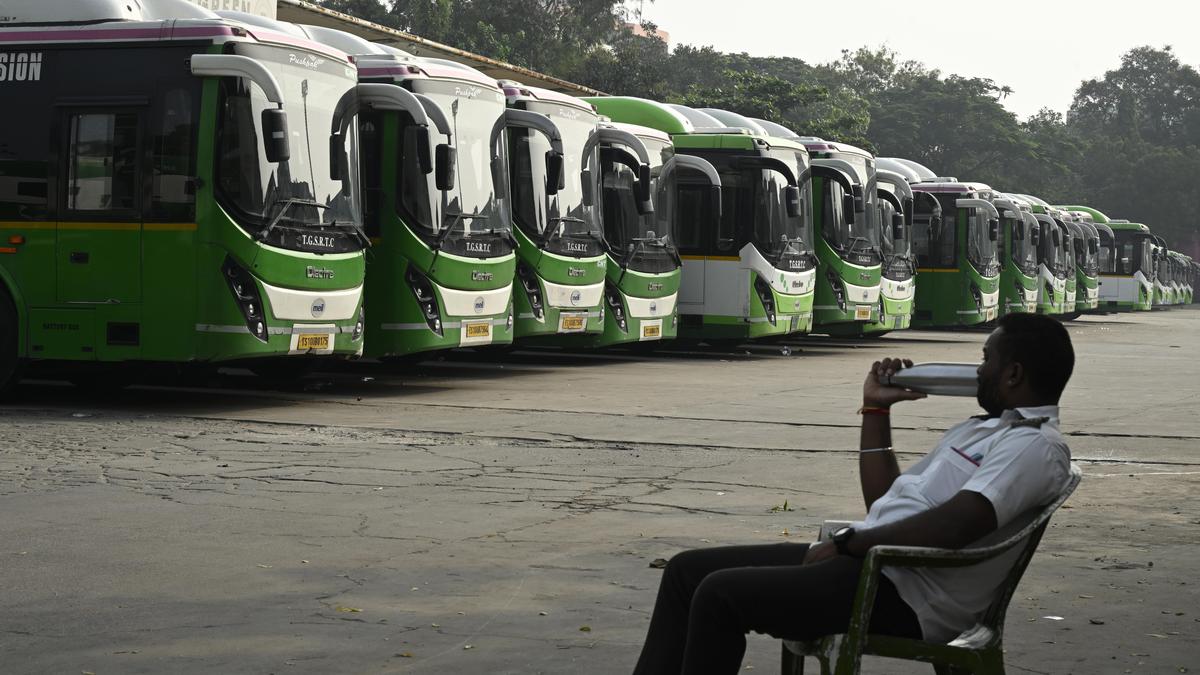

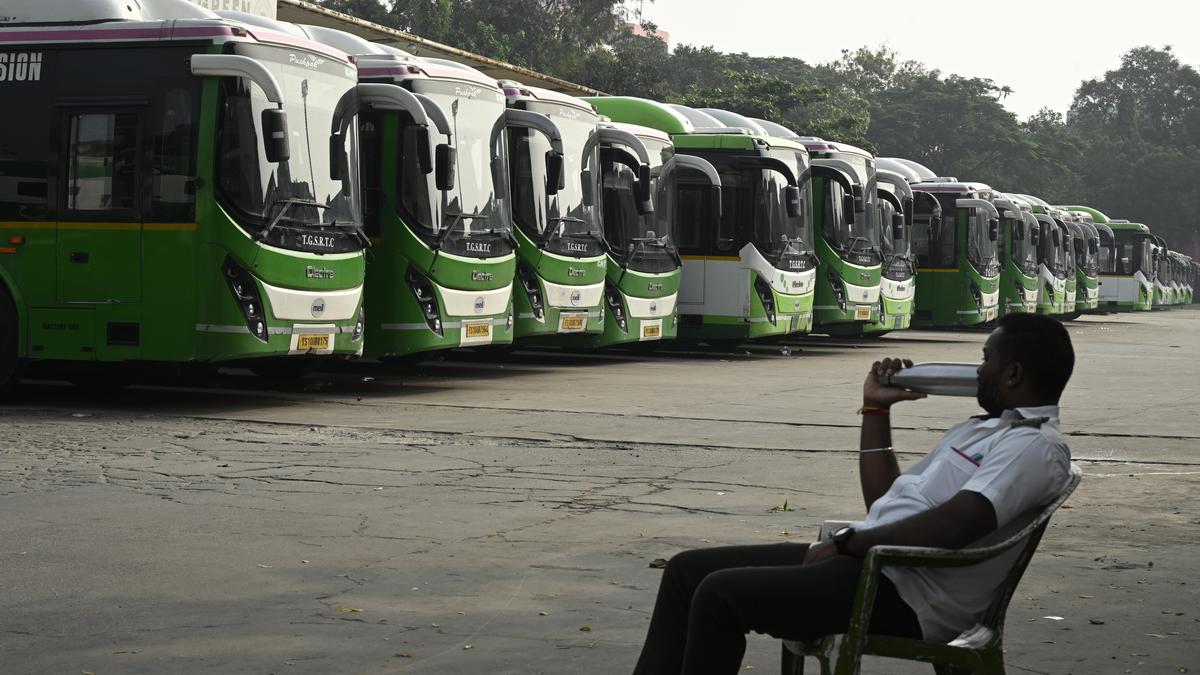
Telangana State Road Transport Corporation (TSRTC) buses stand parked at Cantonment bus depot in Secunderabad.
| Photo Credit: G. RAMAKRISHNA
It has been a rough ride for passengers as well as the Telangana State Road Transport Corporation (TGSRTC) for more than a decade. Successive governments appear to have placed these key public-transport stakeholders low on their list of priorities, often leaving them to political will or expediency.
In October, the Congress government in Telangana approved a fare hike for ordinary bus services: ₹5 for the first three stages (a stage is a set distance — for example, 3 or 5 kilometres) and ₹10 from the fourth stage onward. Fares for metro deluxe and e-metro AC services were raised by ₹5 for the first stage and ₹10 for each subsequent stage. The move was pegged to the need for developing infrastructure, and replacing diesel buses with 2,800 electric vehicles and developing allied electric infrastructure in Hyderabad.
The decision invoked sharp criticism from the Opposition — the Bharat Rashtra Samithi (BRS) and the Bharatiya Janata Party (BJP). It also placed passengers in an uncomfortable position. For students, commuting to educational institutions also became more expensive, as student bus passes saw a price increase.
But this was not the only instance of fare revision. Over the years, passengers have invariably been made to pay more, with the TGSRTC introducing cess or changes without explicitly terming them hikes or revisions. In 2022, a safety cess of ₹1 was introduced at a time when the BRS was in power in the State. Rounding off fares to the next multiple of ₹5, so as to address the problem of lack of change, served as a hike of sorts as well, especially for passengers using more than one bus for their commute.
The city’s fleet strength for around a decade has largely remained stagnant and currently stands at buses. The share of the population being served by city buses nearly halved from 42% to 25%, according to a study by the Hyderabad Metropolitan Urban Development Authority. This does not bode well for public transport. On the other hand, private vehicles increased fourfold from 2011 to 2024, with over 1,500 new vehicles being added each day.
A comparison of the TGSRTC with Bengaluru Metropolitan Transport Corporation (BMTC) lays bare the gaps in fleet strength. While the TGSRTC has 2,927 buses, the Karnataka capital has 7,047, according to official BMTC data.
The Mahalakshmi Scheme in Telangana, which provides free bus rides to women, has led to an increase in occupancy, according to official data. On several occasions, it has even breached the 90% mark. But a larger number of passengers implies the need for more buses. It is time that the Telangana government realises that merely replacing diesel buses with electric buses is inadequate. Instead, it needs to augment the fleet strength.
However, there is a catch. TGSRTC officials have often argued that the state-run public transport corporation has been bleeding on account of losses within its Greater Hyderabad Zone, a jurisdiction in which city buses ply the roads. Using General Transit Feed Specification data, an independent transport researcher from Hyderabad analysed the TGSRTC’s fleet and correlated it with accessibility. Broadly speaking, of the 38,000 daily trips, 62% were made on the least expensive City Ordinary services that operate across Hyderabad. A vast majority of these are high floor buses. This indicates the issue of accessibility. It is crucial that the city has buses that are accessible to the differently abled and senior citizens.
Then comes the issue of TGSRTC workers. The then BRS government adopted a tough approach while dealing with the 2019 strike that lasted for a record 52 days. A key demand of the protesters was the absorption of the corporation into the government. After rejecting this demand, the then government introduced a bill to this effect in 2023, before the Assembly elections. The then Governor, Dr. Tamilisai Soundararajan raised some objections, but finally gave her nod. This merger is yet to become a reality. Meanwhile, TGSRTC unions have been awaiting their recognition.
Public transport is a public service and cannot be reduced an exercise in profitability. An effective method to ameliorate this situation lies in investing in a high quality, affordable, and accessible public transport system. A larger fleet that is dependable in terms of frequency could bring commuters back to buses. This will ease vehicular traffic, reduce pollution, and restore confidence in public transport.
Published – December 08, 2025 12:15 am IST