





A convoy of vehicles is led by a DJ-mounted truck blaring a patriotic Bollywood song from the ’90s. It makes its way down a dusty, broken road in Punhana sub-division of Nuh, earlier known as Mewat. The song, ‘Mera mulk, mera desh, mera ye vatan,’ (My land; my country; this, my homeland) echoes through the air, shattering decibel limits, as the procession passes through a village. Behind the truck, a large white banner on a makeshift chariot reads “Vande Bharat Ekta Yatra” in red letters, accompanied by pictures of India’s first Home Minister Sardar Patel and local hero Raja Hasan Khan Mewati, who resisted Mughal emperor Babur.
About 100 men, women, and children wearing garlands and waving the tricolour, walk behind the rath, their faces full of enthusiasm. As the padyatra (foot march) passes through a roadside settlement, a motorcyclist stops to inquire about the procession.
“Yoh ke se?” (What is this?) he asks in a Mewati accent. A man in the crowd promptly replies, “Bhaichara yatra hai” (It’s a brotherhood march). The motorcyclist nods in approval, “Bhaichara toh acchi baat; bhaichara toh hona chahiye” (Brotherhood is a good thing; there should be brotherhood), before speeding away.
The carefully crafted itinerary of the padyatra was planned across 10 days, beginning on November 27 from the historic Shahpur Nangli village, where locals claim people were hanged in 1857 for participating in the First War of Independence. It passed through a dozen Mewat villages, all connected with a history of sacrifices in the revolt. Mewat RTI Manch convenor Rajuddin Meo, the media coordinator for the padyatra, says the march will cover over 200 villages in Nuh, traversing a distance of 150 km.
The convoy continues its journey. The atmosphere is electric with the sound of patriotic songs, chanting, and cheering filling the air as the procession makes its way through the dusty roads of Nuh.
As dusk approaches, the procession reaches Godhala village, stopping briefly at several villages along the way, where crowds welcome the padyatris with open arms. As the sun begins to set, the convoy comes to a halt at the village, and a large gathering forms on the roadside. Mukesh Vashisth, the media coordinator of Haryana Chief Minister Nayab Saini, steps forward, microphone in hand, and begins his opening remarks.
Political overtones
With a charming smile, he says, “Ittefaqan Mewat se pyaar ho gaya hai,” (I have coincidentally fallen in love with Mewat), his words striking an immediate chord with the audience. The crowd erupts into applause, and Vashisth continues, his voice filled with emotion: “You might think that I have come to seek votes. But I have no such intention.”
He then quickly brings in a reference to Raja Hasan Khan Mewati, the Muslim Rajput ruler of Mewat, to keep the audience glued. “I belong to Faridabad and have been coming to Mewat for the past couple of years at the behest of the Chief Minister. When I came here three years ago, I had an opportunity to participate in a programme on Raja Hasan Khan Mewati in a college. I read about him. But I was surprised to find that a hero like Hasan Khan, who fought against his own Muslim brother Babar for his motherland, is not being talked about much in Mewat.”
A few minutes into his address — invoking Mewat’s culture, a history of patriotism, and a tradition of Hindu-Muslim brotherhood — the speaker subtly changes track to talk about the region’s backwardness and seven decades of political “misrule”. As a teenage boy on the rooftop continues to shower rose petals on him, he says, “A Mewati is so naive that he does not wash his hands for three days if his MLA shakes hands with him. You give so much respect to your political representatives. But what have you got in the return in these years?”
Reiterating that he is not here for votes, Vashisth emphasises that he has taken it upon himself to travel 180 km on foot with his friends to awaken the people of Mewat. “I just want to make you think. You voted them to power for 70 years, but they ruined the future of your children. Despite having five Education Ministers from Mewat, it is still waiting for a university. Their children are studying abroad, but there is no place to study for your children,” he stresses, with a few in the crowd mumbling approval.
Hope for the Mewatis
Nasir Qureshi, 52, stands amid the crowd near Hajipur Gohta village, garland in hand, eagerly awaiting the padyatra. He isn’t quite sure what to expect, but he knows that his community’s demands will be put forth to Chief Minister Nayab Saini at a rally during the culmination of the padyatra. “Yeh log hamari baat CM ke samne rakhenge. Bachcho ko acchi siksha mile. Yuva ko rojgar mile. Hum to yahi chahate hein,” Qureshi says, voicing the community’s hopes for quality education and employment opportunities for their children and youth.
Standing besides him, Junaid, 32, explains that the purpose of the padyatra is to awaken the youth and shed the stigma of communal violence that had rocked the region two years ago. Retired headmaster Rafeeq Ahmed Alvi echoes this sentiment, alleging that the violence was orchestrated to malign Mewat’s reputation and isolate it from the mainstream, keeping it backward.
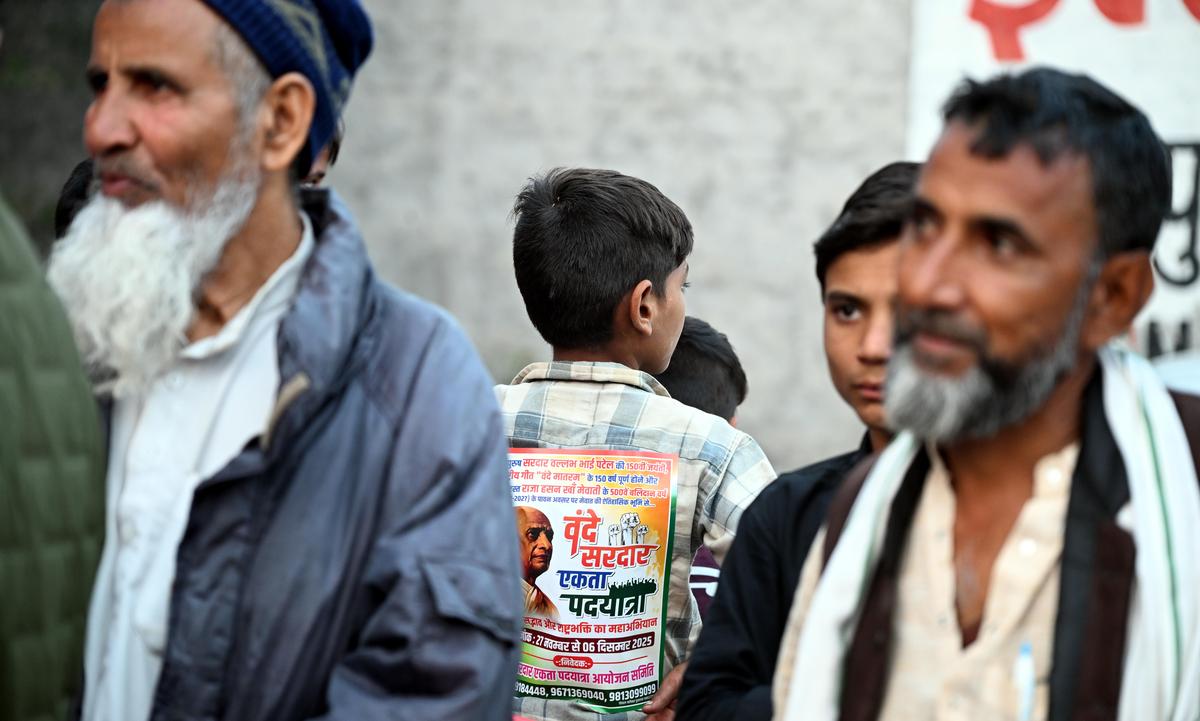
People taking part in the 10-day long Vande Sardar Ekta Yatra in Nuh.
| Photo Credit:
SUSHIL KUMAR VERMA
Mustakim, a local youth, sums up the local sentiment, saying that people had joined the padyatra with hope. He recounts instances where Vashisth had assured the community of government support: upgrading a high school to senior secondary level in Tirwara village, and promising a Khel stadium in another village. “For the locals, he is a representative of the government. And they expect that their demands put forth before him be accepted,” Mustakim says.
Meo recalls the initial struggles of the padyatra: “We started with around 150 people on the first day, but by the end of the day only 40-odd people were left. On the third day, when we marched towards the villages in the foothills of Aravalis, starting from Malabh, only 20-odd people joined us.” He chuckles, “We’ve had our ups and downs, but the numbers have grown as more and more people learn about the padyatra and its purpose.”
The organising committee for the padyatra is headed by Jafruddin Bhagoria, who wrote to the Nuh Deputy Commissioner on November 17, seeking necessary administrative support and arrangements for the smooth conduct of the event. The Deputy Commissioner appointed the Nuh City Magistrate the Nodal Officer for the overall coordination all activities related to the padyatra.
Women’s participation
Local youth icon Anjum Aslam, a 25-year-old Supreme Court lawyer, is proud to be part of the padyatra. She highlights the significant participation of women in the march. “Women in Nuh usually stay away from social and political events but they’ve turned up in large numbers to be part of this procession,” says Aslam, her face beaming with pride.
She recalls a gathering three days ago where over a thousand women attended, showering flowers on the padyatris, preparing food, taking pictures, and giving interviews to the media. “There’s a growing awareness among women about their rights and education and it’s amazing to see,” adds Aslam, secretary, Vande Sardar Ekta Aayojan Samiti, the organising committee.
Underlying the significance of the padyatra, Sabila Jung, another woman participant, says that even today, Mewat lacks basic infrastructure: there’s no university, no railway line, no canal water. Additionally, there are long-pending demands, such as extending the Delhi-Mumbai Expressway to Nuh near Marora and upgrading Nagina to a sub-division, she says, adding that the padyatra has become a means of bringing these fundamental issues into discussion.
‘A social initiative’
In the afternoon, the padyatra halts outside a village for lunch arranged by the panchayat. In an interaction with the media, Vashisth, emphasises that the padyatra is a social initiative and is completely apolitical.
“A group of young people met me saying that there is a narrative that portrays Mewat negatively, saying people here don’t sing Vande Matram, don’t wave the tricolour, or don’t sing the national anthem,” says Vashisth, pointing at the young men and women surrounding him, all part of the committee who are organising the padyatra.
He mentions they asked the youth to fill out Google forms, receiving 287 responses. “We didn’t take support from the police. The administration had offered, but we didn’t want to hold it under the shadow of the police,” he says. All arrangements for food, lodging, and night stays are made by the village or social activists, he claims.
Vashisth vehemently denies that the padyatra has a BJP agenda. He says that it aims to shatter myths and promote Mewat’s cultural and historical legacy. “Many industrialists, including Gurgaon Industrial Association president K.K. Gandhi, have also been part of this yatra. It will help the image makeover for this region and also attract investment. All are welcome to the yatra except those who support fanaticism,” he states, adding that the event was kicked off with a Sarv Dharma Sabha.
Praise for the BJP
A few minutes into the conversation, Mukesh blames the Congress and the previous political parties for neglecting the region, crediting the BJP government for promoting education and opening colleges. “Manohar Lal during his 10-year tenure as Chief Minister opened the ITIs (Industrial Training Institutes), but there are no jobs because there is no industry. Those who ruled for 70 years never thought about it. There were no colleges offering post-graduation courses before a few institutes introduced it during the Manohar Lal government,” says Vashisth.
He adds that the people of the region were treated as “political slaves” during the previous governments.
Addressing a nukkad Sabha (street-corner meeting) Vashisth appeals to the crowd to vote for the party and the candidate that gives them colleges and universities and talks about industry. “Don’t sell your votes for ladoos. Worry about the future of your children,” he proclaims.
Saffron agenda
The padyatra‘s “social” label has been met with scepticism by the locals. Imran Khan, a Pinangwan village shopkeeper, says, “It’s a saffron political agenda wrapped up in a social message.” He points out that the inclusion of Vande Mataram and Sardar Patel’s images are clear nods to the Rashtriya Swayamsevak Sangh and BJP ideologies, while Raja Hasan Khan Mewati’s reference is a calculated move to win over local Meo Muslims and boost the padyatra‘s credibility.
Haryana Gau Sewa Aayog’s lone Muslim member Aas Mohammed, a former BJP block-level president, says that the yatra initially faced opposition in some areas with the locals threatening to pelt stones and not allowing it to enter the villages but the situation was brought under control.
The padyatra’s organisers had touted big-name attendees, including Union Minister Manohar Lal and Chief Minister Nayab Saini, but both failed to show, fuelling speculation about the event’s lukewarm reception. Some suggest the organisers deliberately avoided a high-profile presence to downplay the event’s political undertones.
Nuh, one of 112 Aspirational Districts identified by the Niti Aayog, remains Haryana’s most backward — struggling with education, health, financial inclusion, agriculture, and basic infrastructure. The district has an over 90% Meo Muslim population and has been a Congress stronghold, with the party sweeping the three Assembly constituencies in the 2024 polls. The Meo Muslims also hold the key to Sohna and Hatin Assembly constituencies in Gurugram and Palwal districts.
The BJP’s attempts to break into this stronghold have been unsuccessful, with only a handful of high-profile defections, including Zakir Hussain, Naseem Ahmed, and Aizaz Ahmed, joining the saffron camp. The history of lynching and communal violence hasn’t helped the BJP’s cause in the region.
ashok.kumar@thehindu.co.in