




Having grown up on, and studied Carnatic music in Mumbai, Shanker Krishnan discovered a new and a different world, once he was at the University of California, Berkeley (for a course in applied mathematics). The sounds of the 18th Century Baroque music, mainly German composer Johann Sebastian Bach, created “a deep impact”.
A simultaneous passion for both forms led Shanker to question “if the emotional impact of Carnatic music’s ragas and gamakas could meet the intricate structure of Baroque counterpoint.” An elaborate exploration of the same led the Washington resident to compose and record his debut album Confluence: RagaandCounterpoint.
Released on IndianRaga label and co-produced by Shanker’s sister, Carnatic vocalist Geetha Raja, Confluence… has two compositions. ‘Fugue-Kriti’ is a three-movement piece, which moves between raga Hemavathi and raga Vachaspati. It features solo parts on the Carnatic violin, flute and veena, with string orchestra, gongs and timpani providing accompaniment. The three movements are Pallavi, Anupallavi and Charanam, and it uses the fugue form, which uses multiple independent voices that are closely interwoven. Its emotional arc moves from tranquility and hope to chaos and foreboding.
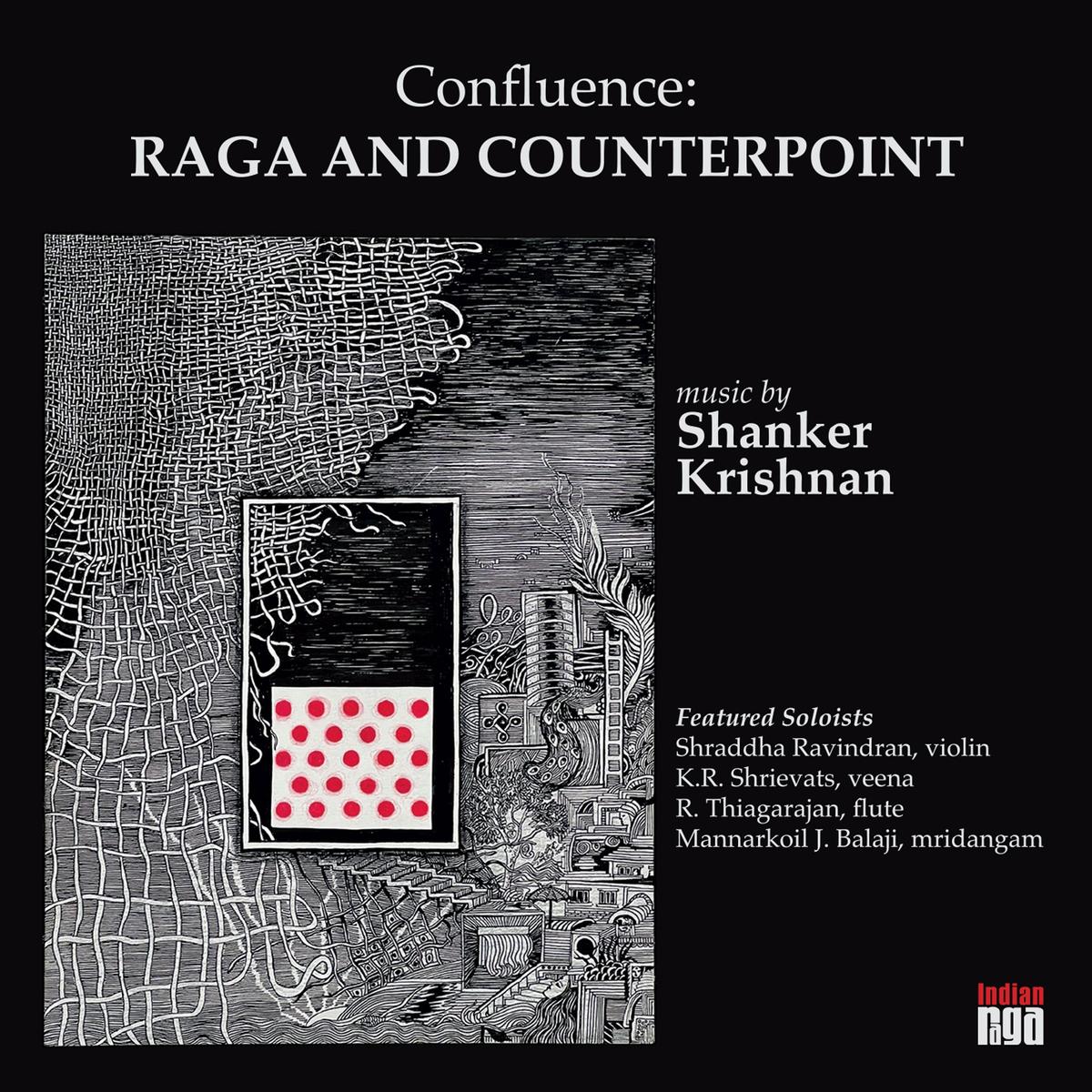
Album cover
| Photo Credit:
Special Arrangement
The second composition is a four-movement Concerto-Kriti ‘Field Of Dharma’, which explores the lyrical landscape of the Bhagavad Gita. It features Carnatic violin and veena as soloists, and uses multiple instruments in the orchestra. It moves between ragas Shanmukhapriya and Charukesi. The four movements are Pallavi (Arjuna’s lament), Anupallavi (field of battle), Charanam (dilemma) and Swaram (realisation). However, it diverges from the traditional concerto by emphasising interaction between soloists within an orchestral context, rather than primarily between a soloist and the orchestra.
The album features soloists Shraddha Ravindran on the violin, K.R. Shrievats on the veena, R. Thiagarajan on the flute and Mannarkoil J. Balaji on the mridangam. Says Shanker. “They are all accomplished concert performers, and were open to the creation of a new sound. My sister helped guide me to the right artistes through her own musical association with each of them.”
Shanker says, one focus of his work is the use of counterpoint — the combination of multiple independent melodic lines — with Carnatic ragas. He adds, “Harmony has often been combined with raga-based melodies in Indian film music and in some classical experiments. But the combination of Baroque counterpoint with Indian classical music, using multiple independent Carnatic melodic lines and their gamakas, has not been similarly explored.”
Geetha points out that the whole process of using counterpoint was new to her. She says, “I was thrilled when Shanker turned to composing music, since he was musically gifted even as a child, and spent years developing his knowledge and expertise in Carnatic and western music.”
She says, since this was a new concept and sound, Shanker used her as a sounding board for the Carnatic portion of his ideas. “It was interesting to watch the evolution of his ideas. I also enjoyed organising the recording at Surang Studio, in Chennai, and liaising with the well-known Carnatic instrumentalists I have worked with extensively in concerts,” she adds.
The siblings grew up in a musically-inclined family — their father wrote on music and culture for a newspaper and mother led devotional singing groups. Both received one-on-one training in Carnatic vocals under Bombay S. Ramachandran. Shanker also studied Hindustani music from Ustad Khadim Hussain Khan.
Shanker says he was deeply influenced by vocalist T. Brinda and elaborates, “With her emotional depth and subtle gamakas, she shaped my musical sensibilities more than anything else. My personal connection to Brindamma deepened that influence.”
The music of M.D. Ramanathan helped him appreciate expansiveness and meditative depth, and from K.V. Narayanaswamy, he learnt about elegance and classical proportion.
Among western composers, while Bach’s Baroque music was transformative, Shanker says, he is also influenced by Claude Debussy’s sense of colour and atmosphere, from Bela Bartok’s modern language drawn from Eastern European melodies, and from Wolfgang Amadeus Mozart’s clarity and seemingly effortless balance. In the US, he trained under composer Nils Vigeland and musicologist Prof. Justin Boyer.
Having studied both traditions, Shanker says, he slowly began finding a deep emotional connection between them. He explains, “In particular, I felt a kinship between the jewel-box complexity of Brindamma’s music and the intricacy of Bach’s counterpoint.”
Shanker has been living in Washington since 1987, when he joined the World Bank group. “I’ve been fortunate to work and pursue western classical music composition study , before beginning this long-planned fusion project.”
Published – December 08, 2025 02:35 pm IST