






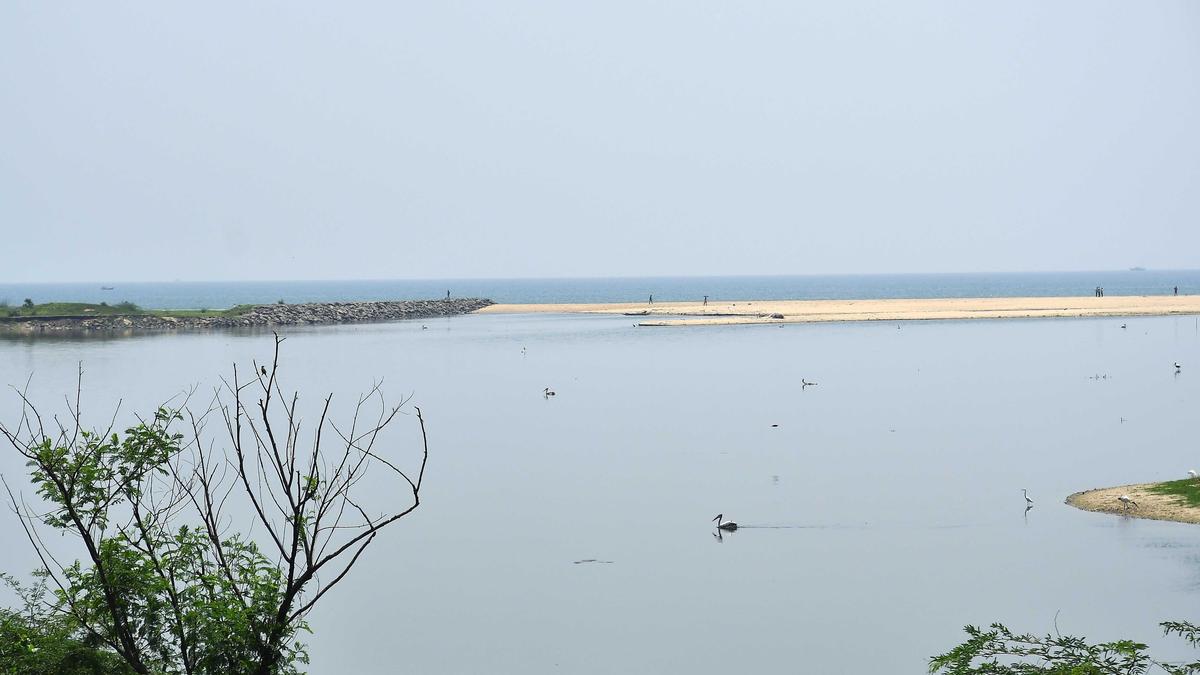

The plan for the Kovalam Reservoir includes a 30-km earthen bund, peripheral drains to channel surplus floodwaters, and a set of inlet, outlet, and offtake regulators.
| Photo Credit: M. KARUNAKARAN
A cross-section of fishermen from Kovalam kuppam and neighbouring coastal villages has urged the Tamil Nadu Department of Environment and Climate Change to withdraw the Coastal Regulation Zone (CRZ) clearance issued for the proposed Kovalam Reservoir Project.
In a petition submitted by village administrators, the members said the drinking water reservoir, approved by the Tamil Nadu State Coastal Zone Management Authority (TNSCZMA) recently, threatened to permanently damage the estuarine system that sustained thousands of fishermen families.
A meeting was convened by nearly a dozen fishing villages on Monday (December 8, 2025) to discuss the perils of the project. They argue that converting tidal backwaters into a freshwater reservoir will destroy the natural salt-freshwater balance essential for prawn, crab, and fish breeding, putting their traditional livelihoods at severe risk.
According to official documents, the proposed reservoir spans 4,375 acres between East Coast Road and Old Mahabalipuram Road. It is designed to store 1.655 TMC of freshwater, fed by monsoon run-off from a 41,408-hectare catchment linked to 69 upstream tanks.
The plan includes a 30-kilometre earthen bund, peripheral drains to channel surplus floodwaters, and a set of inlet, outlet, and offtake regulators. The project aims to supply drinking water to around 50,000 residents in 12 villages while also improving groundwater recharge and reducing seawater intrusion.
The TNSCZMA granted the CRZ clearance after reviewing inputs from the District Coastal Zone Authority, a Technical Expert Committee, and IIT-Madras. The authority said the project did not fall under any prohibited category in the CRZ Notification, 2011, and, therefore, approved it. However, fishermen highlight the unusually stringent conditions attached to the clearance as evidence of the project’s environmental risks.
Among the 36 mandatory requirements are maintaining a minimum 60% ecological flow to protect downstream estuarine ecosystems, prohibiting sewage inflow, restricting dredging to topsoil removal, and conducting a series of hydrological, geomorphological, and biodiversity studies.
The TNSCZMA has also required real-time salinity monitoring, independent quarterly environmental audits, and certification from the Fisheries Department confirming that traditional fishing activity would not be harmed. A key condition explicitly states that the project proponent must ensure that the Kovalam estuary is not adversely affected.
Fisherfolk, however, say this requirement is impossible to meet if the natural backwaters are converted into a freshwater lake. Soundarapandian, a fisherman from Kovalam, said blocking the estuary mouth would wipe out breeding grounds, increase monsoon-season flooding, and trap polluted canal water, turning it into a stagnant sewage pond.
Published – December 08, 2025 08:17 pm IST