

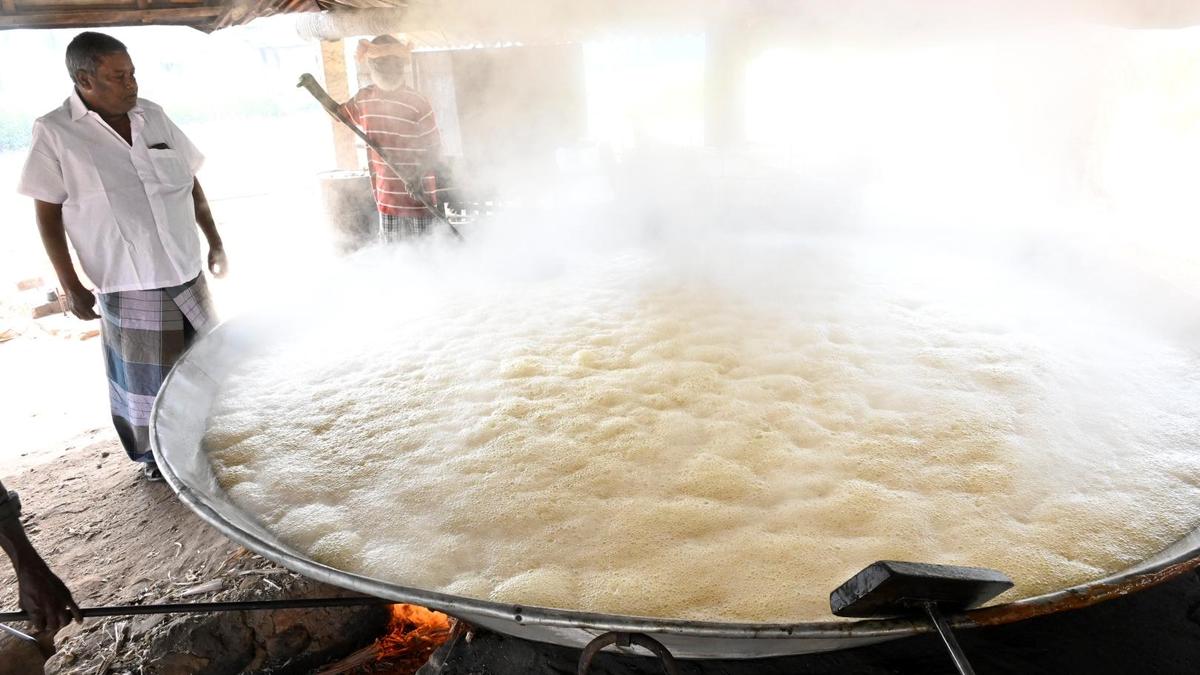

Sugarcane juice is being boiled for preparing jaggery at a unit in Erode in Tamil Nadu on Saturday.
| Photo Credit: GOVARTHAN M.
Escalating labour costs, coupled with other factors, continue to impact jaggery manufacturers in the district, leading to the closure of several labour-intensive units.
With the Pongal festival a month away, production of jaggery (vellam), a key ingredient in sweet pongal, is gathering pace at cottage units operating across Mullamparappu, Arachalur, Ammapettai, Kavindhapadi, and a few other areas. Sugarcane, the primary input, sourced from within the district and neighbouring regions, is processed into jaggery and marketed across the State.
Each unit engages about six to 10 workers, including women, and labourers from other districts are also employed. While several units function year-round, others operate depending on the availability of sugarcane.
“The number of operational units has declined sharply over the past 10 to 15 years,” said S. Subramanian, a unit owner from Mullamparappu. He said the cost of sugarcane has increased to ₹3,500 per tonne, while expenses related to cutting, transportation, labour involved in production, and other input costs have risen significantly over the years. However, a 30-kg bag (chippam) continues to fetch between ₹1,200 and ₹1,800, with prices remaining largely static. “Profit margins have completely eroded,” he said.
Another unit owner, who has exited the business, said the presence of low-priced jaggery produced through spurious practices has emerged as a serious concern for the sector. Speaking on condition of anonymity, he said nearly two-thirds of the units have been driven out of business due to escalating labour costs and adulteration.
The entire production process, from cane cutting, loading and unloading to crushing, boiling, and moulding, is fully manual, with labour expenses constituting nearly 60 to 70 per cent of total production costs. “Mechanisation is impractical, while inconsistent cane quality and a decline in demand have further compounded our problems,” said another unit owner, who appealed to the government to encourage jaggery consumption. Many units also produce country sugar (naatu sakkarai) alongside jaggery to remain viable.
Published – December 13, 2025 05:30 pm IST