






Ghiyasuddin’s eyes keep drifting back to the road as he tends to the fire at a makeshift eatery. It is 11.30 p.m. on a weekday and the traffic that loops around Durgam Cheruvu in Hyderabad never quite pauses, and every slowing vehicle draws a glance. “People keep coming here throughout the night,” he says, glancing up and down the street, tracking both customers and other businesses around. “But I usually wind up by 1 a.m. When the police vehicle comes around midnight, it creates panic, for the diners as well as for us,” he adds.
For a late hour, the place remains unusually busy. Cars and motorcycles slow down, then surge ahead, jolting over the dozens of rumble strips outside a luxury hotel. A zillion lights from offices, shopping malls and high-rise apartments bathe the street in a soft yellow glow.
On the roadside, the acrid smoke of cooking hangs in the air. Woks and pans clang, chilli oil crackles and its pungent heat hits the nostrils. A car pulls over. Three young men step out, hunch their shoulders against the smoke and heat, fold their hands across their chests and ask for ‘bamboo chicken biryani’.
Ghiyasuddin lifts a thick bamboo tube from the fire, cracks it open and tips out the greasy, spicy, reddish rice dish onto three disposable plates. Priced at ₹300, the dish draws a steady stream of customers, some of them perched on plastic chairs and tables by the road while others eat inside their cars.
Ghiyasuddin, who hails from Gorakhpur in Uttar Pradesh, serves dozens of diners every night, working quickly and always keeping an ear out for the siren of the police vehicle.
For years, Hyderabad’s night life has thrived on caution and chance, but this scene may change by the New Year. The screech of police sirens as the Cinderella hour approaches could soon become a thing of the past in select commercial areas of Hyderabad. In a bid to mainstream nightlife, the Telangana government is set to roll out a clutch of proposals under what it calls the Night Time Economy (NTE).
“We will start NTE from January, initially on select stretches in Old City, Secunderabad and Cyberabad,” says Jayesh Ranjan, Special Chief Secretary of the State government.
Night economy itself is not new to Hyderabad. During the month-long Ramzan, three days of Shivaratri or 10 days of Muharram, the city comes alive after dark, creating extraordinary business opportunity. Restaurateurs often start the countdown to Ramzan for the midnight availability of haleem. Iconic restaurants such as Alhamdulillah Hotel in Aghapura, Nayaab and Shadab near Naya Pul, along with countless others in the inner lanes, have long operated past official closing hours, often in a cat-and-mouse game with police patrols.
Unlike these seasonal bursts of activity, the new initiative aims to make late-night business a year-round reality, cutting through bureaucracy and transforming it into a legitimate, organised opportunity.
“The new 24×7 framework is completely different. It is zone-based, not permission-based. Once an area is declared a Night-Time Economy Zone, every business inside it can operate late hours automatically — no permits, no licences, no inspections, no NOCs, no department hopping,” explains Nalamotu Chakravarthy, founder of the Centre for Liberty, who helped draft the policy.
No interference
“The earlier 24×7 initiative launched under KTR (BRS leader and former Industries minister K.T.Rama Rao) collapsed because it relied on the old model of licences, permits and bureaucratic gatekeeping. Businesses had to navigate a maze of approvals, which killed the reform before it even took off. Under the new system, there is no permit raj or licence raj. Government officials will stay away from business operations. The government’s role will be limited,” he added.
The policy identifies four key factors essential for permit-free night zones. “Economic density was the first criterion. Areas with a high concentration of commercial establishments, like HiTec City and Financial District, were prioritised because they naturally support late-night economic activity. Second, zones that already attract people at night — food streets, malls, multiplexes, restaurants and entertainment corridors — were chosen since they can be activated quickly without generating new demand,” Chakravarthy points out.
HiTec City, one of Hyderabad’s glitziest neighbourhoods with a dense mix of offices and residences, has a secret: ultra-high rents compared to other parts of the city. According to Confederation of Real Estate Developers’ Associations of India (CREDAI), which tracks property values, the rental rates have reached ₹106 per square foot, marking a 13% year-on-year growth, driven by a high demand-supply ratio, with Hyderabad, Pune and Mumbai playing key roles in the surge.
These high rentals turn the food business into a high-stakes gamble.
Spoilt for choice
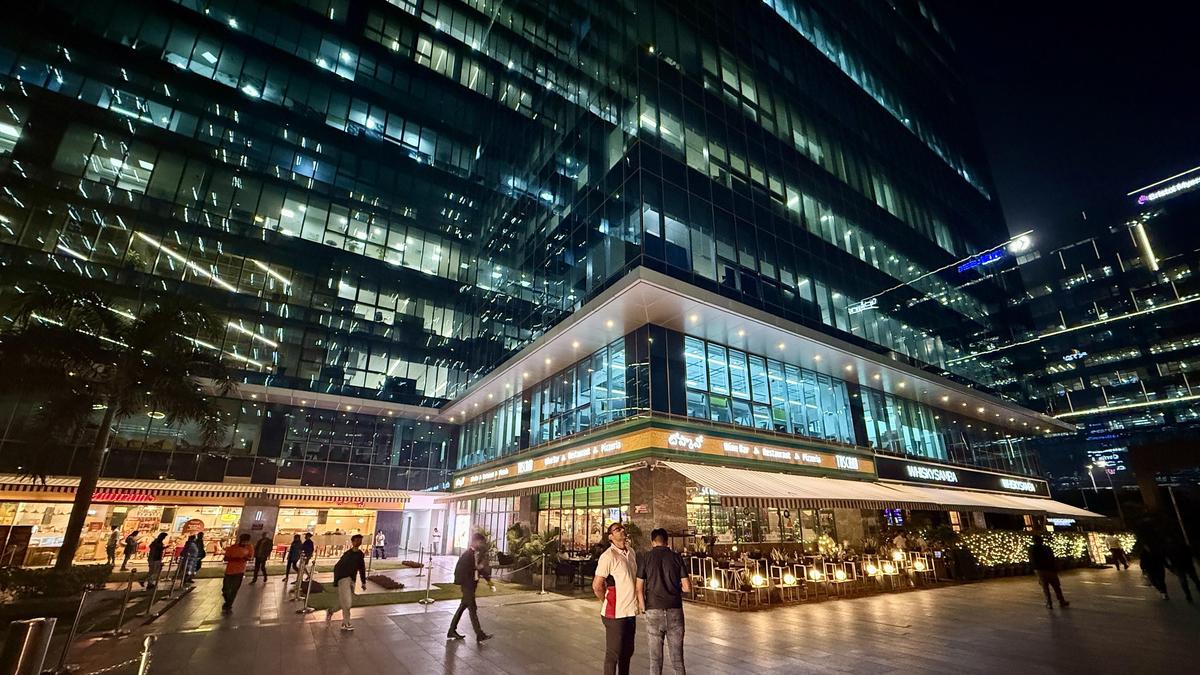
Inside Sattva Knowledge City, office-goers and occasional visitors are spoiled for choice. Whisky Samba, Burma Burma, Raasta, Salt, Toscano, Flury’s and Monastery jostle for attention with the likes of Starbucks, Third Wave Coffee, and Hard Rock Cafe. But the last order is still called between 11 p.m. and 11.30 p.m., just as waves of IT employees log off, looking for a ride, a smoke, a cup of chai or a few minutes of conversation before heading home.
It is this socio-economic demand that the 24×7 policy seeks to address. The NTE is projected to give Hyderabad’s economy a boost, with contributions expected to grow from ₹8,500 crore in 2025 to ₹26,011 crore by 2032, representing a compound annual growth rate of 20.4%. The expansion is also expected to generate 2.1-2.4 lakh jobs by 2031 across hospitality, retail, entertainment, transport and security.
“People who visit Paris want to see it at night. The Eiffel Tower should be experienced both during the day and at night. Tourists in Hyderabad want the same,” says A. Shashank Rao, managing director of Cafe Niloufer. He breaks down restaurant economics by the hour: “From morning to afternoon, we do about 25% of our business. From afternoon to night, it’s 75%, but we still pay salaries to cover both periods. About 80% of the business happens in the last eight hours, roughly 10% per hour. If operating hours are extended, we will benefit and customers will also have more choices. It will be very beneficial for businesses.”
He adds that parking and staffing pose minor challenges, but are challenges nonetheless.
“To coordinate this ecosystem, the city will appoint a Night Czar, an independent authority whose job is not to control businesses but to grow the night economy by reducing government interference and ensuring smooth coordination between departments. The additional tax revenue generated by a thriving night economy, across hospitality, retail, transport, entertainment and logistics, will more than cover the cost of extended police presence, sanitation, lighting and public transport,” says Chakravarthy.
The Vision 2047 document outlines the role of the Night Commissioner and the rollout of the transformative policy. “The State establishes a single empowered office coordinating safety, sanitation and mobility to enable swift decisions… Municipal administration will notify NTE Zones — Gachibowli, Madhapur, Jubilee-Banjara Hills, Tank Bund, Old City and Airport-Financial District — then expands citywide to achieve seamless 24×7 operations,” it states.

The street skirting the Durgam Cheruvu throbs with night life that may become a regular feature with the new policy.
| Photo Credit:
Serish Nanisetti
Outside Paul restaurant in the Financial District, Bilal Majumdar scoffs at the smartly dressed office crowd walking by. “How much money do these people make? ₹50,000? I deliver 45 to 50 orders between noon and 4 a.m. In a good month, I earn up to ₹80,000. I deliver at least 20 orders after midnight since many restaurants stay open, and I can drive at 80-100 kmph,” says the 25-year-old from Silchar, who works for a food-delivery app.
While keeping the city’s food economy moving, Bilal is also a consumer. “I grab a snack at midnight before finishing my day and having dinner at home,” he says.
Hyderabad, in addition to attracting a large IT workforce, is home to lakhs of skilled and gig workers who keep the city thrumming. Kamal Bahadur, who moved to the city 13 years ago and now sells momos near the HiTec City Metro Station, shares a slice of this story: “Most of these people don’t live here. They come here to have food with friends.”
Challenges of night economy
On this short stretch of sidewalk, 62 food kiosks cater to the cravings of home-sick workers with Rayalaseema Chicken Pakodi, Narendar Ram Chole Kulche, Punjabi Paratha, Pokhara Momos and more. But as midnight approaches, the lively sidewalk slowly turns into a trash-strewn corridor, a reminder of the challenges that come with a thriving night economy.
Hygiene, sanitation, toilets, and waste disposal remain among the key challenges to this ambitious policy. To address them, the plan focuses on urban design improvements with focus on clean public toilets, strategically placed waste bins, and dedicated night sanitation squads. It also includes extending Metro and State-run bus services till 2 a.m., complemented by night shuttle services and dedicated auto and taxi stands. Safety measures go beyond surveillance, with Pink Patrols, women-only night hubs, smart lighting, CCTV coverage and SOS systems.
Even as the city plans these systemic changes, the night continues to hum with life. Outside Cafe Niloufer near T-Hub, a couple poses for their wedding album at 11 p.m., the coloured lights of T-Hub, an innovation intermediary and business incubator in Hyderabad, flickering behind them while streaks of vehicles blur past. Along with their photographer friends, they eventually walk into the cafe.
A little farther along, on Tank Bund Road, a group of friends waits for midnight to cut a cake and toss confetti in the air. Meanwhile, at Roast CCX in Banjara Hills, a voice calls out “Last order” just as the clock strikes 12.
Come January, those two dreaded words may finally be a thing of the past, as Hyderabad moves closer to a seamless 24×7 night economy.